



Introduction to Medical Microbiology Education
Medical microbiology education in Nigeria focuses on microorganisms and their effects on human health.
It examines how these organisms influence health.
Effective teaching methods help students understand this field comprehensively.
Medical Microbiology Programs in Nigeria
Medical microbiology forms a vital part of medical and laboratory science programs in Nigerian universities.
The subject covers bacteriology, virology, and mycology.
It gives students knowledge and skills for identifying and treating infectious diseases.
Importance of Effective Teaching Methods
Effective teaching methods help students grasp complex concepts and retain information more effectively.
Engaging approaches can inspire further study and careers in microbiology.
These pursuits can contribute to advances in healthcare and research.
Interactive, hands-on methods can strengthen critical thinking and problem-solving skills.
Those skills support success in the field.
Such methods help shape future medical microbiologists in Nigeria.
Teaching Methods in Medical Microbiology in Nigeria
Medical microbiology education in Nigeria uses several methods to build students’ understanding of disease-causing microorganisms.
These approaches combine structured instruction, practical experience, collaboration, and clinical reasoning.
Together, they help students connect microbiological concepts with diagnosis, treatment, and future medical practice.
-
Lecture-based teaching. Lecture-based teaching provides structured instruction about microorganisms, diseases, and treatments.
Professors and lecturers present this content to large classroom groups.
Students take notes, ask questions, and interact with instructors during sessions.
-
Laboratory practical sessions. Laboratory practical sessions connect theoretical knowledge with hands-on microbiological work.
Students conduct experiments, analyze samples, and identify microorganisms under instructor guidance.
Consequently, practical work strengthens laboratory techniques, critical thinking, and conceptual understanding.
-
Small group discussions. Small group discussions encourage interactive learning among medical microbiology students.
Students analyze case studies, research articles, and clinical scenarios together.
Therefore, collaboration helps them share ideas, solve problems, and clarify complex topics.
-
Case studies and problem-based learning. These methods engage students with realistic clinical situations.
Students examine infectious diseases, outbreaks, diagnostic dilemmas, and treatment challenges.
They apply microbiological knowledge to identify causative agents and develop management plans.
This approach builds critical thinking, decision-making, and problem-solving skills for future clinical practice.
Challenges in Teaching Medical Microbiology in Nigeria
Several challenges affect the teaching of medical microbiology in Nigeria.
These challenges can limit students’ practical experience and understanding.
However, identifying these barriers clarifies the areas requiring attention.
- Lack of modern laboratory facilities
- Limited resources for practical sessions
- Inadequate training for educators
- Large class sizes
Lack of Modern Laboratory Facilities
Many institutions lack modern laboratory facilities for medical microbiology teaching.
Consequently, students may struggle to conduct experiments and analyses.
Limited access to updated equipment also weakens practical learning opportunities.
Limited Resources for Practical Sessions
Practical sessions often operate with limited educational resources.
Shortages may affect reagents, test samples, and other necessary materials.
As a result, students may not fully understand important microbiology concepts.
Inadequate Training for Educators
Some educators lack adequate training in medical microbiology.
This limitation can reduce the quality and effectiveness of instruction.
Furthermore, educators may struggle to explain subject matter clearly.
Large Class Sizes
Large classes create challenges for medical microbiology educators.
High student-to-teacher ratios make individualized support difficult.
Therefore, some students may experience gaps in their learning.
You Might Also Like: Impact of Parasitology on Nigerian Communities
Strategies for Improving Medical Microbiology Education in Nigeria
These strategies can strengthen medical microbiology education in Nigeria.
They focus on technology, online learning, educator development, and institutional collaboration.
Together, these approaches can support educational enhancement and progress.
Technology in Teaching Methods
Educators can incorporate digital tools into lectures and practical sessions.
These tools can enhance how teachers present medical microbiology content.
They can also support practical learning activities.
Interactive Online Learning Platforms
Interactive online platforms can create virtual classrooms for students.
Students can engage with learning activities through these platforms.
They can also collaborate with one another during online learning.
Transform Your Career with Expert Guidance
Get personalized mentorship consulting that’s tailored to your unique path. Our expert advice is actionable and exclusive.
Get StartedContinuous Professional Development for Educators
Educators can receive continuous professional development through training workshops.
These workshops can introduce new teaching techniques.
They can also cover advancements in medical microbiology.
International Training and Research Collaboration
Institutions can partner with renowned universities for training and research.
Exchange programs can support shared educational experiences.
Joint studies can strengthen research collaboration.
Adopting these strategies can enhance medical microbiology education in Nigeria.
The combined approach can support continued progress.
Uncover the Details: Professional Certification for Dental Technologists Nigeria
Successful Medical Microbiology Teaching Methods in Nigeria
Medical microbiology educators in Nigeria use several approaches to create engaging learning experiences.
These methods connect theoretical knowledge with practical activities, visual resources, and independent investigation.
Consequently, students develop practical abilities, critical thinking, problem-solving skills, and research experience.
- Utilization of simulation labs for practical training
- Integration of real-life case studies into the curriculum
- Use of multimedia resources for visual learning
- Student-led research projects for hands-on experience
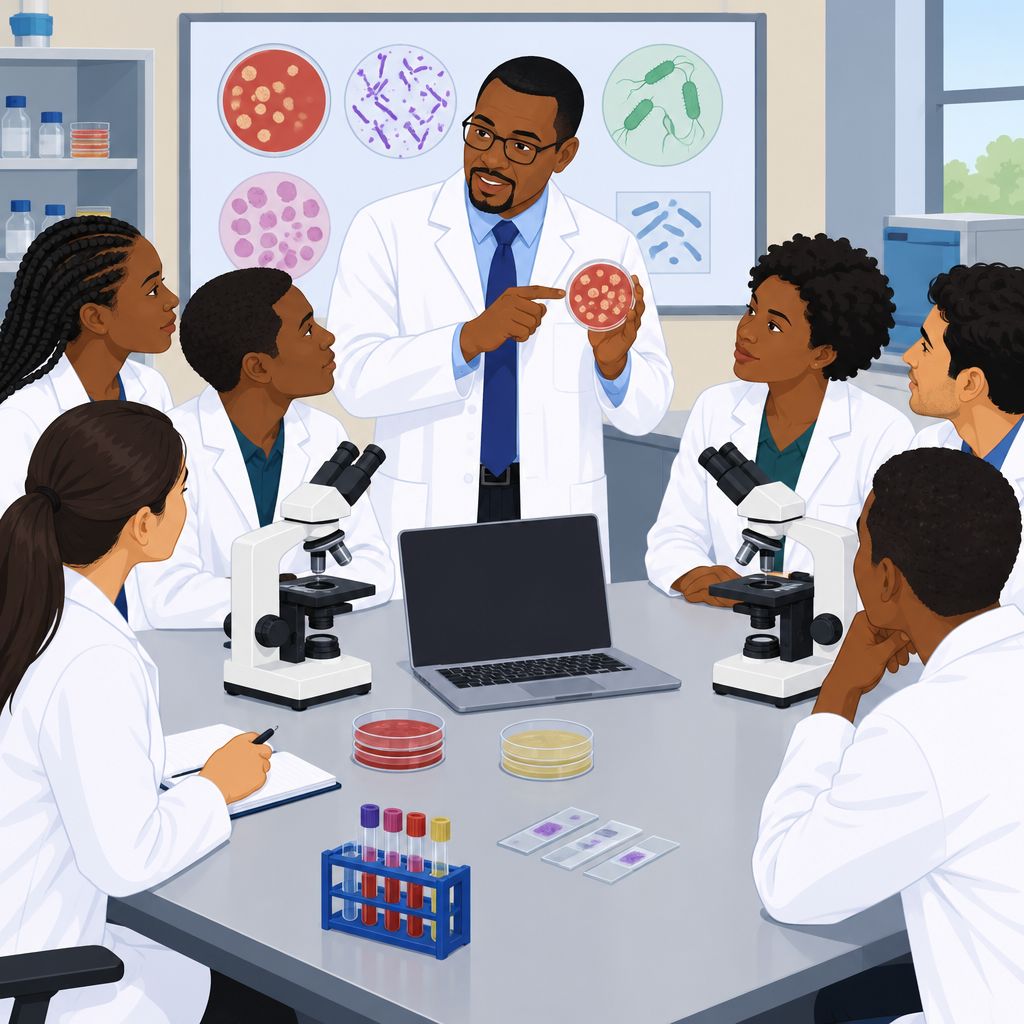
Simulation Laboratories for Practical Training
Simulation laboratories give students hands-on experience with microorganisms and laboratory techniques.
Students can practise and refine their skills within a controlled environment before handling clinical specimens.
As a result, this approach strengthens practical abilities and increases confidence during microbiological procedures.
Real-Life Case Studies in the Curriculum
Educators incorporate relevant case studies into lectures and practical sessions.
Through these examples, students apply theoretical knowledge to real-world microbiological situations.
Moreover, case studies encourage critical analysis, practical problem-solving, and deeper understanding of microbiological concepts.
Multimedia Resources for Visual Learning
Multimedia resources include videos, animations, and interactive software.
These tools visually represent complex concepts, helping students understand and retain important information.
Additionally, interactive resources create dynamic learning experiences and support different learning styles.
Student-Led Research Projects
Student-led research projects provide hands-on experience in medical microbiology.
Students design experiments, analyse data, and draw conclusions through independent inquiry.
Furthermore, these projects strengthen research skills, scientific reasoning, and practical experience in research settings.
Educational Value of Combined Approaches
Combining these teaching methods creates a comprehensive and engaging learning experience.
Simulation, case studies, multimedia, and research activities reinforce both practical skills and theoretical knowledge.
Collectively, these approaches prepare students to apply microbiological knowledge through critical thinking and problem-solving.
See Related Content: How Anatomical Pathology Impacts Nigerian Public Health
Impact of Effective Teaching Methods on Medical Microbiology Education in Nigeria
Effective teaching methods improve engagement, knowledge retention, critical thinking, career preparation, and research participation.
These approaches connect classroom learning with practical responsibilities in healthcare and medical microbiology.
Therefore, strong instruction can support healthcare development in Nigeria and beyond.
- Improved student engagement and retention of knowledge
- Enhanced critical thinking and problem-solving skills
- Better preparation for future healthcare careers
- Greater contributions to medical research and innovation
Student Engagement and Knowledge Retention
Interactive teaching methods encourage students to participate actively in medical microbiology lessons.
For example, case studies, group discussions, and laboratory sessions create a dynamic learning environment.
Consequently, active participation can strengthen students’ understanding and retention of important concepts.
Critical Thinking and Problem-Solving Skills
Innovative instruction helps students develop critical thinking and problem-solving abilities.
Challenging assignments and research projects require students to analyze information carefully.
Meanwhile, real-life case studies help learners apply microbiology knowledge to complex problems.
Preparation for Future Healthcare Careers
Effective medical microbiology teaching prepares students for professional responsibilities in healthcare.
Hands-on training develops practical skills that learners can use in future healthcare roles.
Additionally, exposure to current research methods equips students with relevant knowledge and abilities.
Contributions to Medical Research and Innovation
Effective teaching methods can also support progress in medical research and innovation.
Educators foster curiosity, exploration, and critical thinking among medical microbiology students.
As a result, future healthcare professionals can pursue new solutions and advance medical microbiology.
Uncover the Details: How Technology Is Shaping Anatomy Studies in Nigeria
Advancing Medical Microbiology Education in Nigeria
Implementing innovative teaching methods in medical microbiology education can advance healthcare in Nigeria.
Interactive and practical approaches help students understand complex concepts and develop critical thinking skills.
Therefore, stakeholders must invest in improved teaching strategies to support better health outcomes across the country.
Educational institutions, policymakers, and healthcare professionals share responsibility for this investment.
Moreover, Nigeria must prioritize medical microbiologist training because these professionals support disease prevention, diagnosis, and treatment.
Embracing technology can improve medical microbiology teaching and strengthen healthcare services for citizens.
Collaboration between academia and the healthcare industry can also support this progress.
Additionally, adequate educational resources can prepare future healthcare professionals for microbiology challenges.
Together, stakeholders can equip the next generation with knowledge and skills for this field.
Additional Resources
Google search results for Medical Microbiology Teaching Methods in Nigeria Medical
Bing search results for Medical Microbiology Teaching Methods in Nigeria Medical


