



Introduction:
Anatomy studies provide the foundation for medical diagnosis and treatment in Nigeria.
Technology has revolutionized education in Nigeria.
It offers innovative tools and resources that enhance learning experiences.
History of Anatomy Studies in Nigeria
Anatomy studies in Nigeria have changed significantly over the years.
Initially, educators relied on lectures and diagrams to explain the human body.
Over time, teaching approaches gradually expanded beyond predominantly theoretical instruction.
Evolution of Anatomy Studies
In earlier periods, students mainly studied anatomy through theoretical lessons.
They used textbooks and illustrations to examine human structures and relationships.
Consequently, learners depended heavily on printed materials during their studies.
Challenges of Traditional Teaching Methods
Traditional methods restricted students’ opportunities for practical exposure.
Furthermore, limited resources made detailed anatomical study more difficult.
As a result, students faced challenges when developing deeper anatomical understanding.
Technology in Anatomy Studies
Technology has introduced new approaches to anatomy education in Nigeria.
For example, virtual dissection software gives students more practical learning opportunities.
These digital tools also support clearer exploration of anatomical structures.
Benefits of Technology in Anatomy Studies
Interactive tools encourage students to participate more actively during anatomy lessons.
Moreover, multimedia resources help learners visualize complex anatomical structures.
Digital assessment features can provide students with immediate feedback about their progress.
- Technology increases interactivity during learning.
- Digital tools improve visualization of complex anatomical structures.
- Multimedia resources can strengthen information retention.
- Real-time assessment tools provide immediate student feedback.
Integration of Technology with Traditional Methods
Educators increasingly combine digital resources with established anatomy teaching methods.
Hybrid learning models connect virtual tools with hands-on practical sessions.
This combination gives students opportunities to use both digital and practical learning approaches.
Future Directions for Anatomy Studies in Nigeria
Advancing technology continues to shape the future of anatomy studies in Nigeria.
Innovative tools can further support student engagement and anatomical understanding.
Continued integration may strengthen learning outcomes through complementary educational methods.
Technology’s Early Adoption in Anatomy Education
Nigerian anatomy programs began incorporating technology during the early 2000s.
Initially, traditionalists expressed skepticism and resisted technology-based changes within the discipline.
However, limited infrastructure and insufficiently trained personnel created additional implementation challenges.
Educational Benefits of Technology in Anatomy
Technology improves anatomical visualization and helps students understand complex structures more clearly.
Additionally, virtual dissection tools give learners practical experiences without relying exclusively on physical specimens.
Technology also supports research collaboration between Nigerian institutions and international organizations.
Technology’s Influence on Anatomy Research
Digital tools help researchers collect and analyze anatomical data more quickly.
Meanwhile, online publishing platforms allow researchers to share findings with broader audiences.
Online databases also simplify literature reviews and citation management for anatomy researchers.
Virtual Reality Applications in Anatomy Training
Virtual reality now provides immersive environments for anatomy education.
Through three-dimensional models, students can examine anatomical structures and simulate surgical procedures.
Furthermore, some universities have established virtual reality laboratories for practical student training.
Barriers to Technology Adoption in Anatomy
Acquiring and maintaining technology infrastructure remains a major financial challenge.
Furthermore, limited technical expertise among faculty members can hinder effective implementation.
Some students also need time to adjust because they prefer traditional learning methods.
Transform Your Career with Expert Guidance
Get personalized mentorship consulting that’s tailored to your unique path. Our expert advice is actionable and exclusive.
Get StartedEmerging Directions for Anatomy Technology
Artificial intelligence may transform anatomical research and medical imaging techniques.
Robotics could also support surgical training and procedures within anatomy education.
Continued technological progress will expand anatomy learning opportunities in Nigeria and elsewhere.
Find Out More: Mental Health Legislation: Nigeria's Progress
Role of Virtual Dissection Software
Virtual dissection software has changed how anatomy students study human structures in Nigeria.
The technology creates an interactive environment for exploring anatomy without relying entirely on physical specimens.
It also supports flexible learning for students and educators in universities and medical schools.
Using Virtual Dissection Software in Anatomy Studies
Students explore human anatomy through a three-dimensional and interactive virtual environment.
They manipulate virtual cadavers, examine specific structures, and dissect anatomical parts precisely.
Additionally, learners receive hands-on practice without requiring physical specimens or cadavers.
- Students can access the software from different locations, supporting remote learning.
- Universities and medical schools can integrate the software into their anatomy curricula.
- Users can zoom in on structures to examine anatomical details more closely.
Benefits Compared With Traditional Anatomy Methods
Virtual dissection software reduces the need for costly anatomical specimens and cadavers.
Moreover, students can repeat procedures without damaging physical specimens during practice.
Its interactive design can strengthen engagement and support knowledge retention among learners.
- The software supports self-paced learning for students with different abilities and learning styles.
- Students can study complex anatomical structures in considerable detail.
- Repeated practice helps learners review procedures without replacing physical specimens.
- Virtual methods reduce reliance on cadavers from questionable origins.
- Educational institutions can use the software as a cost-effective anatomy learning tool.
Consequently, virtual dissection software offers an engaging and flexible approach to anatomy education in Nigeria.
The technology combines repeated practice, detailed exploration, and ethical considerations within one learning environment.
Uncover the Details: Accredited Biomedical Technology Programs Nigeria
Three-Dimensional Anatomy Models in Nigerian Education
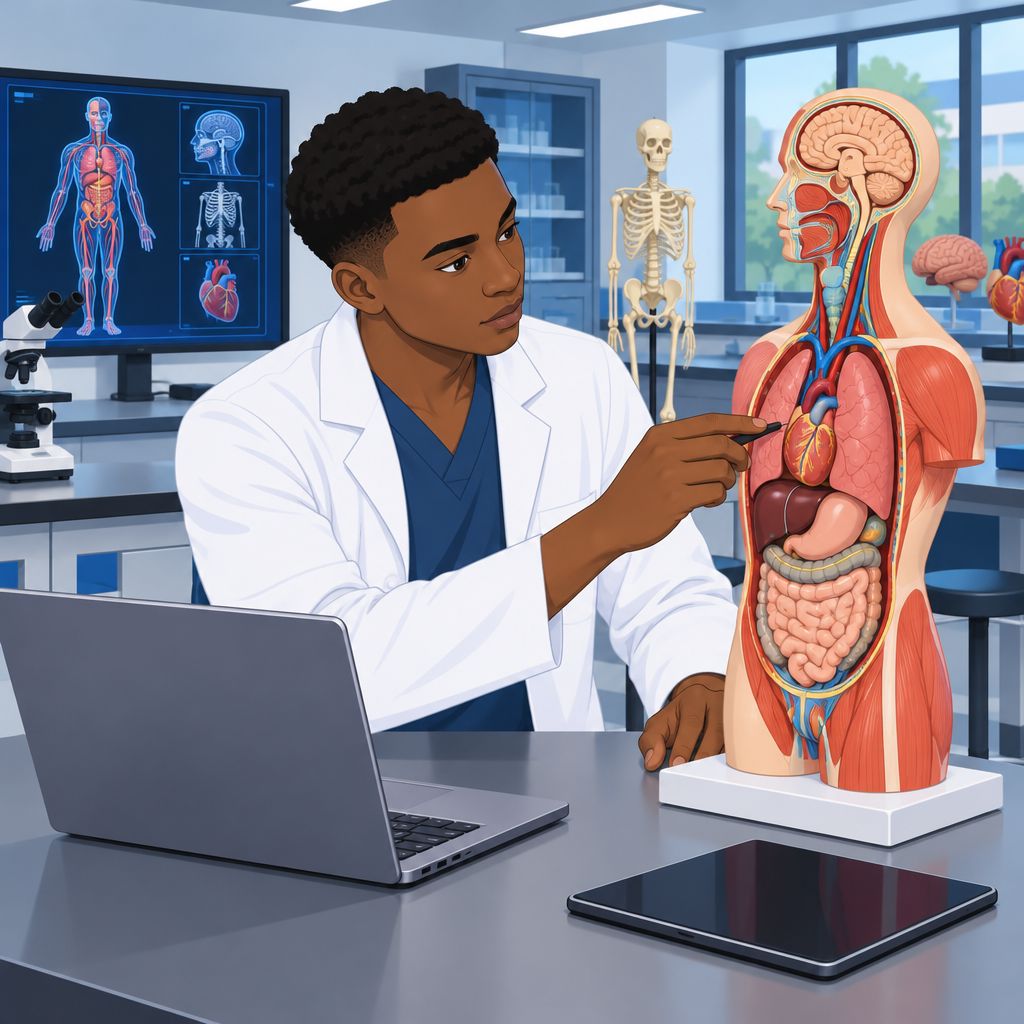
Three-dimensional anatomy models have transformed anatomy studies in Nigeria.
They provide students with more interactive learning experiences than traditional resources.
Students can examine anatomical structures with greater visual detail.
- How Three-Dimensional Models Transform Anatomy Studies
- How Three-Dimensional Models Compare With Traditional Resources
Interactive Visualization and Physiological Processes
Three-dimensional models help students visualize the human body more clearly.
They show relationships between different body parts and systems.
Students can manipulate and rotate models to explore complex anatomical structures.
This hands-on approach strengthens spatial awareness and supports information retention.
Additionally, these models can simulate physiological processes within the body.
Students can observe organ functions and interactions during dynamic learning activities.
Consequently, they can understand concepts more easily and apply knowledge practically.
Comparison With Traditional Anatomy Resources
Traditional anatomical charts and models provide static representations of the human body.
They offer useful basic instruction but provide less depth and detail.
Students also receive limited opportunities to explore structures from multiple angles.
By contrast, three-dimensional models support more immersive and engaging learning experiences.
Students can view structures from various angles and zoom into specific areas.
They can also dissect virtual cadavers to develop deeper anatomical understanding.
Learn More: Patient Stories: Maxillofacial Surgery in Nigeria
Virtual Reality in Anatomy Education
Virtual reality is gaining popularity in anatomy studies in Nigeria.
Its immersive and interactive features create new ways for students to explore the human body.
Furthermore, virtual tools support anatomy learning without depending entirely on physical specimens.
Integration of Virtual Reality into Anatomy Education
Virtual anatomy simulators let students examine human structures through three-dimensional environments.
Students can also interact with virtual cadavers in realistic learning settings.
Meanwhile, headsets and dissection software make practical study more engaging and flexible.
- Virtual anatomy simulators allow students to explore the human body in three dimensions.
- Students can interact with virtual cadavers during realistic anatomy lessons.
- Virtual reality headsets provide students with a more engaging learning experience.
- Virtual dissection software lets students practise dissection without real specimens.
Benefits of Virtual Reality in Anatomy Studies
Virtual reality helps students examine internal structures with greater visual detail.
Additionally, interactive simulations can help students understand complex anatomical concepts more clearly.
Virtual learning environments also support safer and more accessible anatomy education.
- Virtual reality enhances visualization by displaying internal structures in greater detail.
- Interactive simulations improve students’ understanding of complex anatomical concepts.
- Virtual reality provides a safe learning environment without real cadavers or specimens.
- Students can use virtual reality in remote or resource-limited areas.
Delve into the Subject: Anatomy Lab Experiences in Nigerian Medical Schools
Impact of Technology on Research Opportunities
Technology has transformed anatomy research in Nigeria.
It gives researchers new ways to examine the human body in greater detail.
These tools also support collaboration, analysis, and testing across research projects.
Expanded Research Opportunities
Researchers can investigate anatomical structures through digital environments and detailed medical images.
They can also share findings remotely and analyze large datasets with specialized software.
Additionally, simulations help researchers test hypotheses and examine complex anatomical phenomena.
- Virtual dissection tools let researchers explore anatomical structures through three-dimensional simulations.
- MRI and CT scans provide detailed images for in-depth anatomical analysis.
- Remote collaboration allows researchers to share data and insights globally.
- Advanced software helps researchers identify patterns within large datasets.
- Realistic simulations support testing and exploration of complex anatomical phenomena.
Examples of Technology Enabled Research Studies
These opportunities support studies involving training, education, biomechanics, genetics, and robotics.
Researchers can examine technology’s effects on practice, learning, movement, and anatomical variation.
They can also explore technological solutions for surgical procedures and rehabilitation.
- Researchers examine technology’s effectiveness in enhancing surgical training programs.
- Virtual anatomy platforms support medical students during anatomy education.
- Biomechanical studies provide insights for sports science and rehabilitation.
- Genetic research explores factors associated with anatomical variations.
- Robotics research develops solutions for surgical procedures and rehabilitation.
Technology has widened anatomy research opportunities in Nigeria.
Researchers can pursue new questions using digital tools, imaging, collaboration, and computational analysis.
Continued technological development may create further opportunities to understand the human body.
Challenges and Limitations of Technology in Anatomy Studies
Technology integration creates several challenges for anatomy studies in Nigeria.
These obstacles can limit access, participation, and effective technology use.
Institutions and educators continue developing responses to improve anatomy learning experiences.
- Identify challenges associated with technology integration in anatomy studies.
- Discuss strategies that address these challenges.
Limited Access to Technology
Many Nigerian educational institutions lack advanced devices and tools for anatomy instruction.
Limited equipment can reduce technology’s effectiveness in anatomy studies.
To respond, institutions seek funding for modern technology in anatomy laboratories.
They also explore partnerships with industry stakeholders and government agencies.
Connectivity Issues
Unreliable internet connectivity can restrict access to online anatomy resources.
Students may therefore struggle to use virtual anatomy tools consistently.
Educational institutions are improving campus internet infrastructure to address this limitation.
They also provide offline resources and simulation software for students.
Insufficient Training
Some educators and students lack adequate training in anatomy technology.
Without guidance, users may not realize technology’s full educational potential.
Training programs and workshops teach effective technology integration practices.
These activities help educators and students develop essential technical skills.
Maintenance and Technical Support
Anatomy technology requires regular maintenance and reliable technical support.
Equipment failures can interrupt lessons and restrict student access.
Institutions establish maintenance schedules for devices and laboratory systems.
They also use technical support contracts to maintain operational equipment.
Regular checks and updates help reduce avoidable downtime.
Integration with Traditional Teaching Methods
Technology should support traditional anatomy teaching rather than replace it.
Educators may find this balance difficult to achieve.
Curriculum designers are developing hybrid models that combine both approaches.
These models can support different learning styles and preferences.
Strengthening Technology-Based Anatomy Education
Technology can improve anatomy education when institutions address its practical limitations.
Better access, connectivity, training, and maintenance can strengthen technology-supported learning.
Balanced teaching models can also connect digital tools with established instructional practices.
Technology’s Contribution to Anatomy Education in Nigeria
Technology has strengthened anatomy education in Nigeria through clearer visualization and more accessible learning resources.
Furthermore, virtual dissection software lets students explore anatomical structures through interactive study.
Medical schools can also use three-dimensional models to clarify complex anatomical relationships.
These resources make lessons more engaging while connecting theoretical knowledge with practical understanding.
Consequently, technology has improved the quality of anatomy learning across Nigeria.
Emerging Directions for Anatomy Education Technology in Nigeria
As technology advances, anatomy educators may adopt more innovative tools for teaching and learning.
Artificial intelligence and virtual reality could support more interactive anatomy experiences.
Custom applications and learning platforms may also address specific educational needs.
Additionally, collaborative research projects could expand technology’s contribution to anatomy education.
These developments suggest promising possibilities for the future of anatomy studies in Nigeria.
Additional Resources
Google search results for How Technology Is Shaping Anatomy Studies in Nigeria Medical
Bing search results for How Technology Is Shaping Anatomy Studies in Nigeria Medical


