





School community relations research in Nigeria needs a clear boundary between stakeholder opinion and observed change. A favourable questionnaire rating can reveal what staff value. It does not establish that a partnership improved instruction, attendance or learning.
This guide uses a new Delta State survey as a starting point for a better evaluation question. Two charts preserve the reported scale and sample, while a logic-model infographic separates activities from outcomes. Four free CSV tools help you plan a dissertation or school evaluation without inventing a success claim.
School community relations research in Nigeria: read the design first
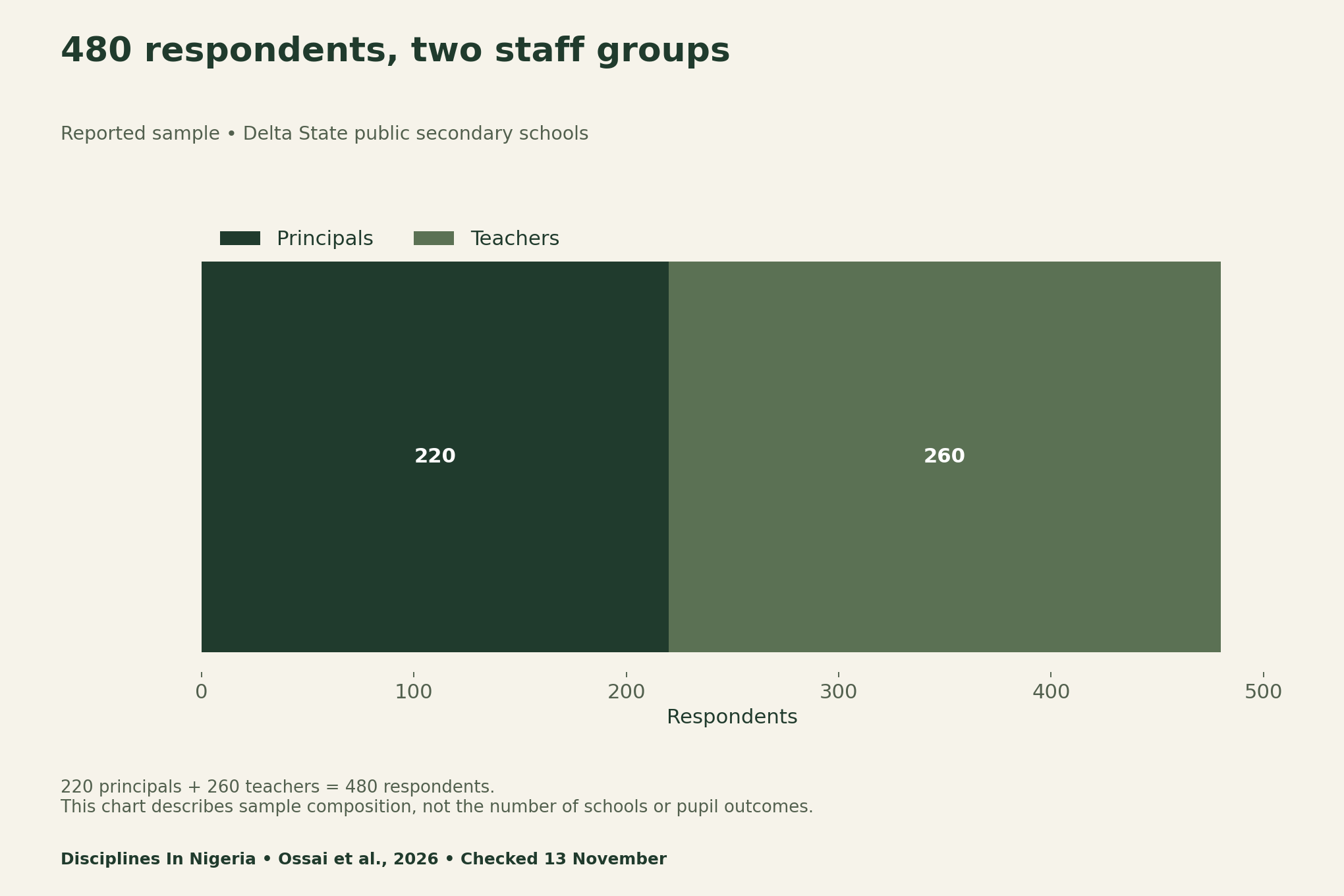
The study by Ossai, Okokoyo and Asabor, published 11 November 2026, describes an analytical descriptive survey of 480 respondents: 220 principals and 260 teachers. It reports four-point questionnaire responses and a 2.50 descriptive acceptance threshold. We did not establish collection dates in the inspected methods.
Keep the original rating scale
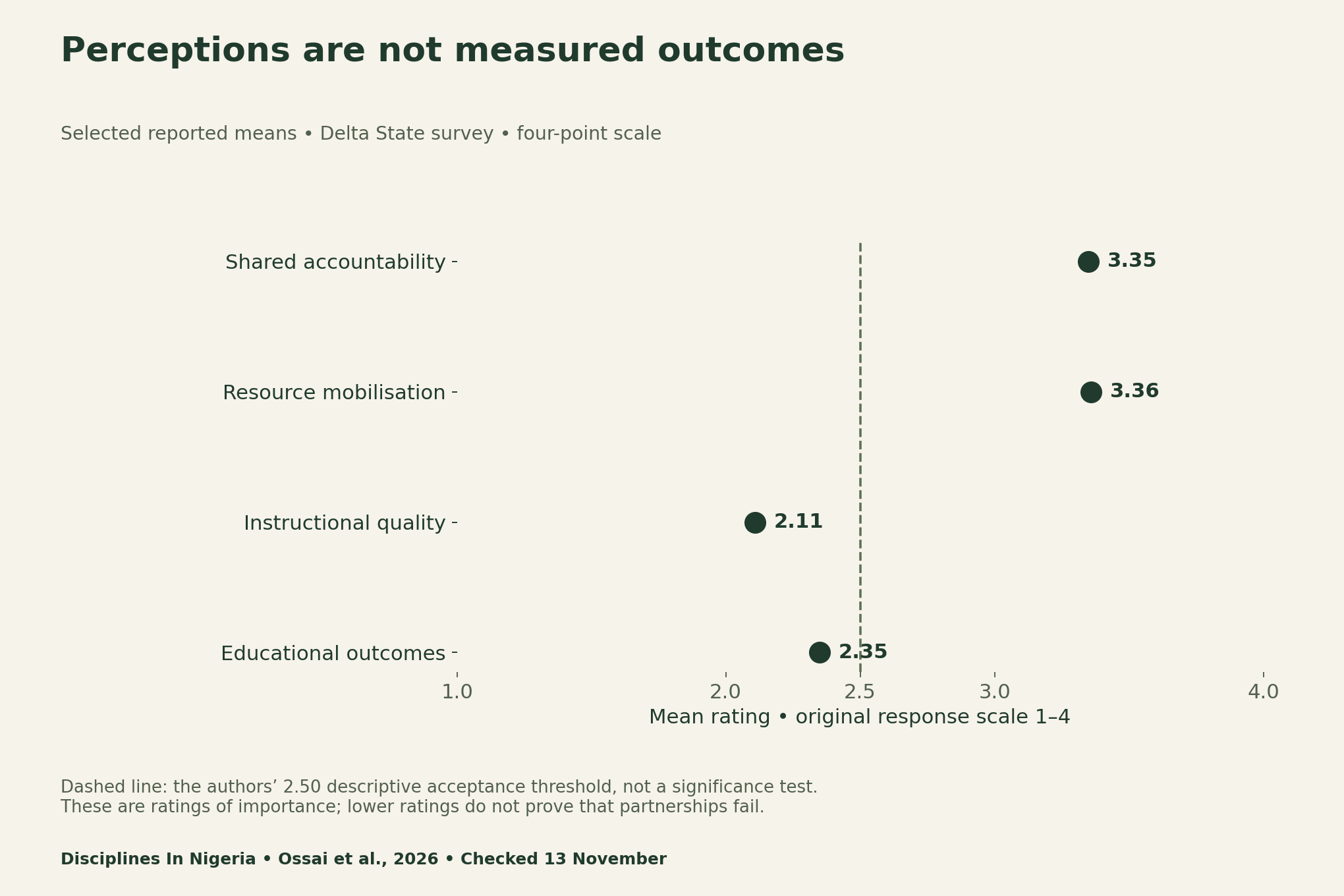
The article also reports hypothesis tests. Our chart does not reproduce those tests or turn the descriptive threshold into a p-value. Nor do the lower ratings show that community participation is ineffective. They identify a useful question about which outcomes should be observed directly.
Separate a construct from its indicator
Start with the idea you want to study, then choose evidence that fits it. “Accountability” might concern whether agreed responsibilities are documented and reviewed. “Instructional quality” needs a suitable measure of teaching practice. A broad label should not quietly become a count of meetings because that count is easier to collect.
Write the proposed definition before collecting new data. State who or what you will measure, the period covered and the denominator. For a completion measure, explain whether the denominator is planned actions, due actions or all actions ever recorded. Each choice can produce a different percentage.
Use a logic model before making an impact claim
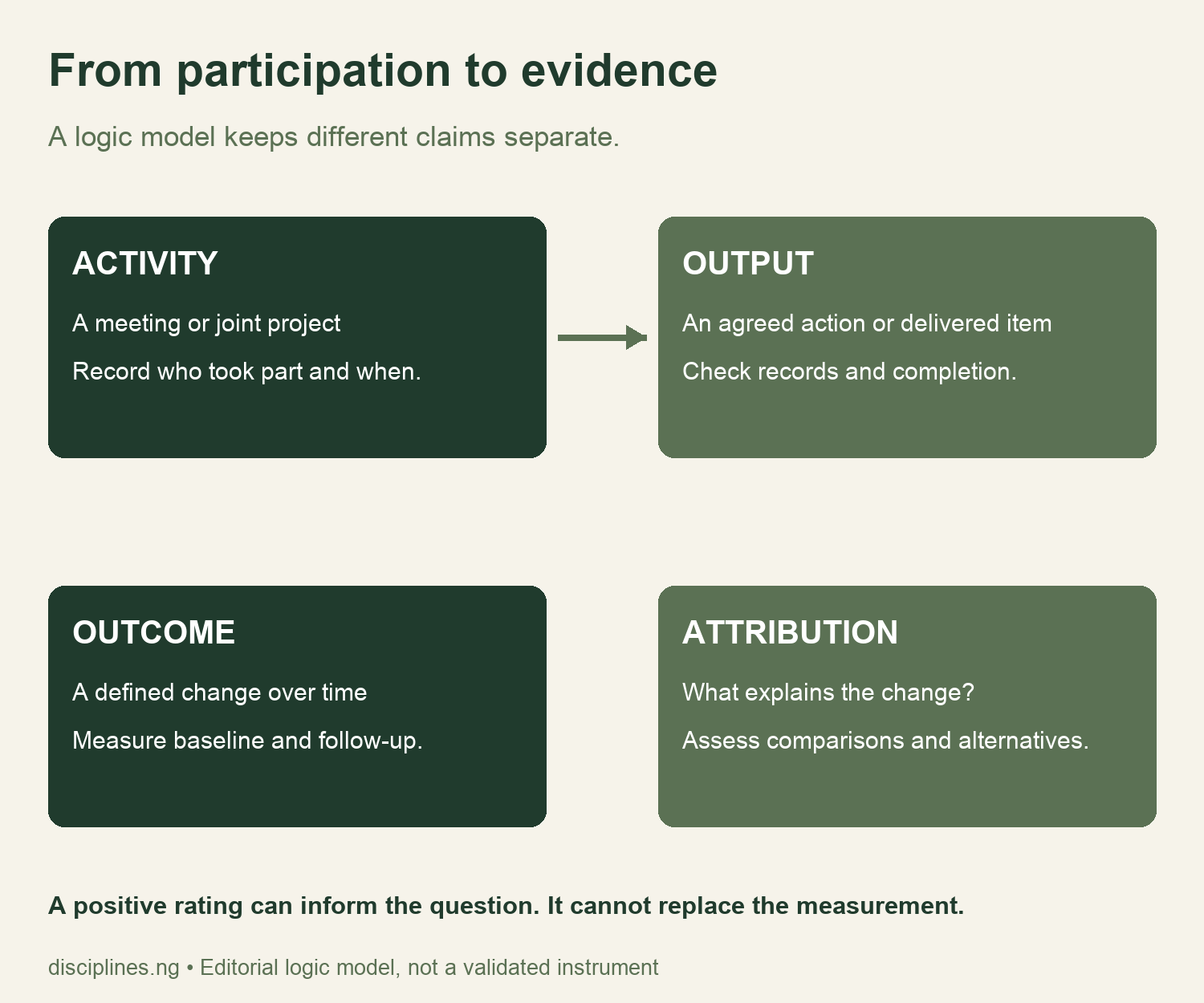
A meeting is an activity. The signed action record is an output. In contrast, a change in a defined process or learning measure is an outcome. Evidence that the partnership caused that change requires a further argument about design, comparison and competing explanations.
Each layer can therefore be useful. A process evaluation may legitimately ask whether the school team completed agreed actions. The problem arises when a researcher describes a process result as improved learning without measuring learning. Keep the conclusion aligned with the question actually answered.
Turn the topic into an answerable question
A narrow question can specify one partnership activity, one primary outcome and one measurement period. For example, a school team could investigate whether a revised communication process changes the time taken to acknowledge an enquiry. That is a fictional planning example, not a finding from the Delta State study.
First, define the start and end events consistently. Decide how to handle weekends, unanswered enquiries and repeated messages. A faster average among completed cases can conceal a growing backlog if the analysis excludes unresolved cases. Preserve those cases and report their status separately.
Plan baseline and follow-up on comparable terms
A baseline describes the chosen measure before the change. Follow-up uses the same definition afterwards. Also, keep the time windows comparable and record changes to data collection. If the baseline uses incomplete paper records while follow-up uses a mandatory digital form, the measurement process itself has changed.
Choose a feasible comparison with appropriate academic and school oversight. Explain why the comparison is credible for the question. Schools can differ in staffing, resources, pupil mix, leadership and prior trends. Simply giving two groups different labels does not resolve those differences.
For a dissertation, discuss the design and analysis with your supervisor before collecting data. Our blank plan does not supply a universal sample size, randomisation scheme or significance rule. Those decisions require a justified design for the actual question, available evidence and ethical context.
Keep alternative explanations visible
A new headteacher, staffing change, funding decision or revised attendance practice might coincide with a community initiative. Record relevant changes rather than treating everything after launch as an effect of the initiative. Where attribution remains weak, describe an observed change with clear limitations.
Use a comparison register to log selection, timing, other interventions and missing observations. Include the evidence you would need to assess each concern. A register makes the reasoning reviewable; it does not remove confounding or make a descriptive study causal.
Check whose perspective is represented
Principal and teacher responses answer questions about those respondents. They do not automatically represent pupils, families, community members or every school in Nigeria. If another perspective is essential, justify how to include it and keep participation appropriate and voluntary.
Avoid publishing pupil identifiers or sensitive family details in a public worksheet. Aggregate reporting may still identify a person in a small group, so consider disclosure risks with the responsible institution. Keep private research files off public downloads and follow the approvals required for your study.
Use ratings as one evidence stream
Survey responses can help explain perceived priorities, barriers and experiences. Administrative records can address a different question about observed processes. Combining them can make an argument more useful when their definitions, limitations and timing remain explicit.
Review the original instrument before reusing it. Similar wording does not guarantee that it measures the same construct in another context. Document adaptations, seek appropriate review and explain what your team has and has not tested. Do not label our planning sheets as validated scales.
School community relations research in Nigeria: free tools
For school community relations research in Nigeria, the first two files retain the selected reported ratings and the sample and scale definitions. The blank outcome plan links an activity to an observable outcome. The comparison audit records alternative explanations and the boundary of the final claim. Use all four privately without sending research data to us.
- Selected reported perception ratings (CSV)
- Reported sample and rating-scale dictionary (CSV)
- Blank baseline and follow-up outcome plan (CSV)
- Comparison and alternative-explanation audit (CSV)
For another example of separating evidence layers, see our electronic SIWES logbook evaluation guide. Our technical and traditional education overview offers broader context, rather than evidence of a partnership effect.
Methods, limitations and citation
We checked the primary publisher article on 13 November 2026. Our charts retain selected published means on their original scale; the sample check confirms 220 + 260 = 480. However, we did not obtain participant-level data, estimate an intervention effect or reconstruct the paper’s inferential analysis. Two charts answer distinct descriptive questions without adding speculative comparisons.
The logic model and blank tools are original editorial aids. They are not validated instruments or a substitute for a justified research protocol. Suggested citation: Disciplines In Nigeria, 13 November 2026, “Nigerian School-Community Research: Measure Outcomes, Not Just Agreement”, alongside Ossai et al., DOI 10.1007/s44217-026-01902-2, and the stated limits.


