




Physiotherapy exercises play a crucial role in maintaining health and wellness in Nigeria.
Many Nigerians experience musculoskeletal issues due to sedentary lifestyles and limited physical activity.
Regular physiotherapy exercises help manage and prevent these conditions.
They also improve mobility and enhance quality of life.
Key Reasons for Engaging in Physiotherapy Exercises
Physiotherapy exercises improve flexibility and support better joint movement.
They also build muscle strength, reduce pain, and support physical recovery.
Additionally, these exercises improve posture, core stability, balance, and mobility.
- Physiotherapy exercises improve flexibility and allow better joint range of motion.
- They build muscle strength, which can prevent injuries and improve overall mobility.
- Furthermore, these exercises can reduce pain by strengthening muscles and improving joint function.
- They promote faster injury recovery by enhancing blood flow to affected areas.
- Physiotherapy exercises improve posture and can help prevent back and neck pain.
- They strengthen the core, improve stability, prevent musculoskeletal issues, and support better balance.
Lower Back Stretches
These stretches support gentle movement in the lower back.
Move slowly and maintain comfortable positions throughout each exercise.
Additionally, controlled stretching can prepare your back for stability exercises.
- Bring one knee toward your chest at a time.
- Alternate between rounding and extending your back during the cat-cow stretch.
- Twist your torso gently while keeping your hips square during the seated spinal twist.
Core Stability Exercises
Core exercises help you practise controlled movement and spinal support.
Begin with manageable durations and focus on steady technique.
Meanwhile, keep your breathing relaxed as you perform each movement.
- Hold a plank while keeping your body aligned and your abdominal muscles engaged.
- Extend one arm and the opposite leg during the bird-dog exercise.
- Lift your hips during bridges while squeezing your gluteal muscles.
Spinal Alignment Techniques
Good posture supports a more balanced position while sitting and standing.
Keep your shoulders relaxed and avoid rounding them forward.
Furthermore, a lumbar roll or cushion can support your lower back while sitting.
- Sit and stand tall while keeping your shoulders relaxed.
- Use a lumbar roll or cushion during extended periods of sitting.
- Engage your core muscles to help maintain spinal alignment.
Exercise Instructions
Follow each exercise step by step to practise controlled and consistent movement.
Use proper form and adjust the movement to maintain comfort.
Gradually increase effort as your strength develops.
- Lie on your back with both knees bent.
Bring one knee toward your chest and hold for 15 to 30 seconds.
Repeat on the other side for two or three sets. - Start the plank in a push-up position with your hands beneath your shoulders.
Engage your core and hold for 20 to 30 seconds.
Complete three sets and gradually increase the duration. - Sit with your legs extended in front of you.
Twist toward one side while placing the opposite elbow outside your knee.
Hold for 15 to 30 seconds and switch sides. - Lie on your back with bent knees and feet hip-width apart.
Lift your hips by squeezing your gluteal muscles.
Hold briefly and lower your hips with control. - Start on all fours with your hands beneath your shoulders.
Round your back and tuck your chin toward your chest.
Then lower your belly and lift your head and tailbone. - Begin on all fours with a neutral spine.
Extend one arm and the opposite leg while keeping your hips level.
Return to the starting position and change sides. - Check your posture throughout the day.
Keep your shoulders relaxed and avoid slouching.
Engage your core to support your spine.
Consistent Practice and Guidance
Practise these exercises consistently to support your back care routine.
Perform every movement with proper form and gradually increase its intensity.
If severe or persistent back pain occurs, consult a physiotherapist for personalised guidance.
Delve into the Subject: Key Skills for Nigerian Orthopaedic Technologists
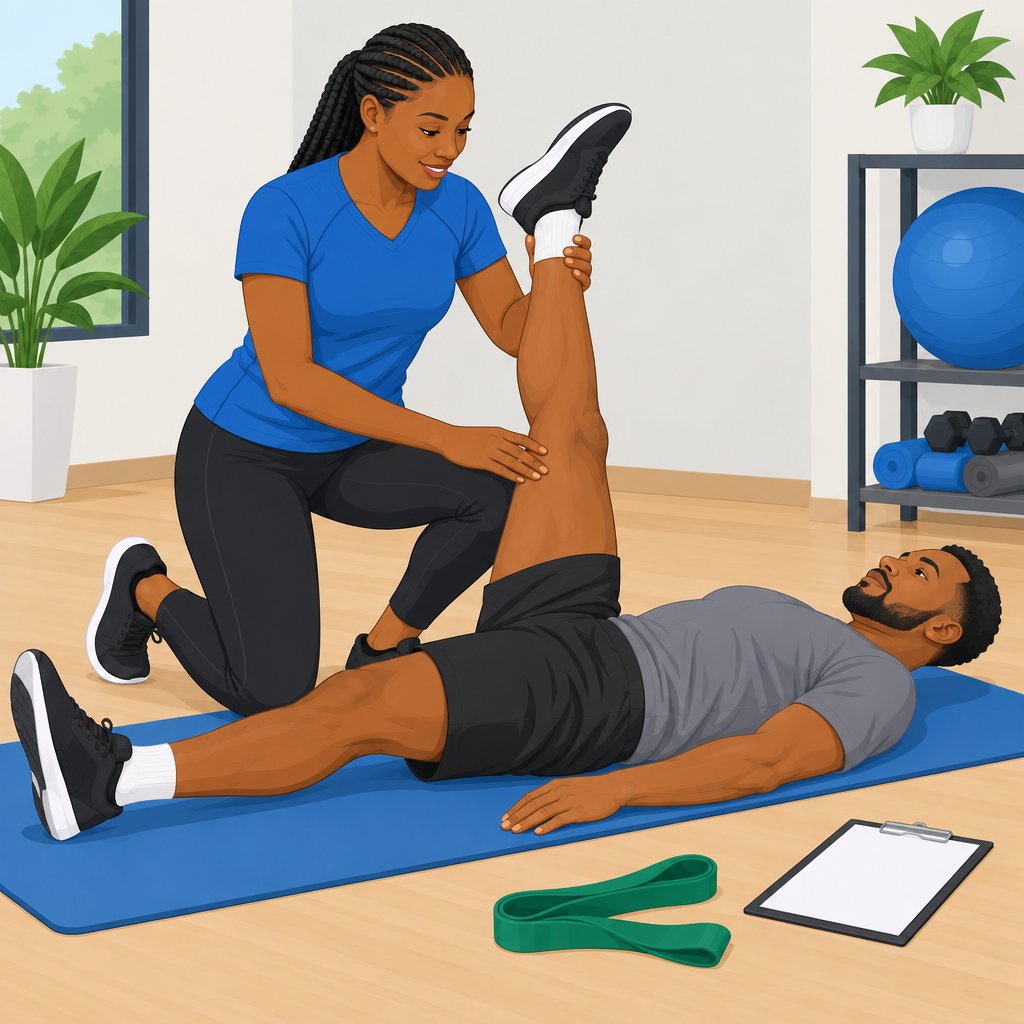
Physiotherapy Exercises for Knee Pain
Knee pain can limit daily activities and affect mobility.
Several factors can contribute to discomfort around the knee joint.
Identifying these factors helps guide suitable exercises for strengthening nearby muscles.
Common Causes of Knee Pain in Nigerians
Different lifestyle and health factors can place additional stress on the knees.
Injuries and poor movement patterns can also affect knee comfort and stability.
Recognising possible causes supports better exercise choices and safer movement.
- Obesity: Excess weight puts added stress on the knee joint.
- Arthritis: Osteoarthritis is a common form of knee arthritis in Nigeria.
- Injuries: Sports activities or accidents can cause knee injuries.
- Poor posture: Incorrect alignment can strain the knee joint.
- Lack of physical activity: Limited exercise can weaken the knee muscles.
Exercises That Strengthen Muscles Around the Knee
Specific exercises can help strengthen muscles surrounding the knee joint.
They may also support improved mobility and help manage knee pain.
Perform each movement carefully, and adjust the effort to your ability.
- Squats: Squats strengthen the quadriceps, hamstrings, and glutes.
- Lunges: Lunges work the quadriceps and improve knee stability.
- Leg raises: Leg raises target the quadriceps and hip flexors.
- Step-ups: Step-ups engage the quadriceps and glutes.
- Hamstring curls: Hamstring curls strengthen the hamstrings.
Exercise Modifications for Different Fitness and Mobility Levels
People should adjust exercises according to their fitness level and mobility.
Starting gradually can help individuals manage effort and movement comfortably.
A physiotherapist can provide guidance for people with ongoing knee concerns.
- Low-impact options: Choose water aerobics to reduce stress on the joints.
- Supportive equipment: Use a knee brace or support for added stability.
- Start slowly: Begin with fewer repetitions, then gradually increase intensity.
- Consult a physiotherapist: Seek professional guidance for personalised exercises.
Adding suitable exercises to your routine can help manage knee pain.
These movements can also support knee strength and mobility.
Consult a physiotherapist before starting exercises for chronic knee problems.
Find Out More: Research Opportunities in Nigerian Microbiology
Importance of Correct Form and Technique
Proper form helps target the intended muscles during physiotherapy exercises.
Transform Your Career with Expert Guidance
Get personalized mentorship consulting that’s tailored to your unique path. Our expert advice is actionable and exclusive.
Get StartedCorrect alignment also reduces the risk of strains, sprains, and further discomfort.
Therefore, careful technique supports safer progress and better exercise results.
Maintaining Proper Form
Keep your spine straight while performing each exercise.
Relax your shoulders to reduce unnecessary tension during movement.
Engage your core muscles to improve stability and control.
Posture and Alignment During Exercises
Good posture helps you perform physiotherapy exercises with greater control.
Proper alignment also helps direct effort toward the muscles being exercised.
Use steady movements and adjust your position whenever your alignment changes.
- Focus on breathing techniques to support oxygen flow and maintain proper form.
- Use mirrors or recorded videos to monitor your form and make adjustments.
- Start with lighter weights or resistance bands before progressing to heavier loads.
Physiotherapist Guidance During Exercises
A physiotherapist can assess your movement patterns and correct your exercise technique.
They can tailor exercises to your specific needs and recovery goals.
They can also monitor progress, adjust exercises, and provide ongoing support.
- Seek physiotherapist guidance if you are new to physiotherapy or recovering from an injury.
- Discuss discomfort or concerns openly so your physiotherapist can respond appropriately.
- Follow professional feedback to maintain safe and effective exercise technique.
Explore Further: Radiography and Radiology: Future Trends in Nigeria
Incorporating Aerobic Exercises
Aerobic activities such as walking or cycling can provide many benefits during physiotherapy.
These exercises can support cardiovascular health and improve general fitness.
They can also assist weight management while supporting your broader health goals.
Benefits of Aerobic Exercises
These activities strengthen the heart and support healthier blood circulation.
They can also build endurance, stamina, and energy for improved fitness.
Furthermore, aerobic movement burns calories and can support weight management.
- Aerobic exercises strengthen the heart and improve blood circulation, reducing heart disease risk.
- They can increase endurance, stamina, and energy, which supports improved overall fitness.
- They burn calories, making them useful for weight management and weight loss.
Increasing Intensity and Duration
Start slowly when adding aerobic exercises to your physiotherapy routine.
Then, gradually increase the intensity and duration as your body becomes stronger.
Set realistic goals and monitor your response to each workout.
- Begin with low-impact activities such as walking or swimming to build endurance and strength.
- Set achievable goals involving your speed, distance, or workout duration.
- Use intervals that alternate between higher and lower intensities.
- As your strength improves, add challenging activities such as running or cycling.
- Listen to your body and adjust the intensity or duration when necessary.
Adding aerobic exercises can improve cardiovascular health and enhance overall fitness.
Gradually increasing effort can also support better well-being and weight management.
Consult your physiotherapist before starting a new routine to confirm its safety and suitability.
Find Out More: Eye Health Education: Resources for Nigerians
Benefits of Strength Training
Strength training supports physiotherapy programs for people across different ages and fitness levels.
It targets muscles while supporting movement, daily activities, and physical performance.
Additionally, regular resistance exercises can support stronger bones and more stable joints.
Advantages of Incorporating Strength Training Exercises
Strength training can improve muscle strength and endurance during daily activities.
It can also enhance flexibility, range of motion, energy levels, and mood.
Furthermore, stronger muscles can support athletic performance, functional ability, and safer movement.
- Improved muscle strength and endurance
- Enhanced flexibility and range of motion
- Increased metabolism and calorie burn
- Enhanced athletic performance and functional ability
- Reduced risk of injuries and falls
- Boosted energy levels and mood
Building Muscle Mass Through Resistance Training
Strength exercises place controlled demands on muscles during each movement.
These demands create small muscle fiber tears that recovery processes repair and strengthen.
This process, called muscle hypertrophy, can increase muscle mass, tone, and overall strength.
Improving Bone Density
Strength training helps maintain and improve bone density.
This benefit becomes especially important for older adults and people at risk of osteoporosis.
Weight-bearing movements can stimulate bone growth and reduce risks associated with bone loss.
- Squats
- Lunges
- Overhead presses
Enhancing Overall Strength
Targeted exercises can strengthen specific muscle groups and improve functional ability.
Consequently, stronger muscles can make daily tasks and routine activities easier.
They can also support joints and reduce risks linked to muscle imbalances, chronic pain, or injuries.
Examples of Strength Training Exercises
People can choose strength exercises according to their abilities, preferences, and training needs.
Bodyweight, resistance band, free weight, and machine-based exercises offer several practical options.
However, a physiotherapist or fitness professional can help select suitable exercises and resistance levels.
- Bodyweight exercises: push-ups, squats, lunges, and planks
- Resistance band exercises: bicep curls, lateral raises, and leg extensions
- Free weight exercises: dumbbell rows, deadlifts, and bench presses
- Machine-based exercises: leg presses, chest presses, and lat pulldowns
Starting Strength Training Safely
Consult a physiotherapist or fitness professional before beginning a new strength training program.
This step becomes especially important when a pre-existing condition or injury affects your movement.
Start slowly, increase intensity gradually, and listen to your body during every workout.
Mind-Body Connection in Physiotherapy
- Mental focus plays an important role in physiotherapy exercises.
- Mindfulness techniques help individuals notice their bodies during exercises.
- Additionally, deep breathing reduces stress and improves oxygen flow to muscles.
- Visualization techniques enhance performance by creating mental images of successful movements.
- Therefore, focusing on the mind-body connection can improve overall wellbeing.
Incorporating Mind-Body Practices
- Begin each session with deep breathing exercises, then repeat them afterward.
- During exercises, practice mindfulness by noticing bodily sensations and remaining present.
- Next, visualize yourself completing each exercise successfully and comfortably.
- Consistent practice can improve physical performance and relaxation levels.
- Furthermore, the mind-body connection supports optimal physiotherapy results.
- Including these practices in your daily routine can enhance physiotherapy outcomes and wellbeing.
Physiotherapy Exercises and Long-Term Well-Being
Top physiotherapy exercises support health and well-being for Nigerians.
They can improve mobility, flexibility, and strength when people practice them regularly.
However, consult a physiotherapist or healthcare provider before starting any new exercise program.
This step helps ensure safety and efficiency.
Furthermore, regular commitment to physiotherapy exercises can provide long-term health benefits.
Additional Resources
Google search results for Top Physiotherapy Exercises for Nigerians Medical
Bing search results for Top Physiotherapy Exercises for Nigerians Medical


