






Energy drink use among Nigerian pharmacy students needs careful reading before it becomes a headline. A new survey offers a useful example: changing the denominator changes the question, even when the same students supply the numerator. This guide helps students, lecturers and research writers audit that change without turning a limited survey into a national claim.
We provide four original charts, a claim-audit infographic and four free CSV tools. The contribution is a reproducible reading method, not a health assessment or a claim that a drink improves academic results. Research checked on 9 November 2026; calendar fieldwork dates were not identifiable in the inspected methods.
Start with the people behind the percentage
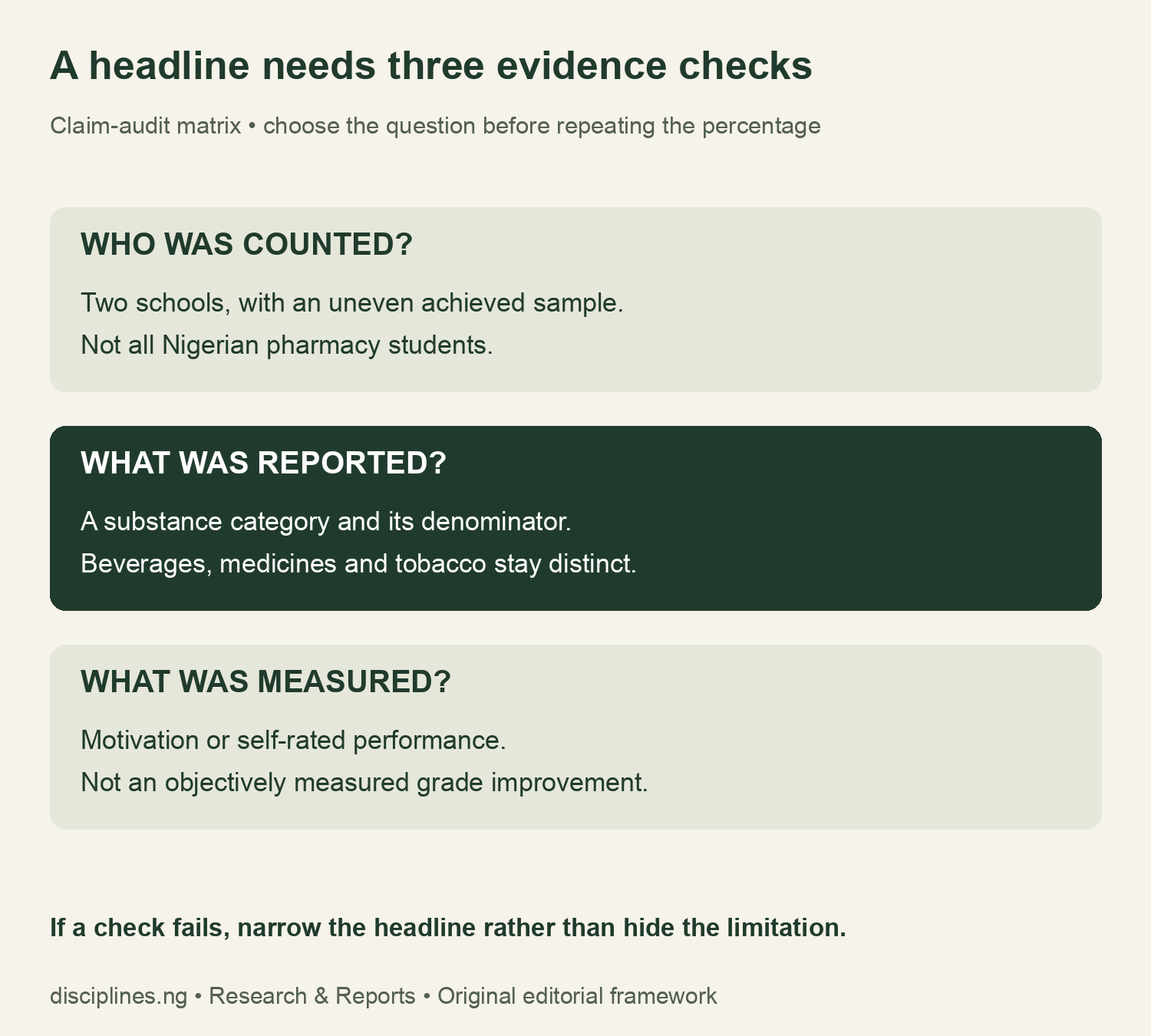
The BMC Medical Education paper published on 4 November 2026 is an early accepted version by Eneje and colleagues. It analysed 752 pharmacy students from UNN and ESUT. Recruitment was online and based on convenience, with 702 respondents from UNN and 50 from ESUT. These are achieved sample counts, not institution-wide response rates.
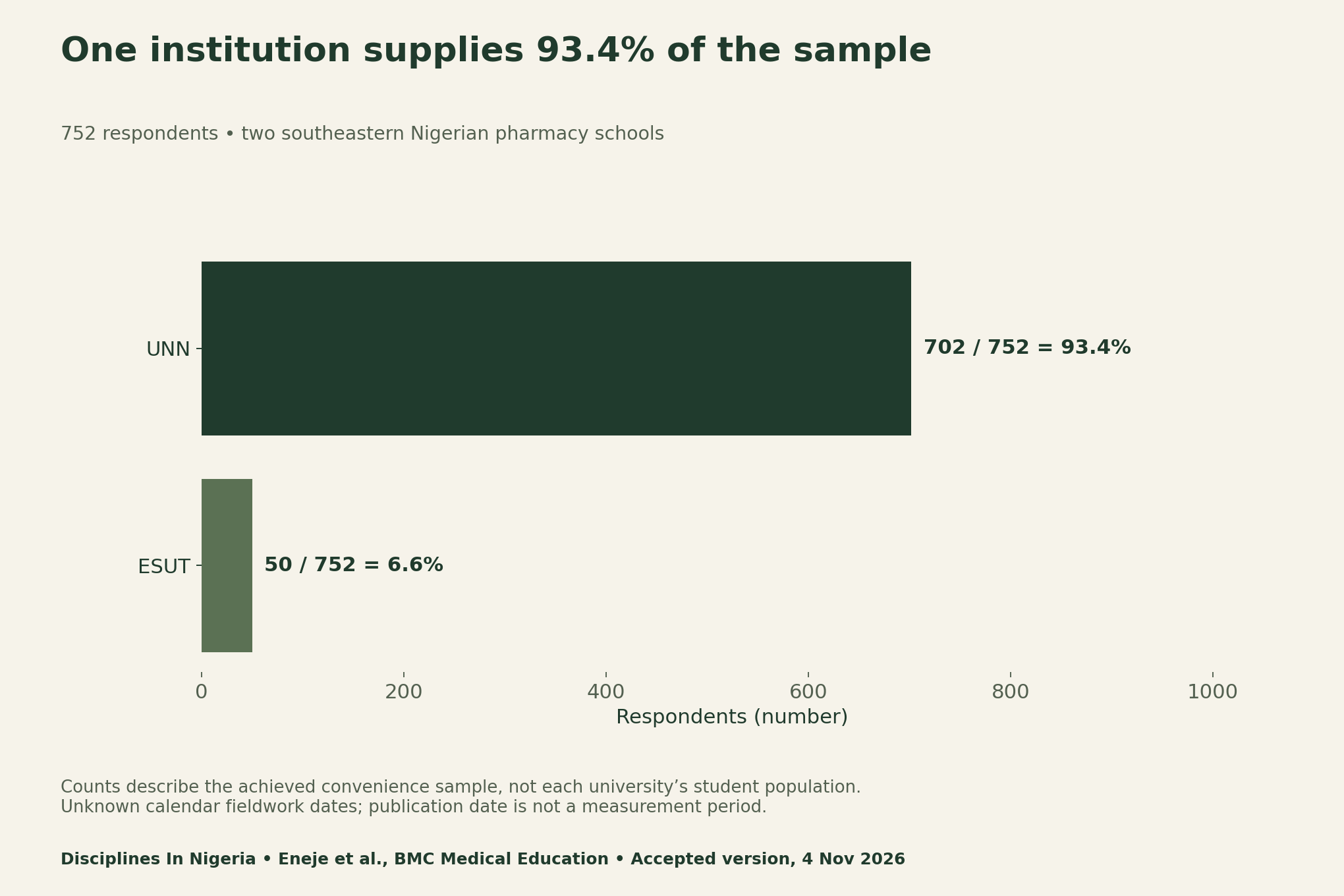
Before citing a survey, write a population sentence in plain language. Name the participants, recruitment route and geographic boundary. Then ask who could have missed the invitation or chosen not to respond. Without a sampling frame and suitable selection design, a confidence interval cannot repair that coverage problem.
Energy drink use among Nigerian pharmacy students: separate the categories
The paper reports energy drinks for 467/752 respondents and other caffeine products for 329/752. Its wider “any surveyed substance” measure is 550/752, or 73.1% (reported 95% interval 69.9–76.2). The accepted manuscript, Table 2, allows multiple responses. Consequently, these categories overlap and their percentages must not be summed to 100%.
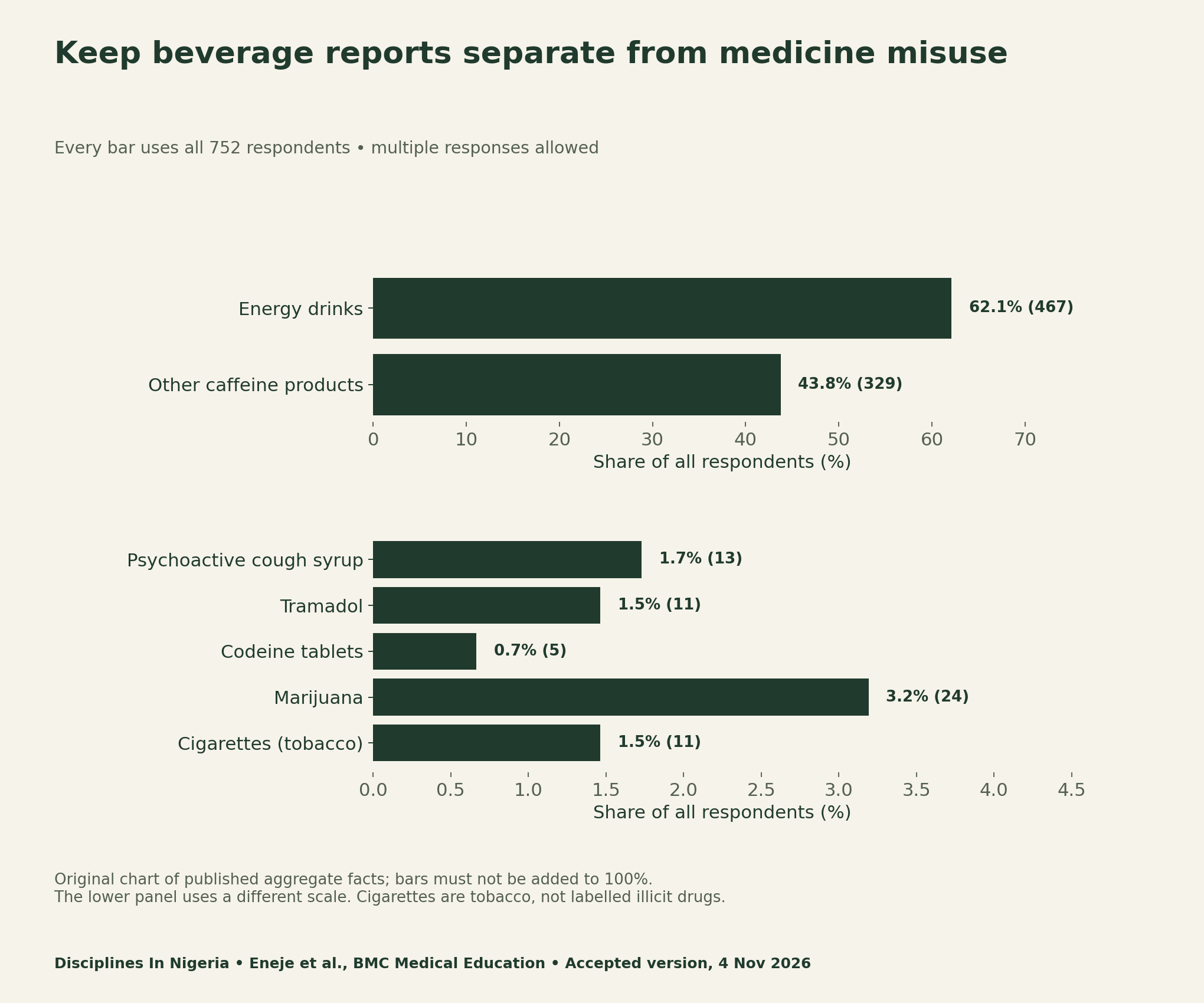
An umbrella label can change a reader’s understanding of a result. Keep beverages distinct from non-medical medicine use, and keep tobacco accurately named. A headline calling the entire combined group illicit-drug users would erase those distinctions. It would also add a judgement that the combined measure does not establish.
For a dissertation table, give each category its own row. Add a note saying whether respondents could select several answers. If you calculate a combined total, first establish whether individual-level overlap is available. Adding published marginal counts cannot tell you how many unique people belong to their union.
Recalculate one numerator with two denominators
The manuscript reports 411 students selecting staying awake to study as a motivation: 74.7% of 550 users, or 54.7% of all 752 respondents. Both fractions are valid for their stated questions. The error is to quote one while describing the other population.
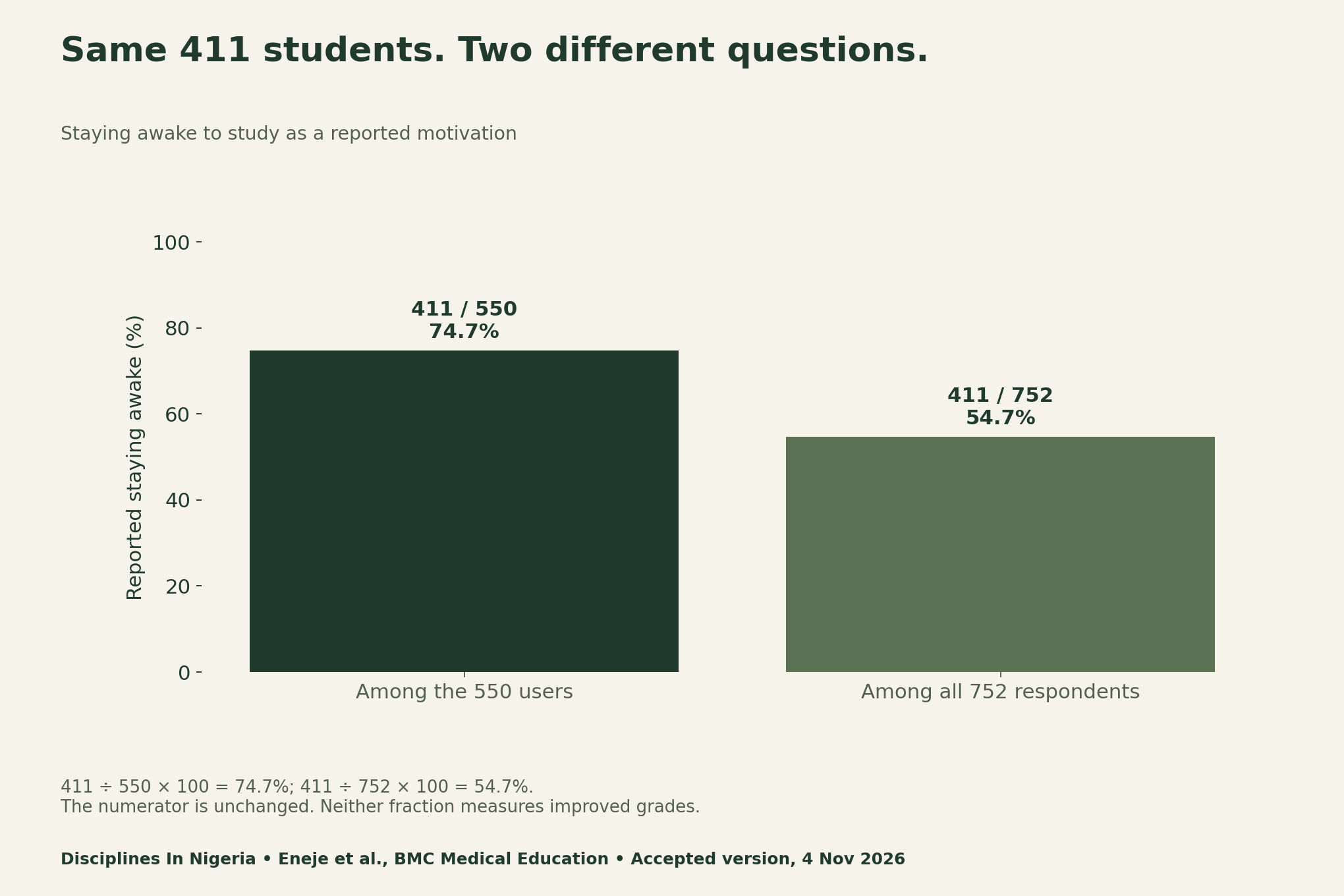
Use a sentence test: “Of which group?” should have an immediate answer beside every percentage. For example, a motivation among users answers a different question from a motivation among all participants. Put the denominator in the chart subtitle, table column or sentence itself, rather than leaving it only in distant methods.
The downloadable calculation file performs numerator divided by denominator, multiplied by 100. Keep full precision during calculation and round only for presentation. When comparing displayed values, note that subtraction after rounding may differ slightly from subtraction before rounding. Here the displayed 74.7 minus 54.7 equals 20.0, while the unrounded difference rounds to 20.1.
Read frequency before giving “any use” a stronger meaning
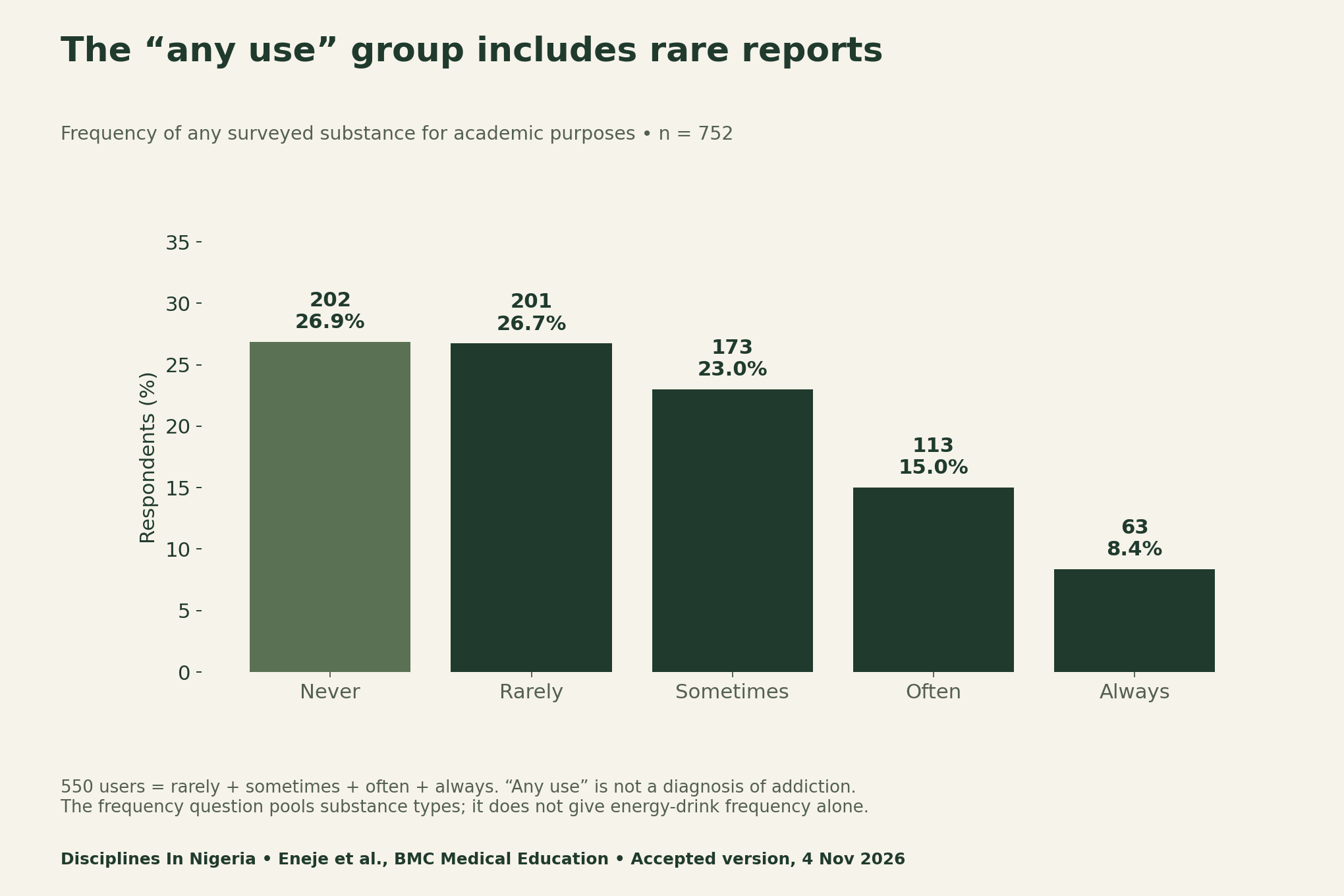
A binary measure compresses several experiences into one category. That can be useful for a defined descriptive question, but it removes detail. When using such a measure in a headline, keep the underlying definition available. Do not silently replace “reported any use” with frequent use, dependence or a clinical diagnosis.
Motivation and perception do not demonstrate improved grades
The survey used retrospective self-rated academic performance rather than objectively measured grades. A reported intention to study longer is not a measured learning gain. Its cross-sectional design also does not identify what would have happened to the same students under a different exposure.
For a proposed educational evaluation, define the outcome independently of the reason students give for an action. A completed course task, a consistently marked assessment or a clearly specified support-access measure answers its own question. None should be relabelled as a clinical outcome. Our tools do not supply treatment, dosage or product recommendations.
Plan a voluntary support evaluation before collecting responses
Our blank protocol is a planning tool. It has not been tested or used to collect student data. Begin with one answerable educational question and the necessary institutional ethics process. Separate access to support from participation in research, so declining a survey does not become a barrier to help.
Next, specify recruitment, consent, privacy, timing and one educational outcome. Record how you will handle non-response and who may access the data. Public versions should contain no names, registration numbers, contact details or identifiable health histories. Avoid small breakdowns that could identify a person in a class.
If a future pilot compares groups or time points, describe the allocation, baseline and follow-up before interpreting differences. A before-and-after change alone can reflect other influences. Predefine marking consistency and uncertainty reporting, and seek qualified pharmacy or clinical review for any health wording. This article does not claim that such a pilot has already worked.
For a related distinction between a training activity and a measured result, see our ADR reporting training readiness audit. Our guide to interpreting university research correlations also separates an association from an intervention effect.
Download the denominator ledger and blank tools
The ledger records selected aggregate facts and accepted-PDF locations. The calculations reproduce the percentages and frequency totals. The two blank tools support headline checks and evaluation planning; they are not completed research, clinical instruments or a reproduction of the authors’ questionnaire.
- Survey denominator and source-location ledger (CSV)
- Recalculated percentages and frequency values (CSV)
- Blank headline and denominator audit (CSV)
- Blank voluntary student-support evaluation protocol (CSV)
Methods, limitations and citation
This audit of energy drink use among Nigerian pharmacy students preserves the paper’s population boundary. We inspected the publisher article and accepted PDF on 9 November 2026. We transcribed selected aggregate counts, preserved their denominators and calculated percentages with count divided by stated denominator. The figures and tools are original; no publisher figure, questionnaire or identifiable student record is reproduced. The accepted manuscript may receive further editing.
The evidence concerns a convenience sample from two schools, heavily weighted toward one. Self-report, overlapping categories and unknown calendar fieldwork dates limit interpretation. No national prevalence, causal academic benefit, addiction diagnosis or clinical safety conclusion is estimated. The four charts answer different descriptive questions; their bars should not be combined into a single total.
Suggested citation: Disciplines In Nigeria (9 November 2026), “Energy Drinks and Nigerian Pharmacy Students: Read the Denominator,” source-linked aggregate audit and educational worksheets. Cite the original study for its findings and this report for the calculations and editorial tools.


