




Green Building Technologies in Nigeria
Green building technologies are sustainable construction practices that reduce environmental impact.
They promote energy efficiency, conserve water, and support healthier indoor environments.
In Nigeria, adoption of these technologies continues to gain momentum.
Explanation of Green Building Technologies
These technologies use eco-friendly materials and efficient design strategies.
They reduce energy consumption, conserve resources, and minimize waste.
Furthermore, renewable energy and sustainable construction practices strengthen environmental sustainability.
Importance of Green Building Technologies
Green building technologies reduce carbon emissions and help mitigate climate change.
They lower operating costs, improve occupant health, and enhance quality of life.
In Nigeria, rapid urbanization increases infrastructure demand, making sustainable solutions increasingly valuable.
Current State of Green Building Technologies in Nigeria
Green building technologies remain an emerging field in Nigeria.
However, awareness and interest continue to grow.
Projects in Lagos and Abuja now incorporate green design principles.
Additionally, government initiatives and international partnerships encourage wider adoption.
The future appears promising for sustainable and eco-friendly buildings in Nigeria.
Government Policies and Regulations
The Nigerian government has introduced policies supporting green building technologies.
These measures promote sustainable development within the construction industry.
They also aim to reduce construction’s environmental impact.
Existing Policies and Regulations
Nigeria uses several policies and regulations to encourage sustainable construction practices.
These measures address building standards, energy use, and sustainable development objectives.
The main frameworks include the National Building Code, Energy Efficiency Code, and Sustainable Development Goals.
- The National Building Code provides construction guidelines, including energy efficiency and sustainable materials.
- The Energy Efficiency Code establishes building energy consumption standards.
- The code encourages renewable energy sources and energy efficient technologies.
- Nigeria’s commitment to the Sustainable Development Goals supports sustainable construction and urban development.
Effectiveness of Current Policies
Current policies have encouraged some adoption of green building technologies in Nigeria.
Sustainable practices have gradually increased across construction projects.
However, several challenges limit the policies’ effectiveness.
Weak enforcement reduces compliance with existing requirements.
Stakeholders also have inadequate awareness of green building technologies.
Limited funding further restricts investment in green projects.
Consequently, green building technology adoption remains relatively low in Nigeria.
Potential Areas for Improvement
Stronger government support could further promote green building technologies in Nigeria.
Several improvements could address current adoption barriers.
These improvements include awareness, financing, training, and research support.
- The government can launch awareness campaigns for developers, contractors, and the public.
- Tax breaks, grants, and subsidies can encourage investment in sustainable construction.
- Training programs and workshops can strengthen construction professionals’ implementation skills.
- Government funded research can develop technologies suited to Nigeria’s construction context.
Addressing these areas can strengthen government support for green building technologies.
Consequently, Nigeria can accelerate its transition toward a sustainable construction sector.
Green Building Materials
Eco-friendly building projects in Nigeria depend heavily on careful material choices.
These choices can affect environmental performance and construction outcomes.
Several sustainable materials are available for Nigerian building projects.
- Bamboo: Bamboo provides a lightweight, durable, and renewable construction material.
- Recycled Glass: Recycled glass reduces waste and saves energy during building construction.
- Adobe: Adobe bricks combine earth, clay, straw, and water in an environmentally friendly material.
- Rammed Earth: Rammed earth construction compacts earth within formwork to create strong walls.
- Cork: Cork offers natural insulation and supports renewable flooring and wall insulation.
Costs and Benefits of Green Materials
A useful comparison considers both initial costs and lasting benefits.
- Cost: Green materials may cost more initially than traditional construction materials.
- Benefits: Energy efficiency can produce significant savings over time.
- Eco-friendly materials can support healthier indoor environments and lower utility bills.
- These materials can also help reduce a building’s carbon footprint.
Successful Nigerian Projects Using Green Materials
Several Nigerian projects have incorporated green materials.
These projects demonstrate sustainable and energy-efficient design.
They also show how material choices can support environmentally responsible buildings.
- Lagos Business School: The campus uses green materials for energy conservation.
- Alpha Beach Residence: This Lekki residence incorporates recycled materials in its sustainable design.
- Architectural Association School of Architecture in Lagos: The building features sustainable materials, including bamboo and adobe.
Learn More: Success Stories in Nigerian Environmental Management
Transform Your Career with Expert Guidance
Get personalized mentorship consulting that’s tailored to your unique path. Our expert advice is actionable and exclusive.
Get StartedEnergy Efficiency
Energy efficiency remains a crucial part of green building technologies in Nigeria.
It reduces energy consumption while maintaining suitable building performance.
Furthermore, efficient buildings can support financial savings and environmental sustainability.
Importance of Energy Efficiency
- Energy-efficient buildings consume less energy, which lowers utility bills for residents and businesses.
- Reduced energy consumption lowers carbon emissions and supports environmental sustainability.
- Better ventilation and air quality can create healthier indoor environments for occupants.
- Energy-efficiency investments create jobs and stimulate growth within the green technology sector.
Renewable Energy Sources
Nigerian buildings can integrate renewable energy sources into sustainable designs.
These sources can improve energy performance while reducing dependence on conventional energy supplies.
Solar, wind, biomass, and geothermal systems offer several renewable energy options.
- Solar panels can use Nigeria’s abundant sunlight to generate electricity for buildings.
- Wind turbines can capture wind energy and convert it into electricity for building operations.
- Biomass systems can use wood waste and agricultural residues to generate heat and electricity.
- Geothermal heat pumps can use the earth’s natural heat for heating and cooling systems.
Case Studies of Energy-Efficient Buildings in Nigeria
Several Nigerian developments demonstrate how buildings can apply energy-efficient technologies.
These examples use efficient systems, renewable energy, or sustainable design strategies.
Their approaches show how energy efficiency can support larger development goals.
- Civic Centre Towers in Lagos uses efficient lighting and HVAC systems, reducing energy consumption by 30 percent.
- Alaro City in Lagos integrates solar power and efficient waste management systems.
- Nestoil Tower in Abuja uses efficient glass facades and lighting controls, reducing energy usage by 25 percent.
- Eko Atlantic City in Lagos prioritizes efficient design and renewable energy integration.
Energy Efficiency Supports Sustainable Building
Energy efficiency helps Nigerian buildings reduce consumption and control operating costs.
Renewable energy integration strengthens these benefits and supports environmental sustainability.
Therefore, efficient building practices can contribute to healthier environments and long-term economic value.
Find Out More: Role of Environmental Scientists in Nigeria
Importance of Water Conservation
Water conservation supports sustainable building practices by reducing unnecessary water use.
It also promotes efficient resource management within buildings.
Moreover, conservation reduces environmental pressure and protects water resources for future generations.
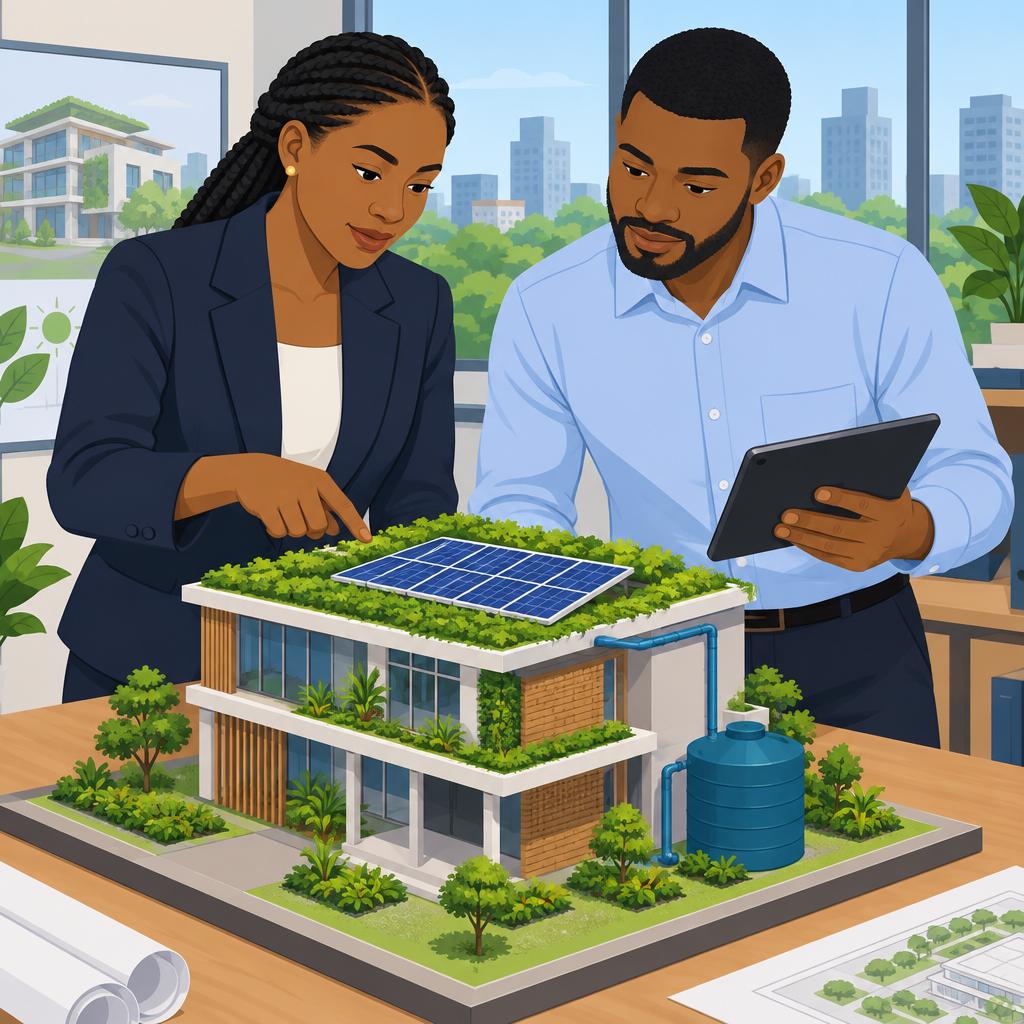
Innovative Water Saving Techniques
Several practical techniques can reduce water consumption in sustainable buildings.
These approaches support efficient use of available water resources.
Furthermore, they help buildings manage water demand responsibly.
- Greywater recycling reuses water from sinks and showers for purposes such as irrigation.
- Rainwater harvesting collects rainwater for non-potable uses within buildings.
- Low-flow fixtures reduce consumption through efficient faucets, toilets, and showers.
- Xeriscaping uses drought-resistant plants and landscaping to limit water requirements.
Examples of Water Conservation in Nigeria
Nigeria faces water scarcity challenges that make conservation strategies important.
Green building technologies can address these challenges through responsible water management.
Several Nigerian projects demonstrate practical approaches to reducing water demand.
Lekki Conservation Centre, Lagos
The Lekki Conservation Centre incorporates rainwater harvesting for irrigation.
It also recycles greywater for toilet flushing.
These systems reduce the project’s overall water demand.
The Civic Centre, Lagos
The Civic Centre uses low-flow fixtures to reduce operational water consumption.
It also applies water-efficient landscaping practices.
Consequently, these measures help minimize water use across its operations.
Green Building, Abuja
A green building in Abuja uses rainwater harvesting for landscaping.
It also recycles greywater for non-potable purposes.
These practices demonstrate sustainable water management within the building.
Innovative Office Building, Port Harcourt
An innovative office building in Port Harcourt uses water-efficient fixtures.
The building also includes a comprehensive water management system.
Together, these features conserve water resources effectively.
Adopting these techniques can support more sustainable building practices in Nigeria.
Responsible water use can also strengthen environmental stewardship.
You Might Also Like: Impact of Government Policies on Estate Management
Sustainable Design Practices
Sustainable design principles use resources efficiently and minimize environmental impact.
In green building technologies, designers apply these principles through energy efficiency, water conservation, and waste reduction.
Architects and designers play a crucial role in promoting sustainable building practices.
They incorporate these principles into their designs.
They must consider site selection, energy sources, materials, and overall building performance.
By designing sustainably, architects can create environmentally friendly buildings that remain comfortable and cost-effective.
One Nigerian example is the Civic Centre in Lagos, which uses solar panels for energy.
It also uses rainwater harvesting for irrigation.
Another Lagos case study, Heritage Place, uses efficient lighting and cooling systems.
These systems reduce energy consumption.
Together, these buildings show how Nigeria’s construction industry can implement sustainable design practices successfully.
Furthermore, these examples can inspire architects and designers to support a greener future.
Learn More: Estate Management in Nigeria: Historical Context
Green Building Certification
Green building certification supports sustainable construction practices in Nigeria.
These programs evaluate how buildings use resources and affect their surrounding environment.
They also encourage healthier indoor spaces for occupants.
Importance of Green Building Certification
Certification helps developers design, construct, and operate buildings sustainably.
It also reduces environmental impacts on surrounding ecosystems.
Furthermore, certification promotes healthier indoor environments and efficient resource use.
- Certification supports sustainable building design, construction, and operation.
- It helps reduce buildings’ environmental effects on surrounding ecosystems.
- It promotes healthier indoor environments that improve occupant well-being.
- It encourages efficient use of energy, water, and building materials.
Comparison of Certification Programs
Several certification programs operate within Nigeria’s green building context.
Each program uses different requirements and sustainability priorities.
Developers can compare these priorities when selecting an appropriate certification approach.
- Leadership in Energy and Environmental Design requires specific energy and water efficiency standards.
- Green Building Council of Nigeria promotes sustainable building practices and technologies.
- BREEAM emphasizes lower carbon emissions and reduced environmental impacts throughout a building’s lifecycle.
Benefits of Obtaining Green Building Certification
Certified buildings can attract buyers and tenants who value environmental responsibility.
They can also reduce utility expenses through improved energy efficiency.
Moreover, certification supports healthier interiors and environmental protection.
- Green buildings offer enhanced marketability among environmentally conscious buyers and tenants.
- Energy-efficient buildings can lower utility bills for occupants.
- Certified buildings can reduce greenhouse gas emissions and support sustainability.
- Healthier indoor environments can improve occupant well-being.
Green building certification benefits developers, occupants, and the environment.
By meeting sustainability standards, Nigerian buildings can support a greener future.
Advancing Sustainable Construction in Nigeria
Green building technologies can advance sustainability in Nigeria’s construction industry.
As urbanization continues and environmental challenges increase, stakeholders must adopt these practices more widely.
Governments, developers, architects, and engineers should prioritize technologies that reduce buildings’ environmental impacts.
These technologies also create healthier, more energy-efficient spaces for occupants.
Continued support and investment can accelerate sustainable construction across Nigeria.
Research and development, training programs, and incentives can encourage broader adoption.
Individuals also influence sustainability within the built environment.
By learning about green technologies, people can make more responsible choices in their projects.
They can use eco-friendly materials, install energy-efficient systems, and design with nature in mind.
These choices support more sustainable projects.
Collaboration among stakeholders can help Nigeria address environmental challenges through sustainable construction.
Green building technologies can create a resilient and efficient built environment.
They can also support the health and well-being of future generations.
Additional Resources
Google search results for Green Building Technologies in Nigeria Environmental
Bing search results for Green Building Technologies in Nigeria Environmental


