







ADR reporting training in Nigeria should assess what a learner can demonstrate, as well as what they say they value. A willingness survey can motivate an educational question. It cannot show that a learner can locate official guidance or recognise missing documentation. This article offers a proposed readiness audit, original charts and four CSV teaching tools.
Checked 5 November 2026. The exercise is for supervised education. It uses wholly fictional information offline, gives no treatment instructions and must never be submitted to a live reporting system.
What the Cross River survey establishes
Eyong, Iheanacho and Hough's BMC Health Services Research paper was published on 3 November 2026 as an early accepted manuscript. The convenience survey ran from 3–12 July 2021 in Cross River State. It included 325 healthcare professionals, with 211 from University of Calabar Teaching Hospital. Read the article and version notice.
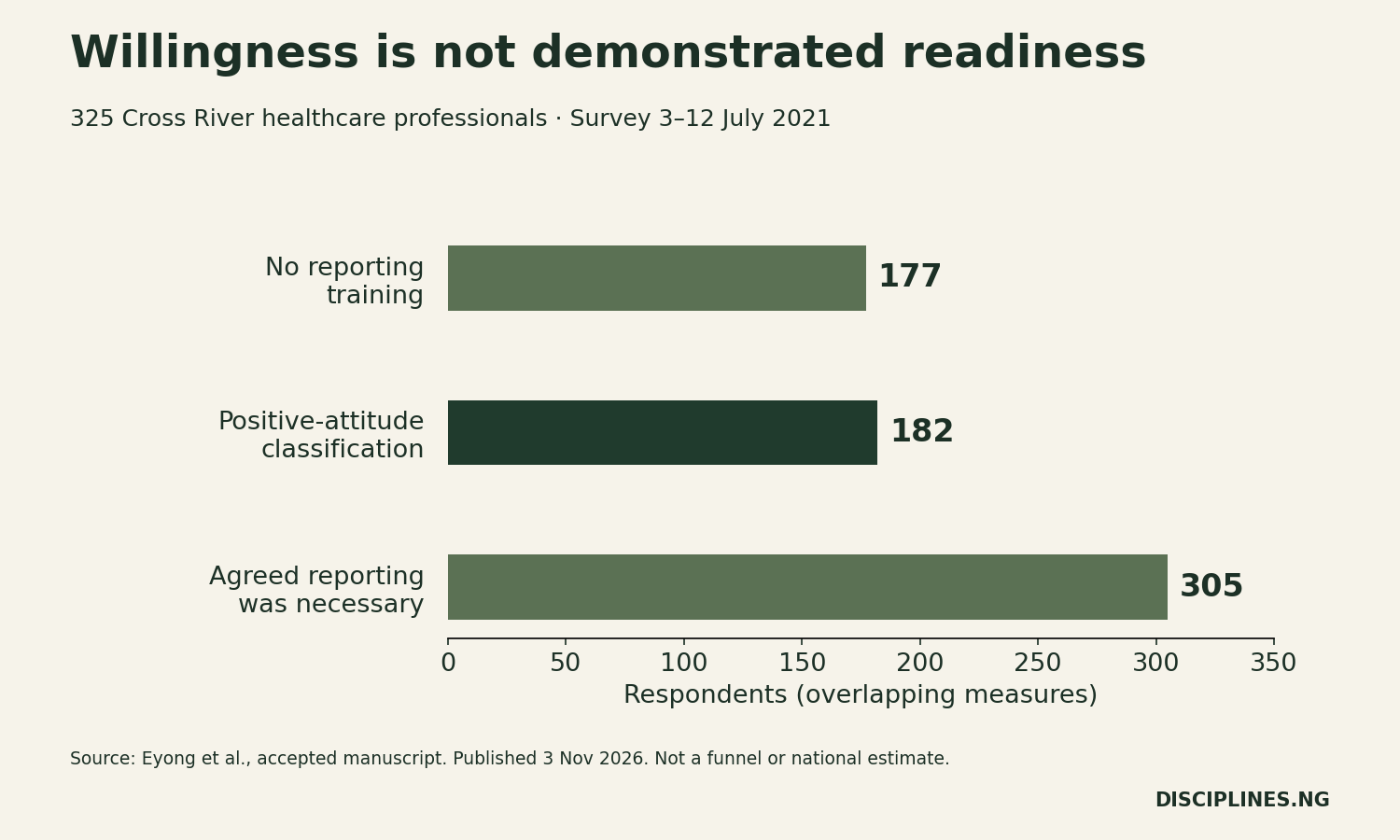
Among respondents, 177 reported no ADR-reporting training, 182 met the study's positive-attitude classification and 305 agreed reporting was necessary. These measures overlap. They are not sequential stages or a count of people who completed a reporting task. Check the accepted manuscript's methods and tables.
The paper reports uncertainty about an ADR as 267 respondents and 83.2%. However, 267 ÷ 325 × 100 = 82.15%. The item denominator remains unresolved here; we do not invent missing responses to explain it.
Keep attitudes and demonstrated readiness separate
Agreeing that reporting matters is a useful response to an attitude question. Demonstrating a workflow is a different educational outcome. A learner might endorse a process but struggle to find the current official source. Another might locate the source but miss a required documentation field.
Neither example is a finding about the survey participants. These are possible classroom tasks that an instructor could examine. Keep the proposed exercise separate from the published observations.
The historical survey also cannot establish today's level of access or today's distribution of barriers. Before teaching a reporting route, check the official source again. Record the retrieval date and any access problem rather than assuming that an older screenshot still matches.
Use official guidance for ADR reporting training in Nigeria
NAFDAC's pharmacovigilance FAQ requests reports of suspected drug-related problems. It identifies the ADR form, Med Safety App and the website's e-reporting route. Its listed information includes the patient details requested on the form, the reaction and its start date, the suspected medicine and relevant dates, and the reporter. Check NAFDAC's own FAQ.
That distinction matters for education: a suspected association is not a proven causal finding. Students should learn the official reporting guidance under appropriate supervision, rather than invent a requirement to prove causation first.
NAFDAC also announced an improved Med Safety App on 2 June 2026. That release is background guidance, not this week's news. An announcement does not prove that every learner can access a route on a particular device. Read the official app announcement.
A safe classroom documentation exercise
Our fictional exercise contains an invented product label, an invented event and deliberately missing fields. It is not a clinical case, a medicine safety signal or a model report for submission. There are no real patient records or actual medicine names in the file.
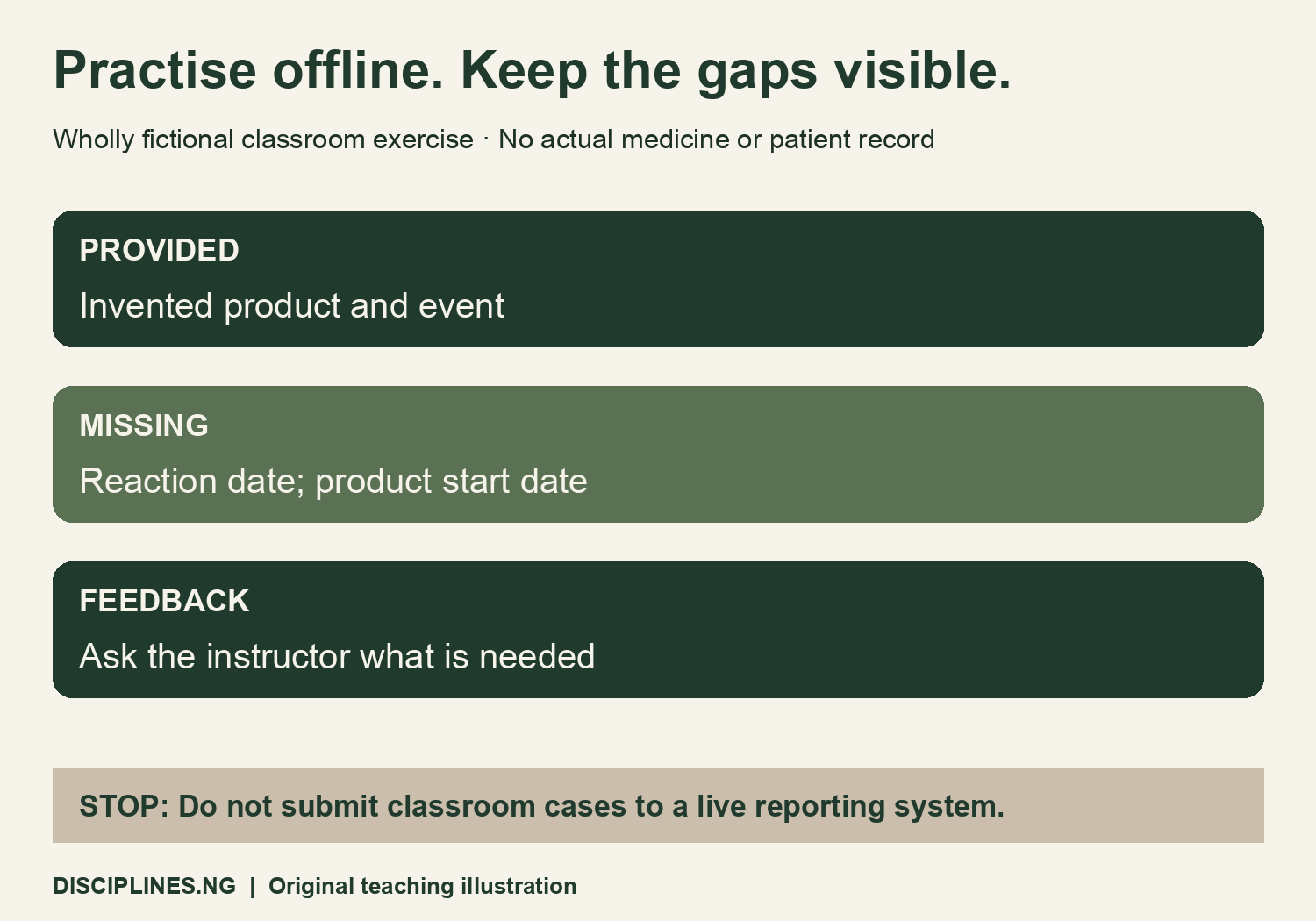
An instructor can ask learners to label each field as provided, missing or unclear. The next task is to identify which official source would explain the documentation requirement. Learners should state what they would ask a supervisor rather than fill gaps with assumptions.
For example, the fictional record omits a reaction start date. The correct educational response is to flag the missing date. Guessing a date would hide the very gap the exercise aims to reveal.
Use only approved teaching materials in the classroom. Keep identifiable patient information out of public worksheets, class screenshots and social posts. Real reporting decisions belong within the relevant professional and institutional process.
Define an ADR reporting training audit in Nigeria
The blank checklist provides space for locally recorded observations. It does not claim that an intervention has already improved reporting or patient outcomes. An instructor can adapt the following tasks and record the assessment rules before the session.
- Locate the official source and record its URL and retrieval date.
- Identify the relevant route without sending a test report.
- Explain which documentation fields need clarification.
- Distinguish suspected association from a confirmed causal conclusion.
- Explain the local supervision or escalation process.
- Record feedback and an unresolved question for follow-up.
If comparing work before and after a session, use consistent task definitions. Record who completed each assessment and which fields were not assessed. A classroom improvement on those tasks would still require a separate evaluation before claiming better real-world reporting or clinical outcomes.
Audit denominators before repeating barrier percentages
Our denominator ledger preserves the reported count and percentage alongside the total sample. It labels the 267/325 calculation as an arithmetic check using the total, not a corrected estimate of the item's true percentage.
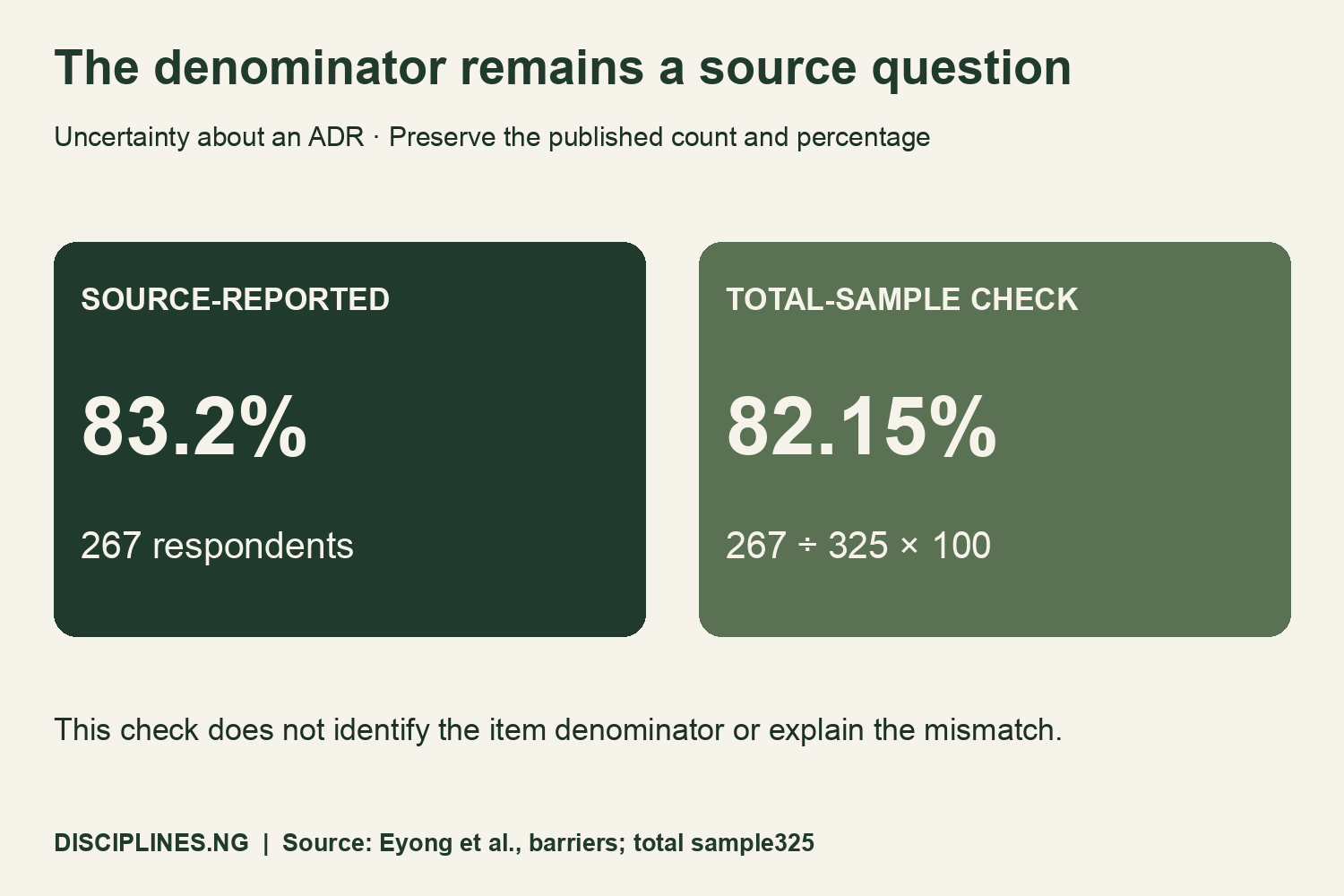
Do not replace the source's number silently in a lecture slide. Instead, show which denominator you used and state what remains unresolved. This makes the calculation checkable without pretending that arithmetic alone explains the original reporting process.
For another example of keeping a claim within its evidence, see our ICT correlation appraisal. Our surveillance-data guide also separates measures with different meanings.
Download the four educational resources
Survey counts and denominator ledger (CSV)
Blank reporting-readiness checklist (CSV)
Wholly fictional offline documentation exercise (CSV)
Blank classroom assessment log (CSV)
The fictional file is clearly labelled in every row. The assessment log contains blank outcomes, not student results. Retain those labels when adapting the resources. Cite the original study for its survey findings and Disciplines In Nigeria for these original teaching tools.
Methods and limits
We checked the accepted manuscript, transcribed the selected aggregate counts and recalculated the stated count against the total sample. We checked the official guidance separately. All charts and the explanatory illustration are original; no publisher figure, questionnaire or patient record was reproduced.
Convenience recruitment and concentration in one teaching hospital limit generalisation. The early manuscript may receive edits. We have not conducted a training intervention or measured clinical effectiveness. ADR reporting training in Nigeria should therefore use these tools to define an answerable educational task, with professional supervision and current official guidance.


