






Reading a soil amendment experiment in Nigeria starts with timing, experimental units and outcome definitions. An early chemistry result cannot be labelled a response to an input applied later. Similarly, more collected soil cores do not automatically mean more independent treatment replications. This guide provides original explanatory figures and four CSV audit tools.
Evidence checked: 5 November 2026. The article examines a published experiment, not a fertilizer recommendation. It does not establish harvest-yield superiority, profit or application rates for another farm.
What this soil amendment experiment in Nigeria measured
Akinnagbe and colleagues published the study on 30 October 2026. It covers September–December 2025 at one Akure site. A 3 × 3 split-plot design with three blocks produced 27 plots. At each soil-sampling time, 243 cores became 27 composite samples. Read the primary paper.
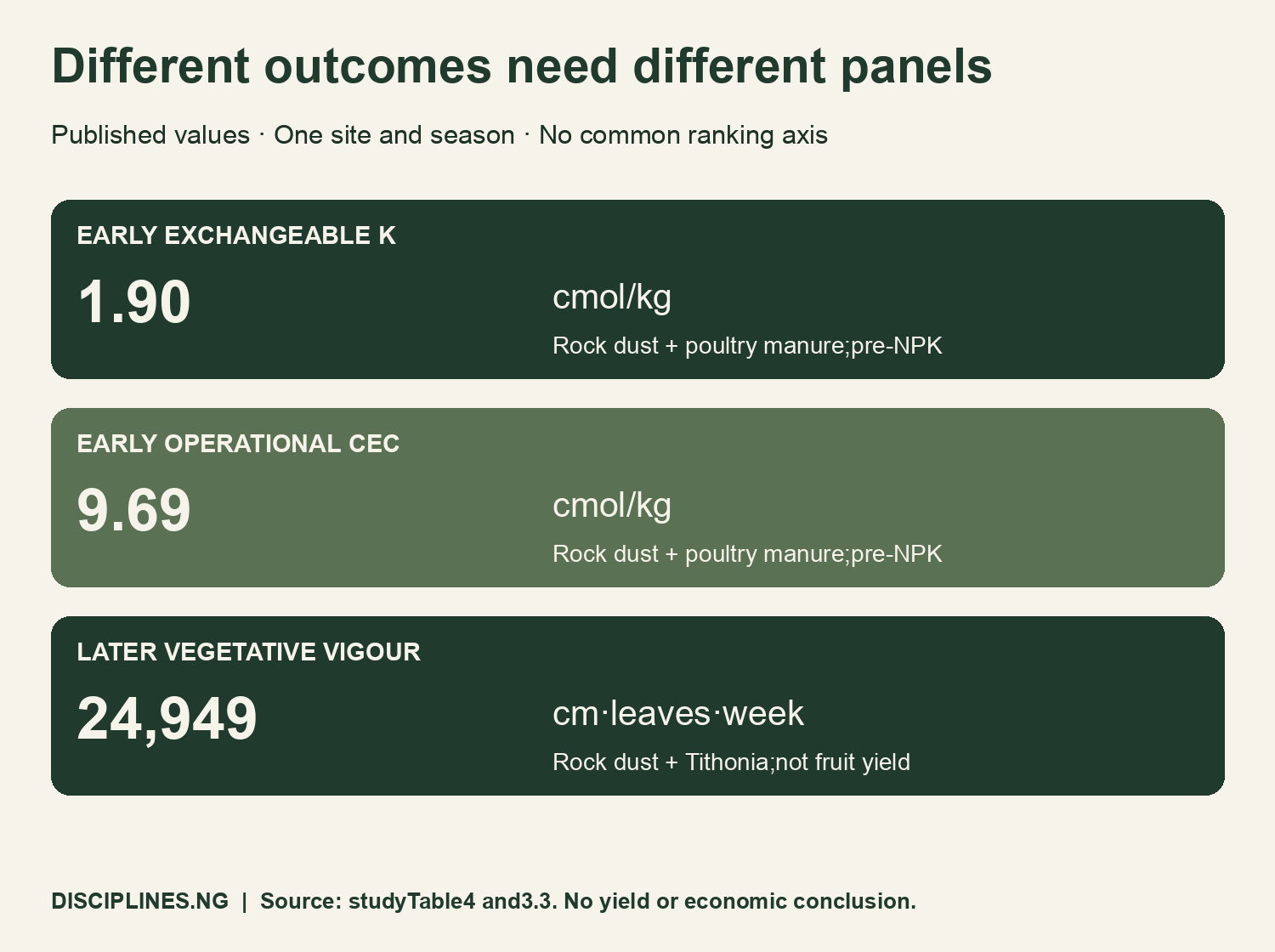
Early sampling occurred 14 days after amendments, before sowing and NPK application. Rock dust plus poultry manure recorded exchangeable K of 1.90 cmol/kg and operational CEC of 9.69 cmol/kg. Rock dust plus Tithonia recorded the highest cumulative vegetative-vigour index, 24,949 cm·leaves·week.
Early K and the baseline-referenced acidity index had weak exploratory associations with later growth: R² 0.039, p 0.323; and R² 0.057, p 0.230. These are not validated predictive models or fruit-yield results. Check the paper's methods and results before reusing any value.
Read the treatment clock before the labels
The methods place baseline sampling before amendments. Early soil sampling followed at two weeks after amendment application, immediately before sowing. NPK followed at two weeks after planting, equivalent to four weeks after amendment application. Later plant observations covered two to twelve weeks after planting.
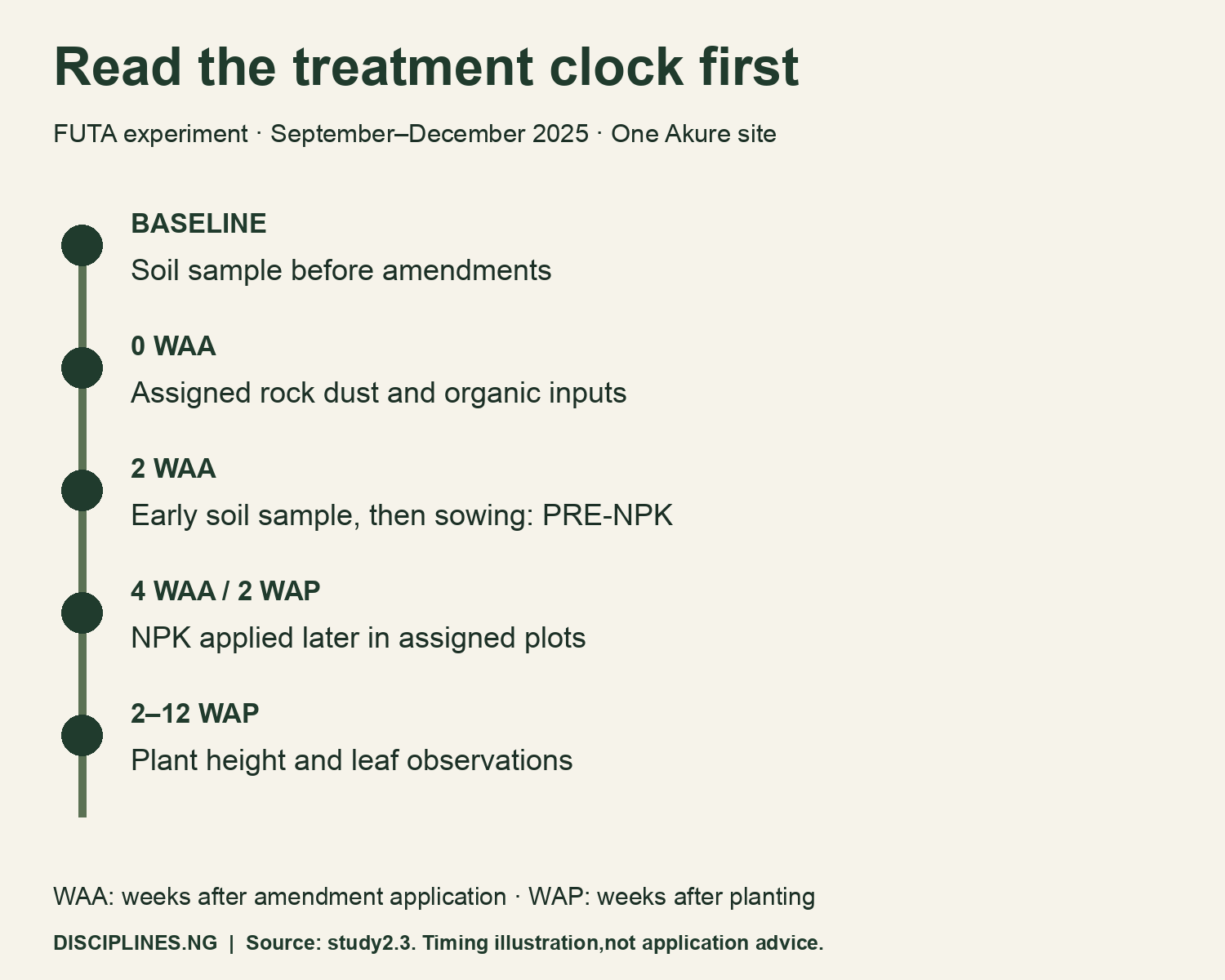
The label assigned to a plot does not tell you which inputs were present on every measurement date. A spreadsheet may retain the later treatment name to preserve the design. Read the exposure date before interpreting an early value as an effect of that treatment.
For your own project, add separate columns for assignment, actual application and measurement date. Record a missed or delayed application rather than silently treating the planned schedule as completed. That distinction can change the question a dataset can answer.
Count plots and preserve the split-plot hierarchy
The paper identifies fertilizer designation as the main-plot factor and organic amendment as the subplot factor. Randomisation occurs at those different levels. Nine cores from each plot were combined into one representative soil sample at each sampling time.
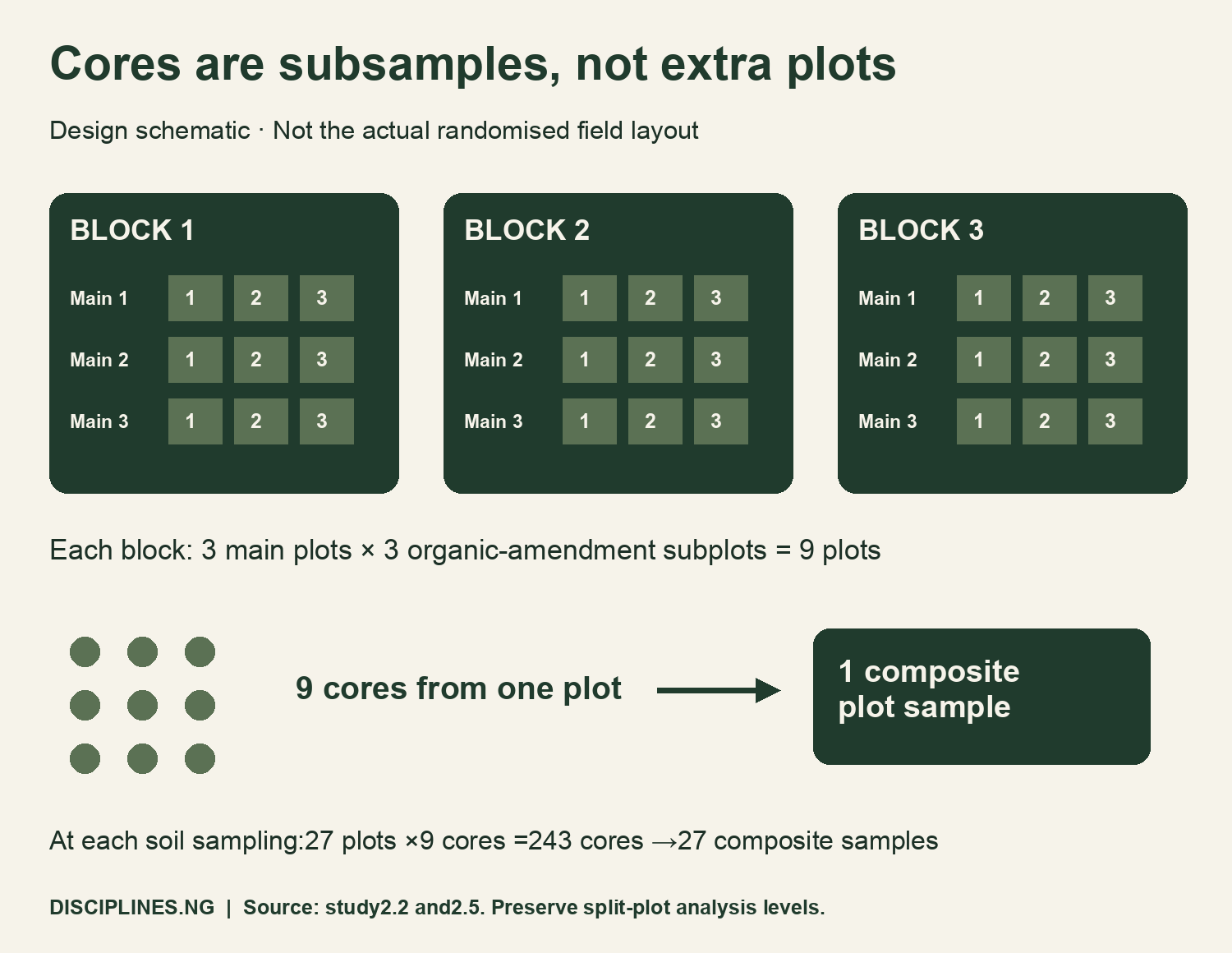
For example, collecting nine cores from one plot does not recreate nine plots exposed independently to the treatment. Keeping the plot identifier attached to the composite sample helps preserve that distinction during data entry.
Repeated sampling also needs a time identifier. A baseline and an early sample from the same plot should not lose their relationship when files are joined. Preserve the design and discuss the analysis with a supervisor before choosing a model.
Our blank sampling log is a planning aid. It contains no reconstructed observations from the paper. A public aggregate number is not enough to recreate the original plot-level dataset.
Separate early chemistry from later vegetative response
The chemical measurements and the cumulative growth index answer different questions. Their units, timings and treatment combinations should remain visible. A large number in one unit cannot be ranked against a smaller number in another.
| Reported measure | Combination | Timing | Value |
|---|---|---|---|
| Exchangeable K | Rock dust + poultry manure | Early, pre-NPK | 1.90 cmol/kg |
| Operational CEC | Rock dust + poultry manure | Early, pre-NPK | 9.69 cmol/kg |
| Cumulative vegetative vigour | Rock dust + Tithonia | Later plant observations | 24,949 cm·leaves·week |
The growth index integrates plant height and leaf number over time. It is not a harvest measure. To answer a yield question, a future project would need an explicit harvest outcome and a suitable analysis of that outcome.
Likewise, an economic claim requires its own evidence: a defined cost boundary, prices, output and relevant uncertainty. We have not collected those inputs. The blank harvest-yield field in the claim worksheet remains empty deliberately.
Weak associations do not settle every biological question
The exploratory regressions relate early plot-level conditions to later growth. They do not isolate an NPK effect or demonstrate that an early indicator will predict outcomes elsewhere.
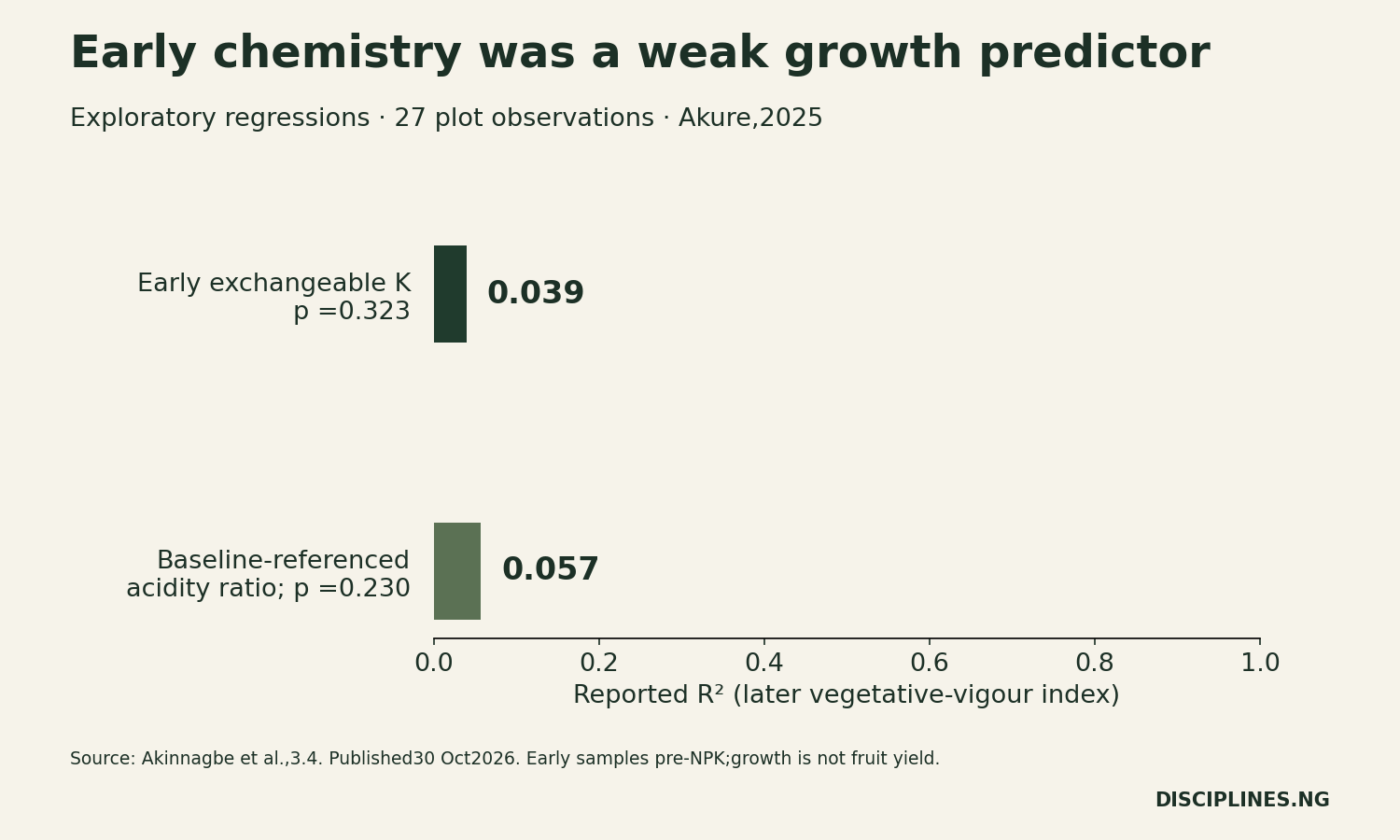
A non-significant result is not proof that a relationship never matters. Conversely, a plausible mechanism does not turn a weak relationship into a reliable prediction. Keep the conclusion tied to the tested conditions and measured outcome.
For a related appraisal method, our ICT correlation guide separates association from intervention effects. Our soil-data coverage guide addresses a different issue: the scale and coverage of mapped datasets.
Audit a soil amendment experiment in Nigeria
Before writing a result sentence, complete these checks using the blank claim-audit template:
- State the proposed outcome and its unit.
- Record when the treatment was actually present.
- Match the measurement date to that exposure.
- Identify the experimental unit and its design level.
- Keep subsamples and repeated measurements identifiable.
- Name the additional measurement needed for a stronger claim.
For example, “higher early exchangeable K” and “higher harvest yield” require different observations. A useful audit makes that gap visible before the headline is written. It also makes the next study easier to plan.
Download the timing and sampling tools
Treatment and measurement clock (CSV)
Published measure register with units and timing (CSV)
Blank claim audit, including an unfilled harvest-yield field (CSV)
Blank split-plot sampling log (CSV)
The first two files contain a documented timeline and selected published aggregate measures. The latter two are original blank resources, not new experimental results. Keep source, unit and timing columns when reusing the extract.
Methods, limitations and citation
We checked the full primary methods and results, transcribed the selected measures and verified the arithmetic linking cores, composites and plots. Direct primary text was accessible during this review. We did not reanalyse raw observations or reproduce publisher figures.
One site and season cannot establish a general recommendation across Nigerian soils. The source did not test fruit-yield superiority or economic performance. Cite Akinnagbe and colleagues for the original experiment and Disciplines In Nigeria for these independent explanatory figures and audit tools.
The practical task is to align the claim with the treatment clock and the measured outcome. Preserve that alignment from field notes to charts, tables and the final sentence.


