



Exam script vetting allocation in Nigeria needs an eligibility check before a fairness score. Imagine three lecturers receiving 30 scripts each. The counts look balanced. However, equality is only one test. Yet if one lecturer receives their own taught course, the roster still fails an independence rule. A scheduling prototype must expose that problem before celebrating equal workloads.
A 19 November 2026 Frontiers in Education paper by Osofuye and colleagues models this task in the Covenant University context. Its evidence comes from synthetic benchmarks, not live student scripts. We examine the model’s rules, redraw its published ranges and provide fictional audit tools for coordinators and education-technology researchers.
What exam script vetting allocation in Nigeria must separate
Vetting follows marking and precedes ratification in the institutional process described by the authors. The vetter checks marking coverage, addition, transcription and consistency with the marking scheme. This is a review of marked work, rather than a fresh marking exercise or an examination timetable.
The allocation unit is an envelope containing one course-programme combination. The model assigns each envelope to one lecturer. It excludes a lecturer’s own taught course, respects capacity and prevents one vetter from receiving two programme cohorts of the same course. These are the paper’s modelled rules, not a claim that every Nigerian university uses an identical policy.
Exam script vetting allocation: an equal roster can be ineligible
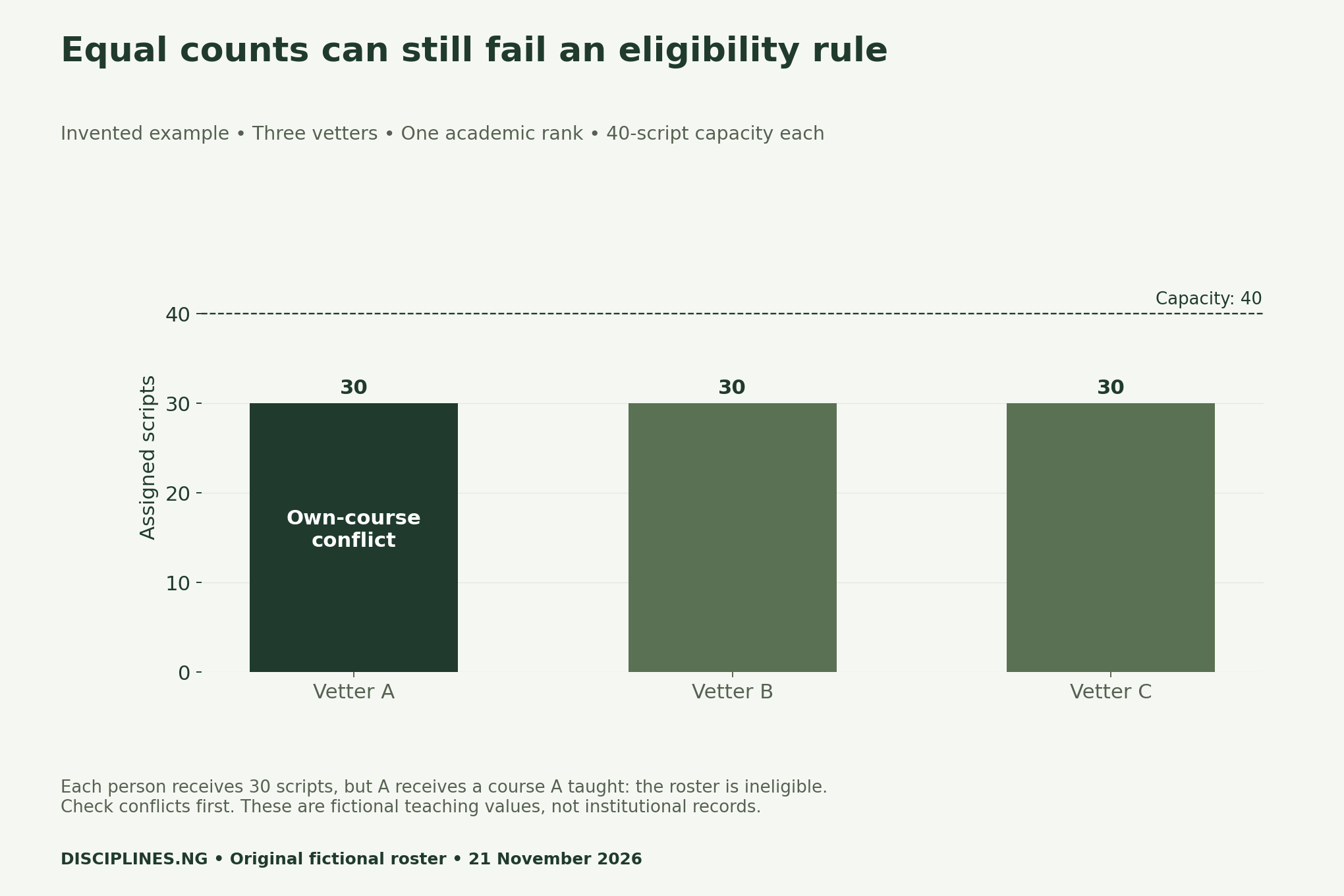
Our first invented roster contains three envelopes of 30 scripts. Vetter A receives course X, which A taught. Vetters B and C have no own-course conflict. Each workload is below a fictional capacity of 40, and each envelope is covered once. Nevertheless, the own-course conflict makes this roster ineligible under the stated rule.
The downloadable second roster swaps the X and Y envelopes between A and B while leaving C’s assignment unchanged. In this deliberately simple example, the swap clears the listed conflicts and retains equal counts. It is not a general algorithm or proof that a feasible solution exists for a larger department. Additional local rules may change the answer.
Read the simulation evidence without inventing five paired results
The medium benchmark, DS2, contains 15 lecturers, 12 courses, 25 envelopes and 1,535 scripts. Table 6 summarises five independently generated instances using ranges. CALBMA’s reported within-rank workload variance spans 1.0000–13.8056; the greedy comparator spans 153.6597–352.1389. Lower values indicate closer workloads within academic ranks. However, that metric does not measure independence.
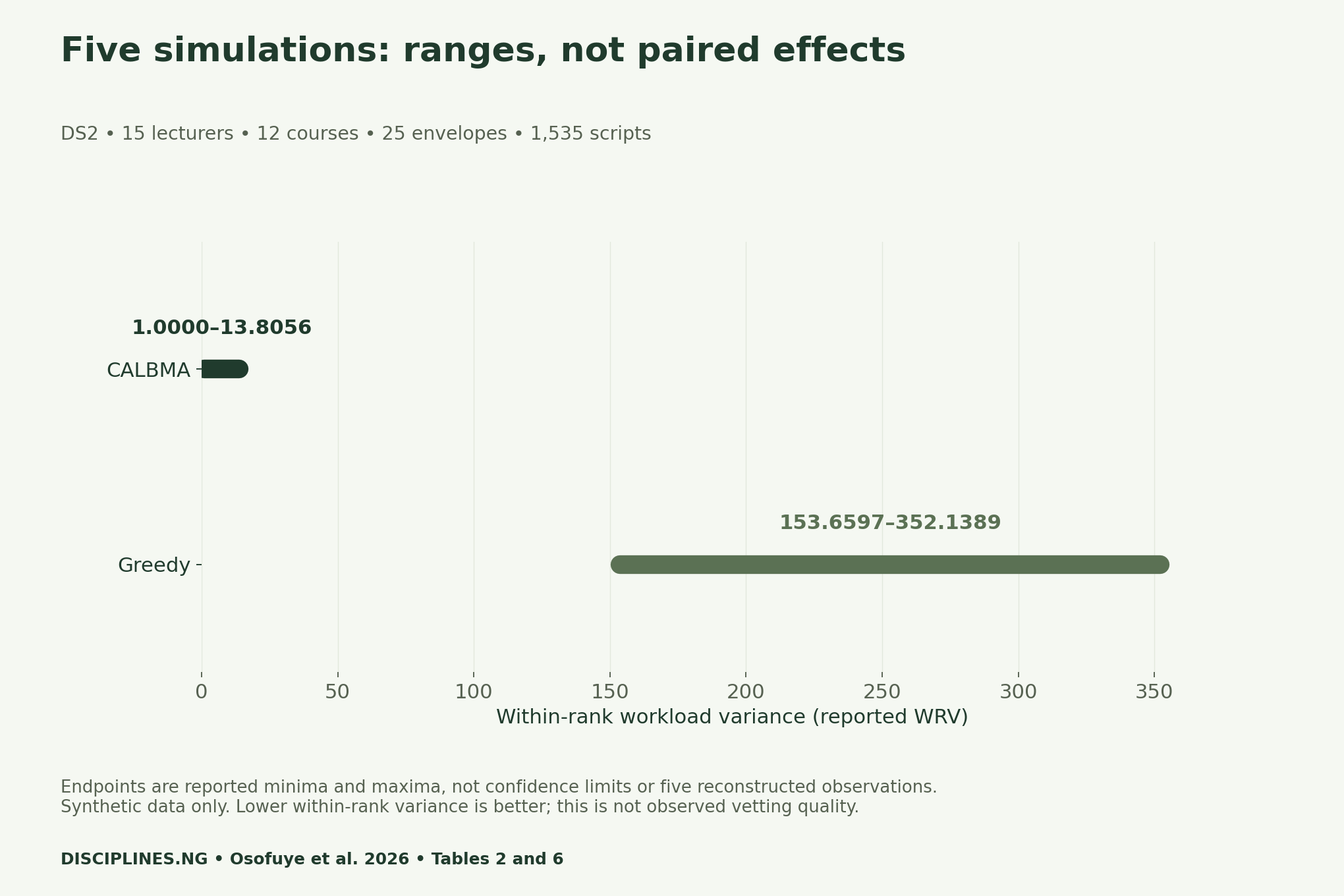
The table does not disclose the five paired values needed for a matched-instance chart. Therefore, we show the two ranges and preserve their status in the CSV. A range endpoint from one algorithm cannot automatically be matched to an endpoint from the other. Nor does a lower variance show that staff were happier or that more marking errors were found.
Source sections also report different representative-run summaries. For example, the narrative near Table 3 discusses 7.56 versus 156.41, while its displayed DS2 row gives 2.50 versus 86.11. We do not combine those figures or headline a fold reduction. Our study chart is confined to the explicitly labelled Table 6 ranges. We also omit the paper’s inferential effect statistic rather than imply that we independently verified it.
Use a gate before scoring workload balance
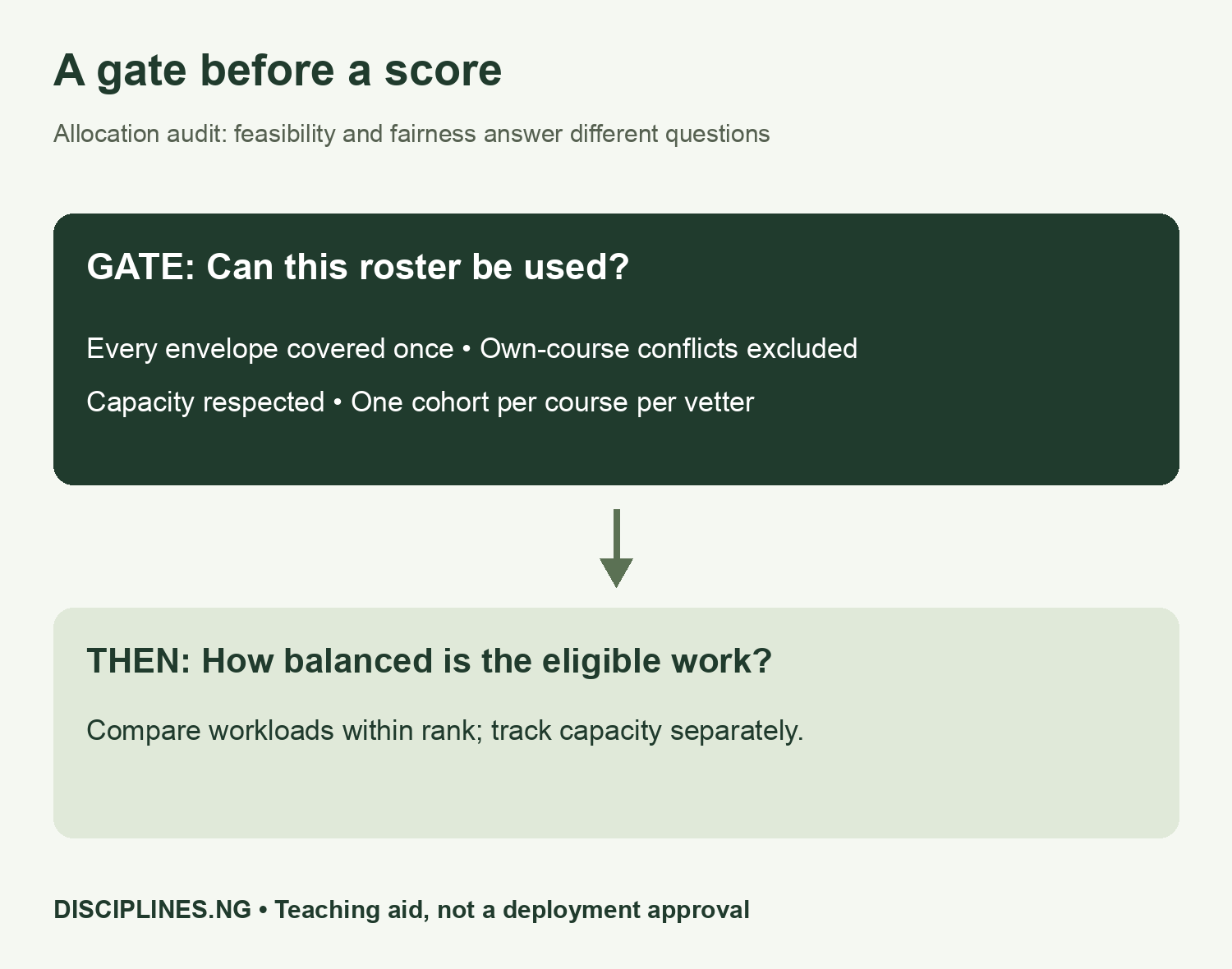
Start with a complete envelope register. Check that every course-programme unit appears once and has exactly one named reviewer. Record who taught the course before checking the proposed vetter. Next, test each person’s capacity and the restriction on multiple cohorts of the same course. A documented override reason is an audit field, not permission to waive a mandatory rule.
Only then compare eligible workloads. The paper optimises variance within academic rank, rather than demanding identical counts across all ranks. Capacity is a separate upper limit. Record the institutional policy and rank definitions explicitly; do not import the study’s configurable weights as a national standard. A fairness metric cannot settle an unresolved workload policy.
Define the missing requirements before a supervised pilot
The authors also identify important boundaries. Subject-matter qualification, co-teaching conflicts and temporal availability are outside the current model. The researchers used synthetic evaluation datasets only, and the web prototype lacks enterprise-grade security. The linear solver exercise did not establish the exact quadratic optimum. Therefore, a demonstration is a research starting point, not a production approval.
A campus team would need its own governance, access controls, retention rules, acceptance tests and authorised data arrangements before any real-record pilot. Use fictional envelopes while developing requirements. Do not upload student scripts, marks, names or credentials to a public demonstration service simply because a journal article links to it.
The useful next question is specific: does a candidate roster meet the local rules, and how balanced is its feasible work? A later evaluation could examine review quality and coordinator experience separately. Those outcomes require evidence of their own. They cannot be read from a simulated workload-variance chart.
Methods, sources and reusable audit downloads
We transcribed DS2 configuration from Table 2 and ranges from Table 6 of the primary paper, checked on 21 November 2026. We did not reconstruct raw benchmark instances. The three-vetter examples use original fictional teaching data. We retain the same scripts, capacities and course definitions across both rosters. The blank audit is a planning aid, not a validated allocation system.
For broader educational context, browse Education and the Research & Reports archive. Our guide to teacher education programme requirements addresses a different stage of educational preparation.
- Published simulation ranges and configuration (CSV)
- Two fictional allocation rosters (CSV)
- Blank allocation audit worksheet (CSV)
- Measure and interpretation dictionary (CSV)
Source credit: Osofuye OD, Adeoba AJ, Oladipupo OO and Oyelade JO, 2026, DOI 10.3389/feduc.2026.1930149, licensed CC BY. Disciplines In Nigeria redrew the figures and added the teaching examples. Suggested citation: “Exam Script Vetting Allocation in Nigeria: Check Conflicts First”, 21 November 2026.


