





Training cohort completion rate evaluation in Nigeria should start with a reconciled ledger, not a league table. A completion percentage answers a narrow question: how many people met a stated rule within a defined cohort and reporting period? It cannot repair uncertain participant identities or establish why outcomes differ.
The ALAMIME evaluation published on 16 November 2026 provides a useful exercise. Table 4 describes its 2024 cohort: 259 enrolments and 230 completions. The three Nigerian university rows total 75 and 73 respectively. However, the study is descriptive and non-comparative, and one subgroup needs clarification.
Training cohort completion rate evaluation in Nigeria: define the denominator
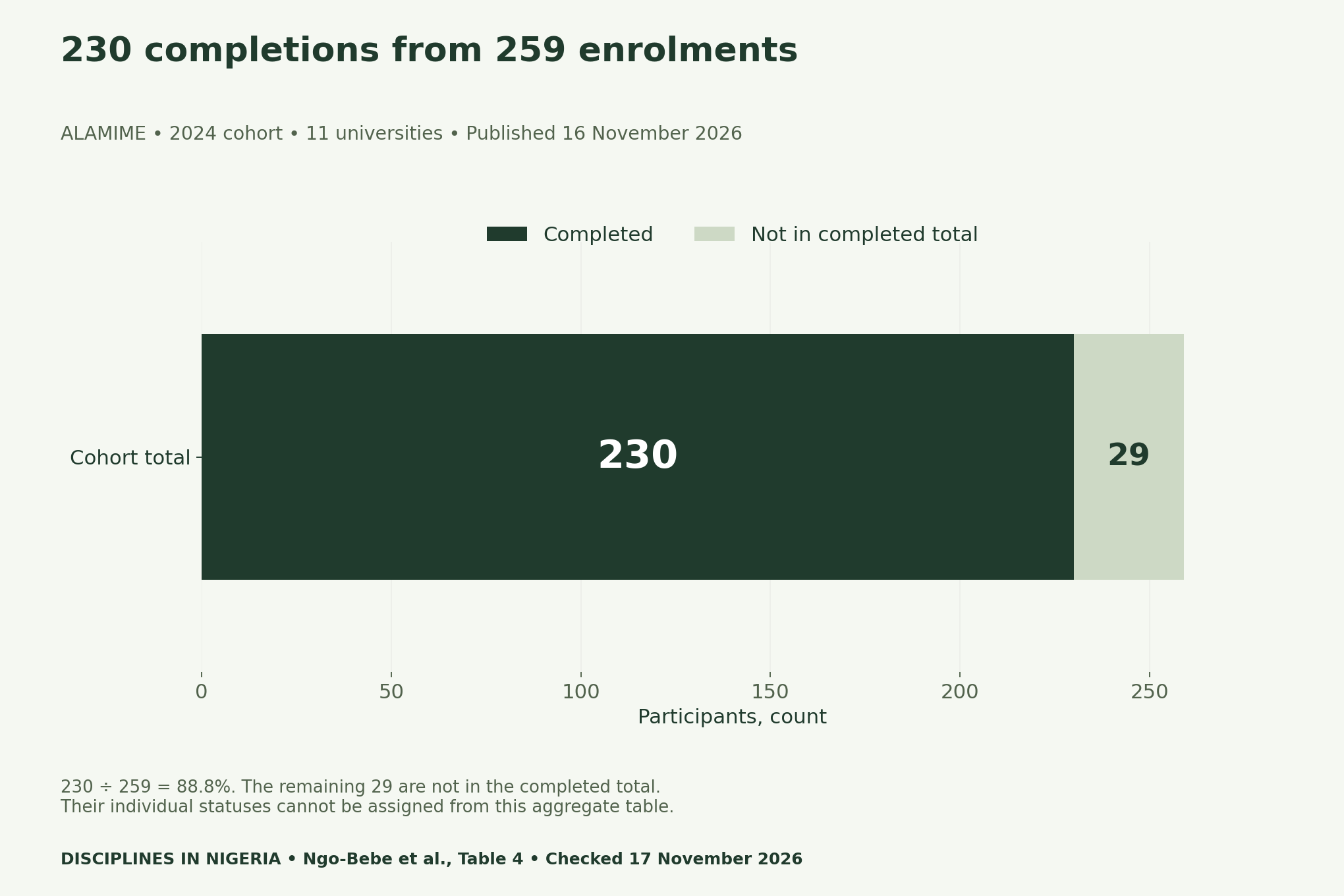
Write the cohort definition before calculating. Does enrolment mean accepting an offer, registering, attending the first session or meeting an administrative deadline? State the cut-off date and decide how transfers enter the ledger. Otherwise, two teams may use the same word for different populations.
Next define completion. The source links it to participation and required practicum work. A local evaluation still needs a dated rule and evidence for each person. Do not substitute attendance, satisfaction, a certificate request or a later survey response for the chosen endpoint.
Reproduce the Nigerian counts without ranking institutions
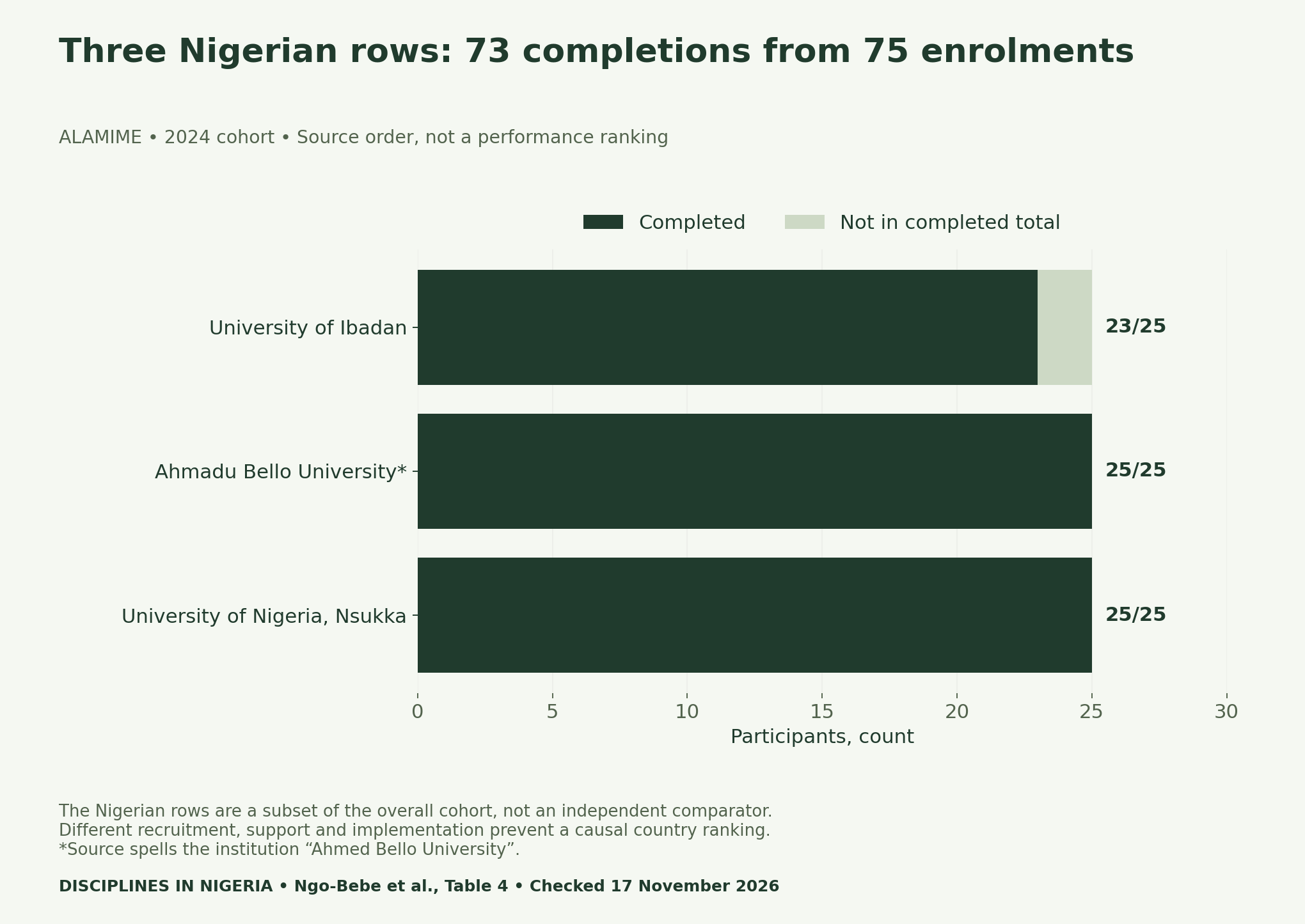
Keep counts beside percentages. A small denominator makes each person influential, and a rounded percentage can conceal that scale. Here, the sum uses the enrolled counts as weights. It is not an unweighted average of institutional rates and does not require a new country-level causal claim.
Nor does the difference from the overall percentage prove superior delivery. Recruitment, participant circumstances, support, assessment and implementation may differ. The source does not supply a controlled comparison. Preserve the table’s order instead of sorting it into a performance ranking that the design cannot justify.
A subgroup can fail even when the grand totals add up
The MUHAS row reports 11 female enrollees and 12 female completers. For a fixed subgroup in a closed cohort, completers should be traceable to its enrolled members. That apparent excess needs reconciliation. We retain both printed counts and do not invent a corrected value.
A total can balance while subgroup labels or transitions remain unclear. Possible questions concern data entry, changing classifications, transfers and the timing of membership. Those are questions for the underlying ledger or authors, not explanations established by this article. Avoid presenting 12/11 as a meaningful success rate.
Use two connected audits before calculating a rate
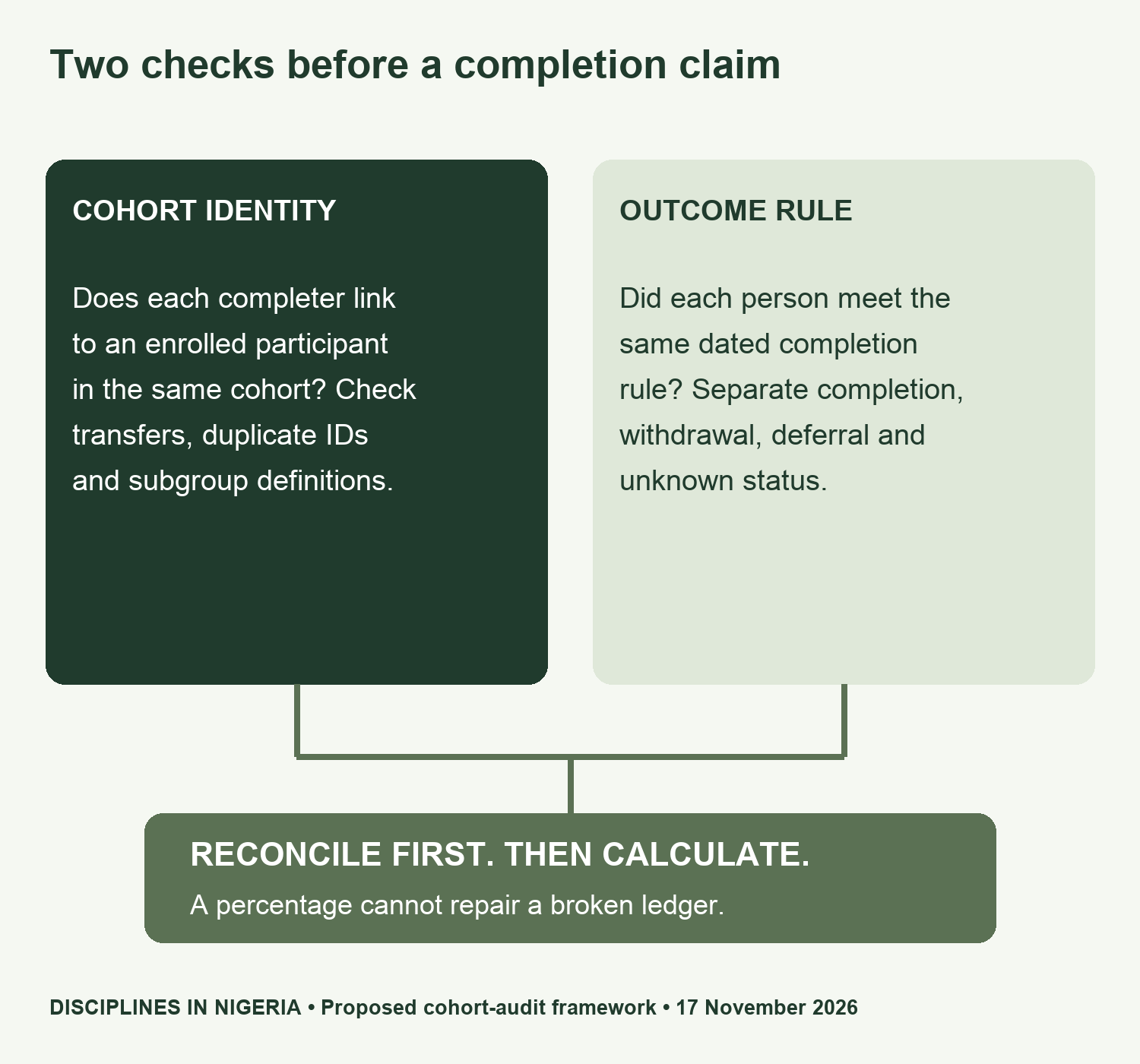
The identity audit asks whether each completion belongs to an enrolled person in the same reporting population. Use anonymous stable identifiers in an analytical file, retain an appropriate restricted crosswalk locally and check duplicate records. Aggregate charts should never expose a participant’s private details.
The outcome audit checks the evidence and rule version. Keep completion, withdrawal, deferral and unknown status separate. A blank status is not automatically a dropout. Record when a status changed so a later update does not silently rewrite the original reporting cut-off.
Separate completion from effectiveness and later impact
Completion is one endpoint. Learning, changes in workplace practice and population outcomes require their own measures, follow-up periods and denominators. A training programme may report several endpoints, but their coexistence does not make one a substitute for another or establish a causal chain.
For a fairer future comparison, specify recruitment criteria, starting conditions, delivery, support and assessment consistency before analysing results. Also report missingness and follow-up response. A statistical adjustment cannot recover information that the evaluation never collected; sometimes the defensible output is a descriptive account with limits.
A reusable ledger and a transparent discrepancy log
The blank status-transition CSV is a proposed structure for a new evaluation. It includes cohort ID, anonymous participant ID, dates, status, rule version and evidence reference. Adapt it to the programme’s governance requirements. It contains no participant records from ALAMIME and is not a validated evaluation instrument.
Maintain a discrepancy log alongside the ledger. Record the conflicting cells, source location, question, owner and resolution date. Preserve earlier versions when a correction arrives. For related denominator checks, see our guide to sampling units and repeated readings.
Method, limitations and four downloadable tools
We inspected the primary study and Table 4 on 17 November 2026. Our scripts reproduce the institutional sums, completion fractions and subgroup flag. The charts show counts rather than a ranking. Publication in 2026 does not turn the 2024 cohort into a current intake.
No participant-level ledger, author clarification or independent programme audit was available for this analysis. The female-subgroup discrepancy remains unresolved. The new tools support teaching and planning; neither the displayed completion fractions nor the proposed ledger demonstrates workplace effectiveness or malaria-control impact.
- Published institution-level cohort counts (CSV)
- Completion arithmetic and denominator notes (CSV)
- Blank training status-transition ledger (CSV)
- Reconciliation flags and comparison-readiness checks (CSV)
Suggested citation: Disciplines In Nigeria, “Training Completion Rates: Reconcile the Cohort Before Comparing Universities”, 17 November 2026. Source: Ngo-Bebe et al., DOI 10.3389/fpubh.2026.1903500, Table 4 and methods; new audit graphics and tools by this publication.


