





Chemical composition percentages and units in research in Nigeria need a measurement passport: what was measured, in which material, by which method, and relative to what denominator? A percentage sign alone does not make two findings compatible. Before calculating a comparison, establish the basis of each number.
A kenaf-core characterisation paper published on 13 November 2026 offers a useful reading exercise. It reports oleic acid at 44.74% GC-MS peak area. Separately, its mineral-figure caption combines mg/kg wording with percentage shares. We preserve those labels rather than translating them into an unsupported whole-biomass composition.
Chemical composition percentages and units in research in Nigeria: ask “of what?”
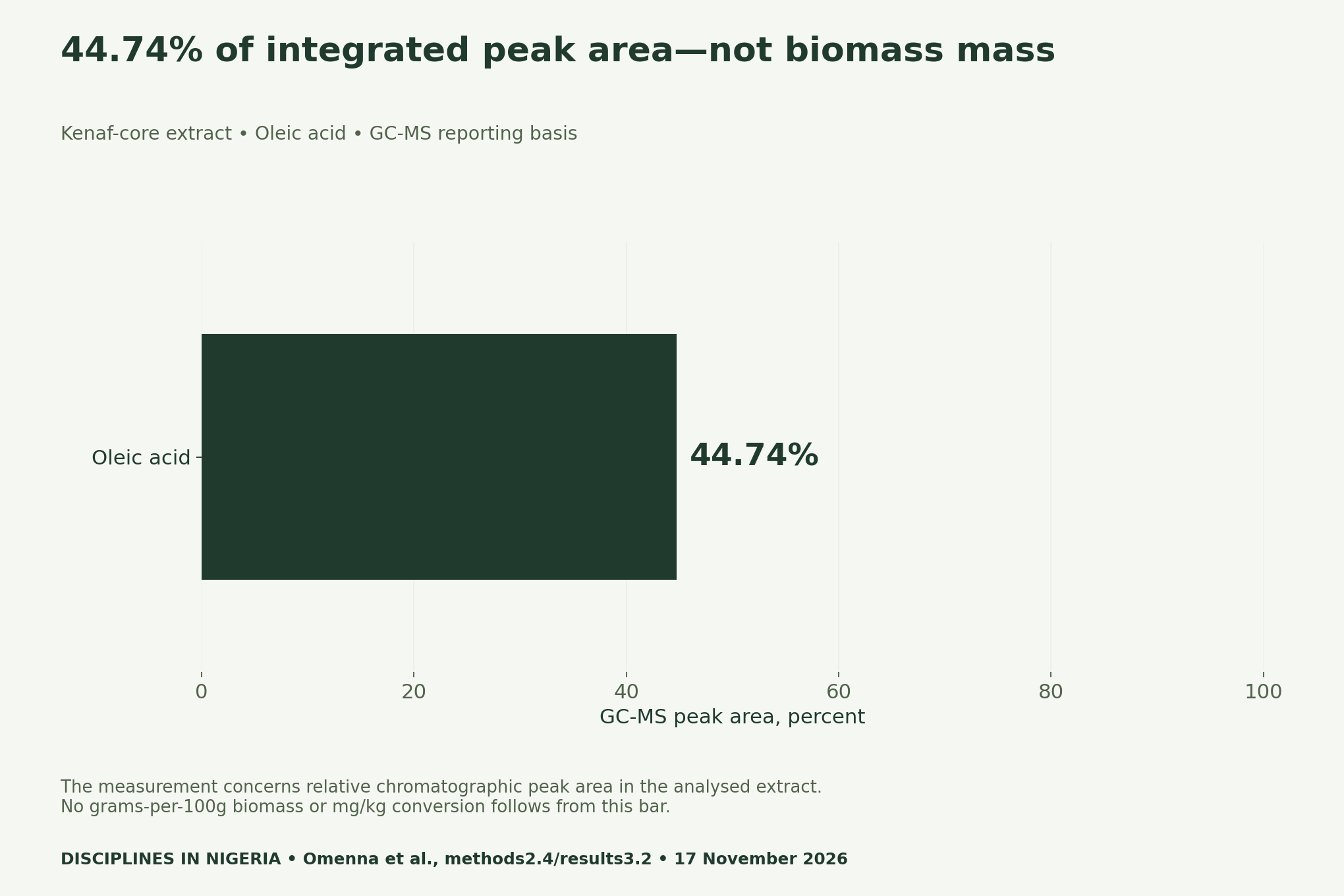
A mass fraction compares one mass with a defined total mass. A peak-area fraction compares a signal area with a defined total integrated area. Those are different numerators and denominators. Even if both display a percentage, the method has not made them interchangeable.
Likewise, mg/kg describes a mass concentration with a kilogram denominator. A conversion requires the relevant material basis and supporting information. Do not move a value from one unit column to another simply because the resulting number looks plausible. Keep the original field and document any justified transformation separately.
An arithmetic total does not resolve a label
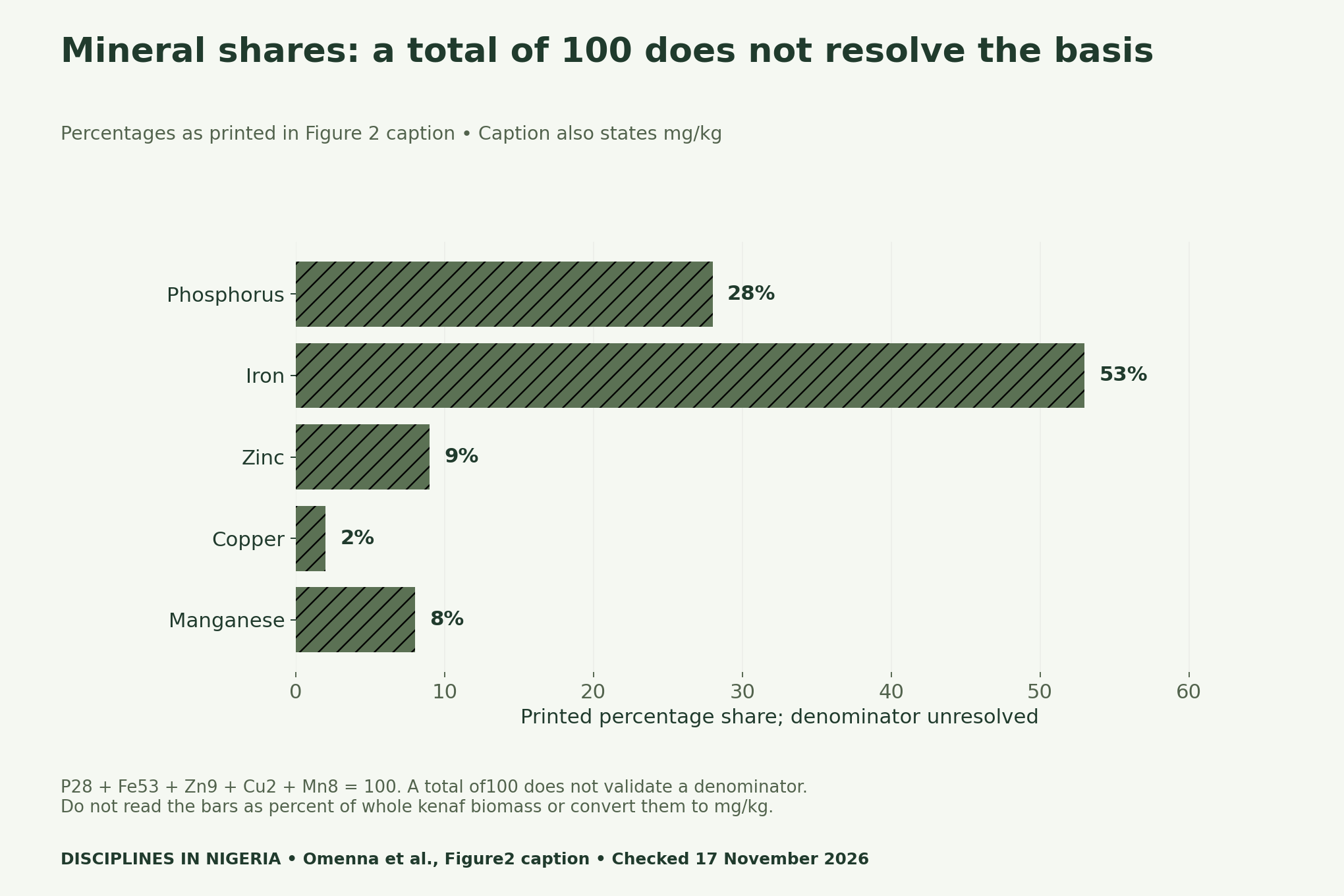
The five printed shares add to 100: 28 plus 53 plus nine plus two plus eight. That checks the addition only. It does not establish whether the denominator is a subset of detected elements, a reporting convention or something else. The article provides no author clarification resolving that basis.
Therefore, retain the caption wording and mark the question open. A literature review can report a value with an explicit limitation. It should not silently repair a label, assume a denominator or convert an unresolved share into a nutrition or formulation claim.
Use a compatibility decision tree before combining results
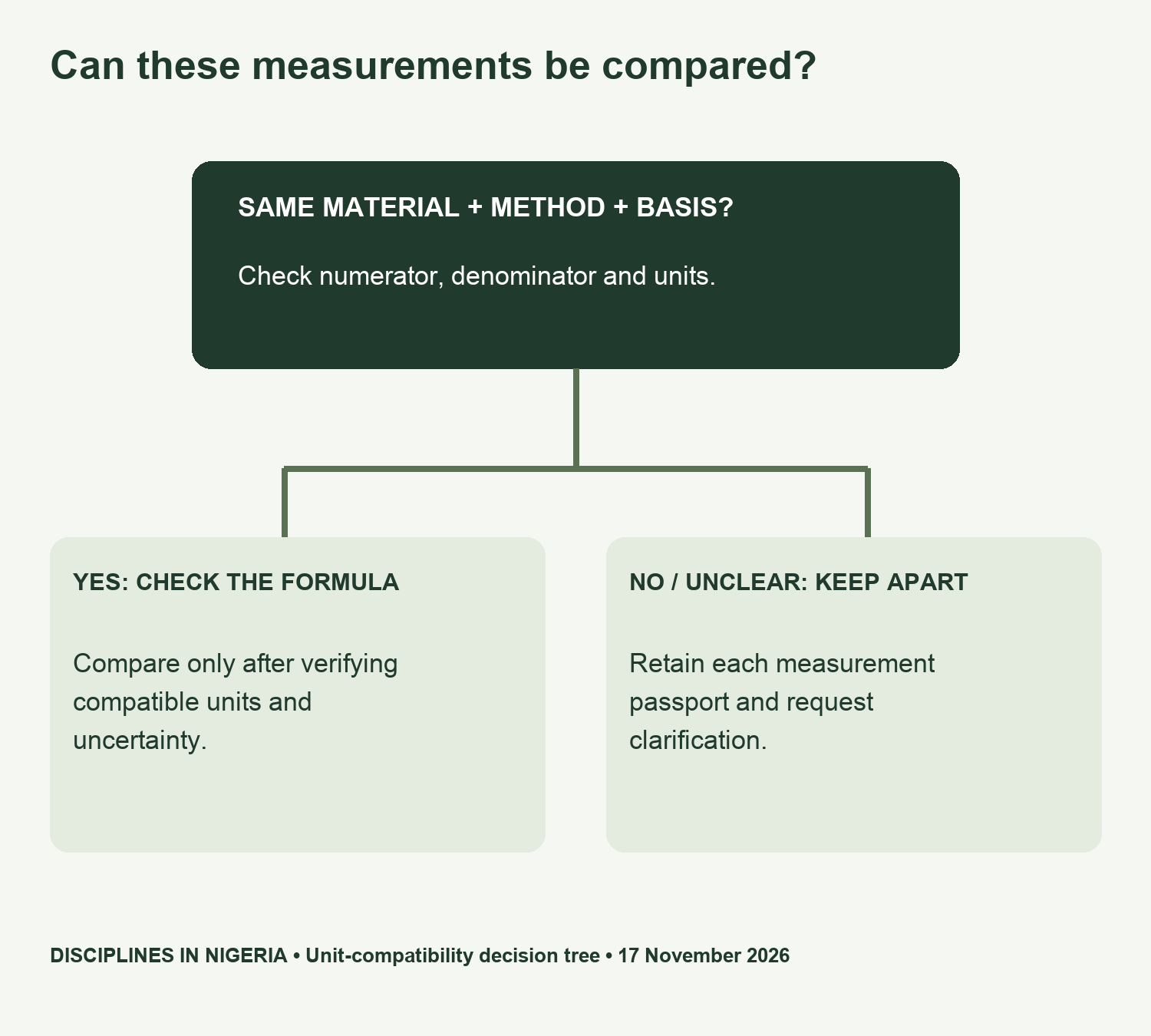
Start with the material. Whole core, ash, an extract and a prepared analytical portion are different objects. Next record the preparation and method. Finally, identify the numerator, denominator, unit and wet or dry basis. A shared plant name is insufficient evidence that all measurements refer to the same material.
If those fields match, check the proposed formula and uncertainty. If they do not match, keep the results in separate panels or table columns. That separation is a useful finding: it explains why a tempting comparison cannot yet support the intended conclusion.
Keep moisture and dry-matter questions explicit
Moisture and dry matter require particular care because the sample basis changes the denominator. The source’s proximate-method wording and composition discussion need to remain attached to the relevant quantities. We leave that interpretation open rather than supplying corrected values from an assumption.
For a new laboratory report, state which mass is the starting basis and which quantity a formula calculates. Keep preparation dates and the source equation alongside the result. Where a manuscript’s terminology remains unclear, place the question in the clarification register and limit subsequent calculations.
Composition is different from demonstrated performance
The paper discusses possible bioremediation relevance but identifies direct validation in contaminated soil as further work. Chemical characterisation and performance testing answer different questions. A promising profile does not by itself establish effectiveness, a field application rate or a safe formulation.
This article therefore supplies no nutritional recommendation, remediation recipe or corrected chemical composition. Its purpose is measurement literacy. A careful report can explain a hypothesis while making clear what experiment would be needed to test the proposed application.
Build a measurement passport for each claim
The blank passport separates analyte, material, preparation, method, numerator, denominator, unit and sample basis. Add the exact source location and clarification needed. This structure is useful when several techniques appear in one paper, because the labels remain attached as you write a synthesis.
For example, a GC-MS result and an elemental-analysis result can both be relevant without belonging in one ranked composition chart. Separate them and explain their different meanings. Our Sciences archive offers related context for students reading laboratory and research reports.
Method, limits and downloadable audit tools
We inspected the primary article’s method, results and figure captions on 17 November 2026. The new graphics show two separate reporting bases, not a combined composition. We checked the five-share sum and documented the unresolved denominator. No replication or author correspondence has occurred.
The source’s mineral percentages and moisture/dry-matter interpretation remain unresolved for reuse here. Do not infer missing concentrations or corrected values from the charts. The downloadable passports and question log are editorial teaching tools, requiring the relevant disciplinary checks before operational use.
- Source measurements with units and unresolved bases (CSV)
- Percentage arithmetic and conversion-limit audit (CSV)
- Blank chemical-measurement passport (CSV)
- Unresolved labels and clarification questions (CSV)
Suggested citation: Disciplines In Nigeria, “Reading Chemical Percentages: A Nigerian Kenaf Study’s Unit-Checking Lesson”, 17 November 2026. Primary source: Omenna et al., DOI 10.1007/s44340-026-00065-y; audit graphics and tools by this publication.


