



Introduction
Applied microbiology examines practical uses of microorganisms in various industries.
These applications support biotechnology, food production, and environmental conservation.
Microorganisms play crucial roles in these fields.
Success Stories in Nigerian Applied Microbiology
Nigerian applied microbiology includes notable advances in microbial pesticides for crop pest control.
These biopesticides offer eco-friendly options for farmers.
They reduce reliance on harmful chemicals.
Nigerian researchers also produce probiotics.
These beneficial microorganisms improve gut health and boost immunity.
Consequently, they contribute to overall wellness.
Nigerian scientists have also advanced bioremediation.
They use microorganisms to clean oil spills and other environmental pollutants.
This sustainable approach helps protect ecosystems and human health.
Furthermore, pharmaceutical microbiology has advanced in Nigeria.
Researchers have developed novel antibiotics and vaccines.
These products help tackle infectious diseases and save lives in the country.
Nigerian applied microbiologists continue to drive innovation across various industries.
Their research and discoveries address real-world challenges.
These achievements inspire budding scientists.
The Role of Nigerian Microbiologists in Healthcare
- Nigerian microbiologists improve healthcare through research and innovation.
- They actively develop vaccines and treatments for various diseases.
- Additionally, they contribute significantly to disease prevention and control efforts nationwide.
Success Stories of Nigerian Microbiologists in Healthcare
- Dr. Adebayo developed a groundbreaking malaria vaccine that reduced the mortality rate.
- Professor Ibrahim discovered an antibiotic effective against drug-resistant bacteria through his research.
- Moreover, Dr. Fatima improved sanitation practices and reduced infectious disease transmission.
Impact of Nigerian Microbiologists on Disease Prevention and Control
- Nigerian microbiologists helped control outbreaks of Ebola and Lassa fever.
- Their research produced rapid diagnostic tests that support earlier disease detection and treatment.
- Through public health education, they increased awareness about hygiene and vaccination.
These contributions have saved lives, improved health outcomes, and advanced microbiology in Nigeria.
Innovations by Nigerian Microbiologists in Increasing Crop Yield
Nigerian microbiologists have advanced agriculture by developing solutions that increase crop yield.
Through research and experimentation, they identify beneficial microbial strains that promote plant growth.
These strains can improve overall crop productivity.
For example, microbial inoculants enhance nutrient uptake in plants.
By introducing specific bacteria and fungi into soil, researchers improve essential nutrient availability.
Consequently, crops produce higher yields and better quality produce.
Success Stories of Nigerian Microbiologists Enhancing Soil Fertility
Nigerian microbiologists also enhance soil fertility to sustain agricultural productivity.
They develop biofertilizers and soil amendments that restore soil health.
These approaches promote sustainable farming practices.
Notably, microbial biofertilizers replenish soil with beneficial microorganisms.
Some of these microorganisms fix nitrogen and improve soil structure.
As a result, farmers can reduce reliance on chemical fertilizers.
This approach also supports cost savings and environmentally friendly agricultural practices.
Use of Microbiology in Food Safety and Security in Nigeria
Nigerian microbiologists also support food safety and security through microbiological techniques.
They study foodborne pathogens and develop methods for detecting microbes.
These efforts help prevent foodborne illnesses and protect food quality.
Furthermore, food processing facilities can implement microbial testing protocols.
These protocols monitor and control harmful bacteria in food products.
This proactive approach has significantly reduced foodborne outbreaks in Nigeria.
Therefore, it safeguards public health and food security.
Together, these contributions help transform agriculture and support sustainable farming practices in Nigeria.
Transform Your Career with Expert Guidance
Get personalized mentorship consulting that’s tailored to your unique path. Our expert advice is actionable and exclusive.
Get StartedFind Out More: Sustainable Practices in Nigerian Boat Building
Nigerian Microbiologists in Environmental Conservation
Nigerian microbiologists support environmental conservation through research and practical microbial applications.
They address waste, pollution, and resource challenges affecting communities across Nigeria.
Their work connects environmental protection with sustainable development goals.
- Contributions of Nigerian microbiologists in waste management
- Success stories of Nigerian microbiologists in bioremediation projects
- Impact of microbiology on sustainable development in Nigeria
Contributions to Waste Management
Nigerian microbiologists apply microbiological expertise to improve waste management practices.
They contribute through research, policy development, and practical waste treatment applications.
These efforts address the country’s growing waste management challenges.
Researchers identify microbial strains that break down organic waste efficiently.
As a result, microbial treatment can reduce the waste reaching landfills.
This approach also helps minimize environmental pollution.
Moreover, microbiologists promote recycling and waste-to-energy initiatives.
They use microbial processes to develop biodegradable materials from organic waste.
They also support biofuel production from organic waste materials.
These applications reduce waste while supporting sustainable energy development.
Success Stories in Bioremediation
Nigerian microbiologists have supported bioremediation projects that restore polluted environments.
They use microorganisms to detoxify contaminants in affected locations.
Their expertise has supported remediation efforts across different Nigerian industries and regions.
One important example involves oil-contaminated sites in the Niger Delta.
Researchers developed microbial consortia that degrade petroleum hydrocarbons.
These efforts helped restore affected ecosystems.
Environmental restoration also created opportunities for sustainable development and local livelihoods.
Additionally, microbiologists addressed heavy metal contamination in soil and water.
They harnessed metal-resistant microorganisms to remove toxic metals.
Consequently, these projects reduced risks to human health and the environment.
These examples demonstrate microbiology’s importance in solving environmental challenges.
Microbiology and Sustainable Development in Nigeria
Microbiology contributes substantially to sustainable development in Nigeria.
Nigerian microbiologists promote environmentally responsible practices and technologies.
Their work supports development while helping preserve natural resources.
Microbiologists use microbial processes to create green technologies.
These technologies support agriculture, waste management, and energy production.
They can increase productivity while reducing environmental impacts.
Microbiology also supports food security and food safety in Nigeria.
Researchers help combat foodborne diseases and improve food preservation methods.
Furthermore, their work supports agricultural productivity and protects public well-being.
These contributions strengthen the agricultural sector and support economic growth.
Through these applications, microbiology supports a healthier and more sustainable future for Nigeria.
Find Out More: Career Paths in Applied Chemistry in Nigeria
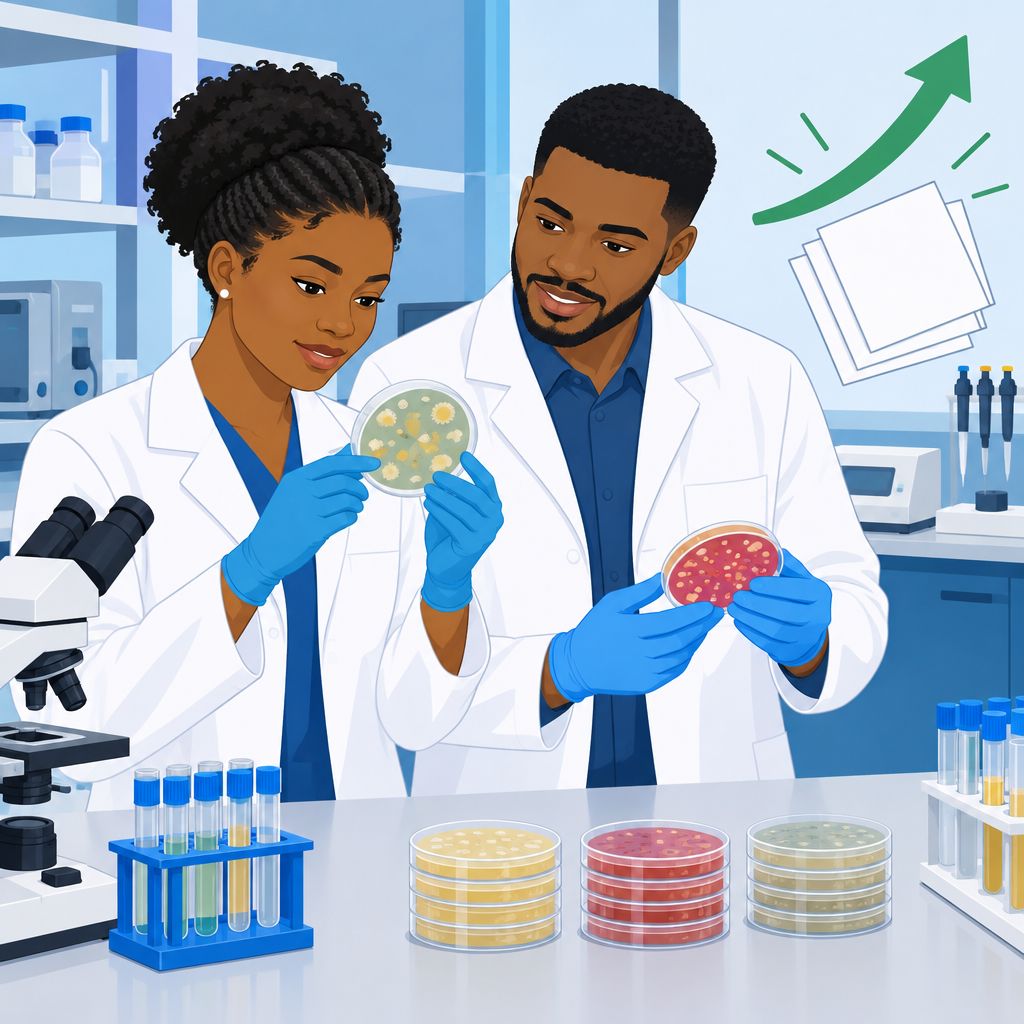
Research and Innovation by Nigerian Microbiologists
Prominent applied microbiology projects in Nigeria demonstrate the country’s commitment to scientific advancement.
- Researchers use microbial enzymes in wastewater treatment to improve sanitation.
- Scientists examine probiotics that may mitigate antibiotic resistance in hospitals.
- Microbiologists explore indigenous microorganisms for sustainable agricultural practices.
Furthermore, Nigerian microbiologists have made discoveries with potential applications across various industries.
- Researchers develop microbial biodegradation techniques to address environmental pollution.
- Scientists identify bacterial strains for producing biofuels and pharmaceuticals.
- Microbiologists discover microbial solutions that enhance food preservation and safety.
Consequently, Nigerian microbiologists expand scientific knowledge while supporting innovation and progress.
- They collaborate with international partners to exchange expertise and access advanced technologies.
- They mentor future microbiologists through workshops, seminars, and educational programs.
- They promote interdisciplinary research that addresses complex challenges across multiple fields.
Uncover the Details: Introduction to Agricultural Economics in Nigeria
Collaboration and Partnerships in Nigerian Applied Microbiology
Collaboration between Nigerian microbiologists and international organizations remains crucial for scientific progress.
First, partnerships allow researchers to exchange ideas, expertise, and resources that may remain unavailable locally.
These relationships provide access to advanced technologies and methodologies that can improve research quality.
Consequently, Nigerian researchers can apply innovative approaches to important microbiological challenges.
International partnerships also connect Nigerian microbiologists with broader scientific communities.
This exposure supports networking, cultural exchange, and new research opportunities.
Furthermore, global partnerships can provide funding for large projects, sophisticated equipment, conferences, and training programs.
Such support strengthens research capacity and helps Nigerian microbiologists follow global scientific developments.
Success Stories from Joint Research Projects
Joint research projects have produced valuable outcomes for Nigerian applied microbiology.
For example, Nigerian and United States researchers studied microbial diversity in Nigerian soil.
The project identified novel bacterial strains with possible bioremediation and pharmaceutical applications.
Similarly, Nigerian scientists and European researchers investigated the antimicrobial properties of traditional Nigerian herbs.
Their work identified compounds with strong activity against drug-resistant bacterial strains.
These findings may support alternative approaches for treating infectious diseases.
Meanwhile, Nigerian microbiologists and Asian institutions studied microbial enzymes for industrial applications.
Their collaborations produced biocatalysts that improved several industrial processes.
These processes included biofuel production and waste treatment.
Knowledge and Resource Sharing in Applied Microbiology
Knowledge sharing gives Nigerian researchers access to diverse expertise and specialized skills.
Moreover, collaboration encourages innovation, interdisciplinary research, and faster scientific progress.
Researchers can also share equipment, facilities, and financial resources through international partnerships.
This cooperation helps address limitations involving funding, infrastructure, and laboratory equipment.
Consequently, Nigerian microbiologists can conduct broader studies and examine complex research questions.
Shared resources also provide access to state-of-the-art facilities and specialized research environments.
In addition, international collaboration increases the visibility of Nigerian research.
Greater visibility can attract recognition, new partnerships, and future joint initiatives.
These partnerships strengthen scientific excellence and advance applied microbiology in Nigeria.
You Might Also Like: Career Opportunities in Ecology for Nigerians
Challenges Facing Nigerian Microbiologists
Nigerian microbiologists encounter obstacles that restrict research progress and professional growth.
Limited resources can reduce their ability to conduct advanced experiments and apply scientific findings.
Furthermore, restricted access to technology, literature, and training can delay important discoveries.
- Researchers often lack adequate funding for their projects.
- Many laboratories lack infrastructure for advanced experiments.
- Limited access to modern technology and equipment restricts research capabilities.
- Insufficient support affects postgraduate studies and professional development.
- Researchers may struggle to access relevant scientific literature and resources.
Strategies for Advancing Microbiology Careers
Nigerian microbiologists can address these difficulties through purposeful cooperation and continuous professional engagement.
International partnerships can provide opportunities for knowledge exchange and broader research development.
Additionally, industry connections can help researchers adapt scientific work to practical applications.
- Collaborate with international research institutions for knowledge exchange.
- Seek grants from global funding agencies.
- Build networks with industry professionals for practical research applications.
- Advocate for stronger government investment in science and technology.
- Attend conferences and workshops to follow current developments.
Government and Private Sector Support
Government and private sector support can strengthen applied microbiology across Nigeria.
Public investment can improve laboratory capacity, while private partnerships can encourage innovation and commercialization.
Supportive policies can also connect academic research with industry needs and expand educational opportunities.
- Government funding can establish research centers and laboratories.
- Public-private partnerships can advance innovation and product commercialization.
- Tax incentives can encourage companies to invest in research and development.
- Policies can promote collaboration between academic institutions and industry.
- Scholarships and grants can help aspiring microbiologists pursue higher education.
These measures can help Nigerian microbiologists overcome barriers and strengthen applied microbiology.
With sustained support, their expertise can contribute more effectively to scientific and industrial development.
Applied Microbiology Achievements in Nigeria
Applied microbiology has produced notable advances across several Nigerian sectors.
Nigerian microbiologists have pursued research and discoveries with practical value.
These efforts support health, agriculture, and environmental conservation.
Contributions to Health Sciences
Health research addresses infectious diseases, antibiotic resistance, and vaccine development.
These contributions strengthen scientific responses to important health challenges.
Furthermore, microbiologists apply research findings to support health science progress.
Applications in Agriculture
Agricultural research helps Nigerian farmers improve crop yields.
Microbiologists also investigate methods for combating plant diseases.
Consequently, their work promotes more sustainable agricultural practices.
Environmental Conservation Efforts
Environmental research uses microbiology to address pollution and contaminated sites.
Microbiologists develop bioremediation techniques that help clean polluted environments.
These techniques can also support efforts to reduce environmental pollution.
Future Contributions to National Development
Applied microbiology remains important for Nigeria’s health, agricultural, and environmental progress.
Its achievements demonstrate the practical value of microbiological research.
Therefore, aspiring microbiologists can continue this legacy through dedicated work in the field.
Additional Resources
Google search results for Success Stories in Nigerian Applied Microbiology Sciences
Bing search results for Success Stories in Nigerian Applied Microbiology Sciences


