




Smart Farming and Agricultural Engineering
Smart farming uses modern technologies to improve agricultural efficiency and sustainability.
It helps farmers meet growing food demands as the population continues to increase.
Meanwhile, agricultural engineering innovations have transformed traditional farming practices.
These innovations improve productivity, minimize waste, and reduce agriculture’s environmental impact.
Precision Agriculture
Precision agriculture uses technology to optimize farming through data-driven decisions.
Farmers can analyze crop variability and improve operational efficiency.
This approach supports better production management while using resources more carefully.
Benefits of Precision Agriculture
Precision agriculture helps farmers manage crops with greater accuracy.
It also supports efficient resource allocation and more informed management decisions.
Additionally, precise applications can reduce unnecessary resource use and environmental impacts.
- Farmers can increase productivity by maximizing yields with minimal resources.
- Precision agriculture reduces excessive fertilizer, water, and pesticide use, resulting in cost savings.
- Precise input applications can reduce water pollution and greenhouse gas emissions.
- Accurate data collection helps farmers make informed crop management and resource allocation decisions.
Examples of Precision Agriculture Technologies
Several technologies help farmers collect and interpret information about their fields.
These tools support field mapping, crop monitoring, and targeted management.
Farmers can use the resulting information to identify areas requiring attention.
- GPS technology maps field boundaries, analyzes soil samples, and monitors crop growth.
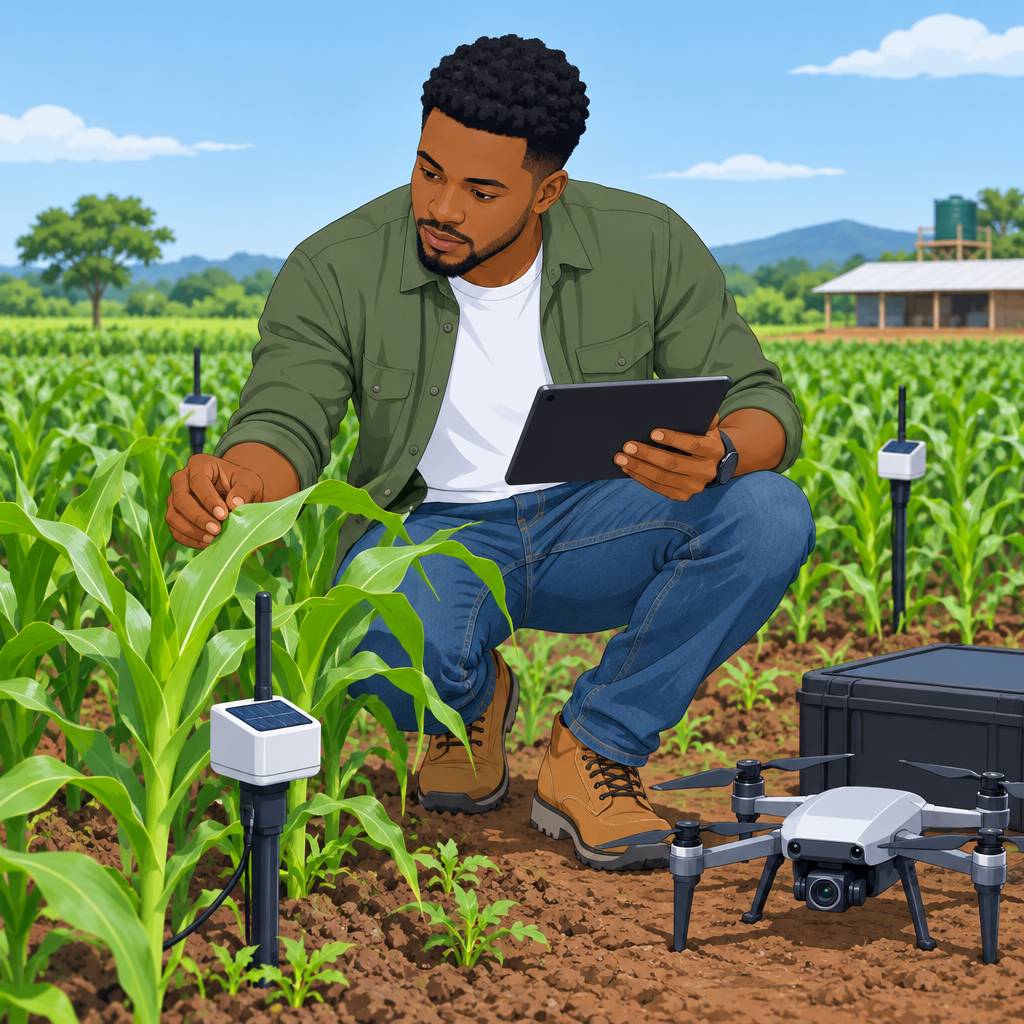
- Drones use cameras and sensors to provide high-resolution crop images.
- Sensors collect data about soil moisture, temperature, nutrient levels, and crop health.
These technologies enable farmers to make data-driven decisions about crop production.
Consequently, precision agriculture can increase efficiency and reduce production costs.
Farmers can also optimize operations while supporting environmental sustainability.
Internet of Things in Agriculture
IoT is revolutionizing agriculture through smart devices and data analytics.
It allows farmers to monitor fields in real time and make informed decisions.
Additionally, farmers can use collected data to improve efficiency and sustainability.
- Remote Monitoring: Sensors, drones, and cameras monitor soil moisture, temperature, humidity, and crop health.
- Precision Agriculture: IoT data supports variable fertilizer and pesticide applications, improving efficiency and reducing costs.
- Smart Irrigation: IoT systems adjust watering schedules according to real-time data, conserving water and improving yields.
Successful IoT Implementations in Farming
- John Deere: The company integrates IoT technology into equipment, helping farmers monitor performance and field conditions.
- AgriSol: This startup uses IoT sensors to monitor soil moisture and weather conditions for smarter irrigation.
- The Climate Corporation: Its IoT platform provides data-driven insights and recommendations through mobile devices.
These implementations give farmers practical tools for making smarter operational decisions.
Furthermore, IoT technology helps farmers increase efficiency while using resources more carefully.
As technology advances, new IoT solutions may continue changing farming practices.
Gain More Insights: Hydrology and Water Resources in Agricultural Engineering
Robotics and Automation in Agriculture
Robotic systems now support many agricultural tasks.
These systems help farmers improve efficiency and increase productivity.
Additionally, automation supports consistent operations across planting, harvesting, and crop monitoring.
Robotic Technologies Used in Agriculture
Several robotic technologies perform essential field and crop management tasks.
Farmers can combine autonomous equipment, drones, and specialized robots.
Together, these tools support faster and more consistent agricultural operations.
- Autonomous tractors use GPS technology and sensors for plowing, seeding, and crop spraying.
- Drones monitor crop health, irrigation systems, and soil conditions from above.
- Harvesting robots collect fruits and vegetables while reducing labor requirements.
- Weeding robots use computer vision to identify and remove weeds.
Benefits of Agricultural Automation
Automation allows farmers to manage repetitive work more efficiently.
Moreover, automated systems support accurate resource use and timely crop management.
Farmers can also use collected information to guide operational decisions.
- Robotic systems increase efficiency by automating repetitive agricultural tasks.
- Automation supports precise planting, fertilizing, and spraying practices.
- Reduced manual labor and improved resource management can lower operating costs.
- Automation systems collect real-time crop information for informed management decisions.
- Robotic tools can reduce chemical use, conserve water, and limit environmental impact.
As technology advances, farmers will continue integrating robotics into agricultural operations.
These tools can help improve productivity while supporting more sustainable farming practices.
Consequently, automation can help agriculture respond to increasing food demands.
You Might Also Like: Success Tips for Agricultural Engineering Students
Importance of Sustainability in Agriculture
Sustainable agriculture meets present needs without limiting future generations’ ability to meet their needs.
It requires farmers to manage resources responsibly while supporting environmental, economic, and social benefits.
Moreover, sustainable practices address climate change, soil degradation, water scarcity, and biodiversity loss.
How Smart Farming Promotes Sustainability
Smart farming uses innovative technologies and practices to support more sustainable agricultural systems.
Transform Your Career with Expert Guidance
Get personalized mentorship consulting that’s tailored to your unique path. Our expert advice is actionable and exclusive.
Get StartedThrough data-driven decisions and precision techniques, farmers can optimize resources, reduce waste, and improve productivity.
Additionally, these methods help farmers manage irrigation, fertilization, pest control, and crop health more efficiently.
Examples of Sustainable Farming Practices
Sustainable farming methods can improve resource efficiency while reducing environmental pressure.
For example, controlled growing systems help farmers produce crops where arable land remains limited.
Meanwhile, soil-free systems can manage water and nutrients more precisely.
Vertical Farming
Vertical farming grows crops in vertically stacked layers, often within controlled environments.
This approach maximizes space and suits urban areas with limited arable land.
By using hydroponics and LED lighting, vertical farms can produce higher yields with fewer environmental impacts.
It reduces reliance on expansive farmland, heavy water use, and chemical inputs.
Hydroponics
Hydroponics grows plants without soil by using nutrient-rich water solutions.
This system improves control over water, nutrients, and environmental conditions affecting plant growth.
Furthermore, farmers can use hydroponics in greenhouses, vertical farms, or indoor spaces for year-round crop production.
Therefore, it avoids soil erosion, nutrient depletion, and contamination concerns.
Building Resilient Food Production Systems
These practices support agriculture’s long-term viability and protect the health of the planet.
Smart technologies can improve efficiency and strengthen food production systems for the future.
Together, sustainable methods help farmers build more resilient operations.
Find Out More: Agricultural Engineering Conferences and Workshops
Impact of Artificial Intelligence in Agriculture
Artificial Intelligence is revolutionizing farming through predictive analytics and crop management.
Farmers can use AI technology to make data-driven decisions.
These decisions optimize crop yields and minimize waste.
- AI transforms farming through predictive analytics.
- Farmers analyze historical data and predict future trends accurately.
- Consequently, they improve planting, irrigation, and harvesting decisions.
- This approach increases productivity and profitability.
- AI also monitors crop health and detects diseases early.
- By analyzing drone and satellite images, AI identifies crop stress or disease.
- Therefore, farmers can take proactive measures to protect crops.
- AI-powered tools optimize water and fertilizer use.
- They provide real-time recommendations based on weather, soil, and crop types.
- Thus, farmers improve yields and reduce environmental impact.
Success Stories of AI Applications in Agriculture
- Japan uses AI to enhance agriculture.
- The country developed autonomous tractors and AI-equipped drones.
- These machines plant crops, spray pesticides, and monitor crop health.
- In the United States, John Deere incorporated AI into agricultural equipment.
- Its self-driving tractors navigate fields and plant crops precisely.
- As a result, farmers save time and reduce labor costs.
- In India, CropIn provides personalized crop insights and recommendations.
- It analyzes weather, soil quality, and market demand.
- Therefore, farmers improve yields and profits.
- AI also supports African small-scale farmers facing limited resources and information.
- Projects like the African Drone and Data Academy train local farmers.
- They use drones and AI tools to monitor crops and predict yields.
- Additionally, these tools help farmers respond to climate change.
Gain More Insights: Trends in Agricultural Engineering Education in Nigeria
Agricultural Engineering for Future Food Security
Agricultural engineering innovations have transformed farming and helped farmers improve efficiency and productivity.
Farmers should embrace technology and adopt smart farming practices to support sustainable agricultural production.
Tools such as drones, sensors, and data analytics help farmers make informed decisions.
Consequently, these decisions can improve yields and strengthen environmental stewardship.
Meanwhile, the growing global population increases the demand for food.
Therefore, farmers must use technological advancements to help meet that demand.
Smart farming can reduce costs and improve operational efficiency for farmers.
It also supports food security for future generations.
Accordingly, farmers should integrate smart farming practices into their operations.
This approach can improve productivity, reduce waste, and support a more sustainable agricultural industry.
Ultimately, collaboration can help create an agricultural future that remains productive and environmentally friendly.
Embracing agricultural engineering innovations can help advance this vision.
Additional Resources
Google search results for Smart Farming: Agricultural Engineering Innovations Engineering
Bing search results for Smart Farming: Agricultural Engineering Innovations Engineering