







Agricultural curriculum evaluation in Nigeria becomes more useful when a broad ambition becomes a testable learning question. A new faculty survey can inform consultation. It cannot, on its own, establish that a redesigned course improves learning, farm decisions or food security. This report shows how to make that next step explicit.
We reproduce the achieved sample’s regional shares, separate awareness percentages from scale means, and propose one assessable farm-decision assignment. Two charts, an evidence-ladder infographic and four free CSV tools support the method. No course pilot, student assessment or downstream impact study has been conducted for this report. Research checked on 9 November 2026.
Read the faculty survey as consultation evidence
The Frontiers in Sustainable Food Systems paper published on 6 November 2026 surveyed 105 faculty through professional networks and convenience/snowball recruitment. Its participants came from Southwest (56), Southeast (28) and North Central Nigeria (21). Calendar fieldwork dates were not established in the inspected methods.
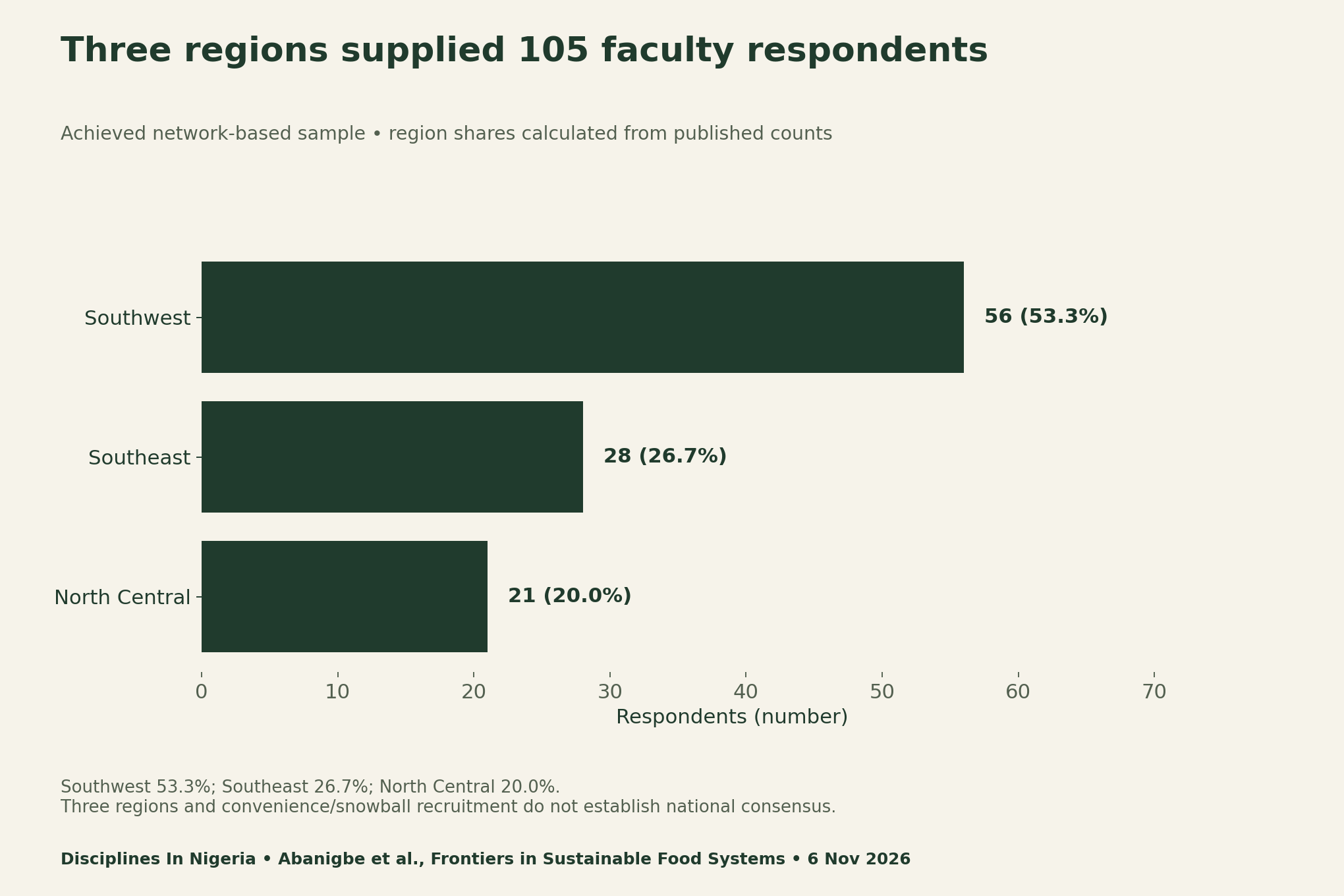
When planning a local consultation, define whose perspectives you need and how you will reach them. A network can bring useful expertise, but those outside it may remain unheard. Report the recruitment route and missing perspectives alongside the responses. Do not turn participation into a claim of agreement across all institutions.
Agricultural curriculum evaluation Nigeria: keep each measure distinct
Table 1 reports 71/105, or 67.6%, for the awareness item concerning integration of African ideas and Western approaches. That item’s reported mean is 4 on a five-point scale, with SD 1.486. These are different summaries. The scale mean is not a percentage of faculty or a measure of learning improvement.
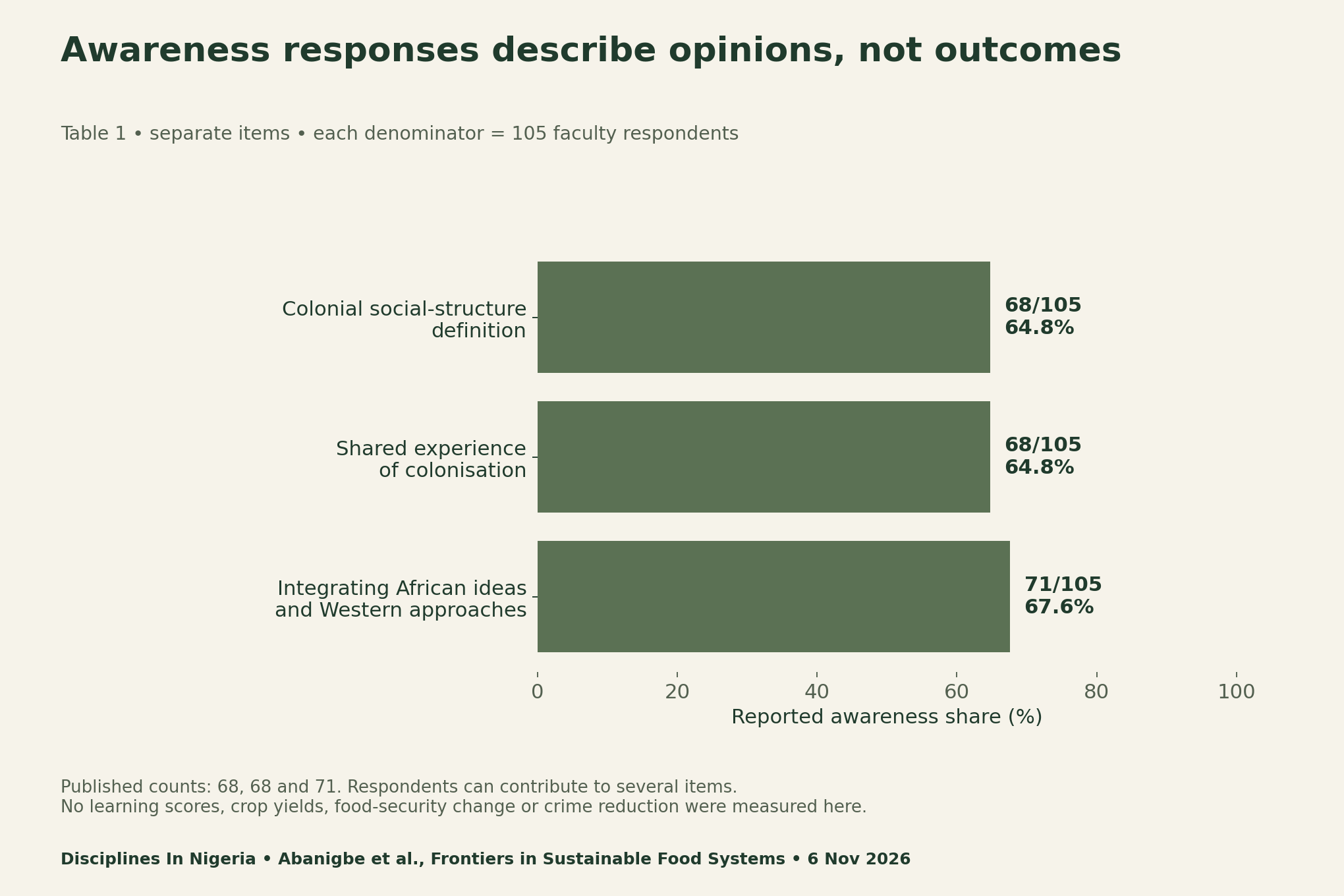
A respondent percentage asks how many people fall into a reported response grouping. A scale mean summarises numeric coding across response levels. To interpret the latter, inspect the question, anchors and coding. Multiplying a mean by 20 does not turn it into an awareness share, an approval rate or an educational effect.
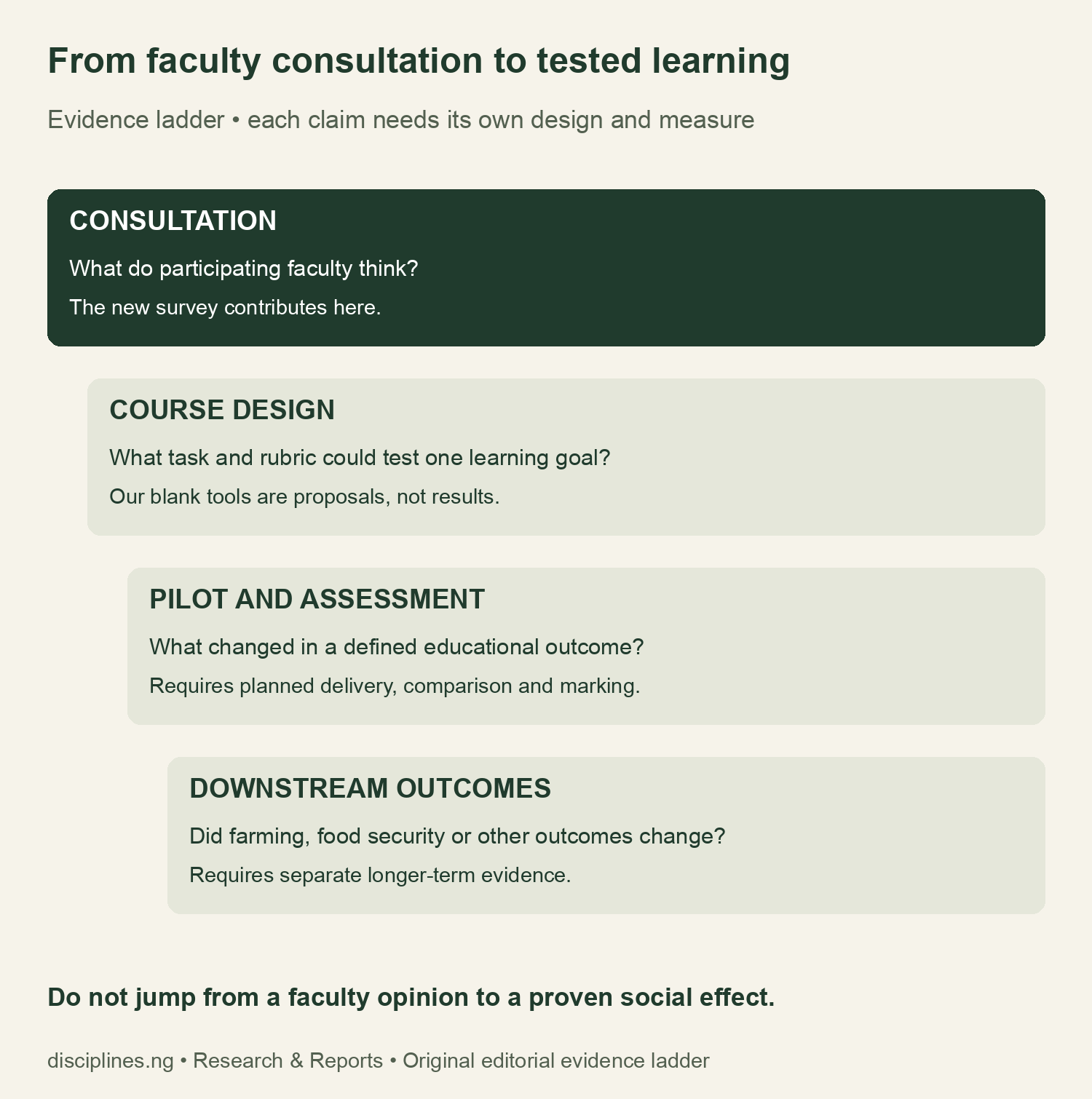
For curriculum work, define the educational outcome separately from the consultation question. A person may favour an idea while its implementation remains untested. Likewise, a well-designed task can still fail if delivery, resources or marking differ from the plan. Each stage needs its own evidence.
Choose one farm-decision assignment you can actually assess
Our editorial proposal is a short assignment built around a locally relevant farm decision. For example, ask students to compare two feasible options under a stated land, water or budget constraint. Supply a common evidence pack, define the units and require an explanation of assumptions. Do not present invented costs as current local prices.
Invite appropriate local contributors to help frame the problem, with consent and clear credit. Their knowledge can identify constraints a generic exercise misses. Students should still examine provenance, applicability and uncertainty for every source. The task does not assume that any one knowledge tradition is uniform or always superior.
State one learning goal before writing a rubric. An example is: “Compare two options using relevant evidence, correct calculations and a justified account of uncertainty.” That is assessable within a course. Reducing hunger or crime is a different outcome requiring a much broader design and a longer evidence chain.
Use a draft four-criterion rubric, then test its clarity
| Criterion | What a stronger answer demonstrates | Draft score range |
|---|---|---|
| Constraints | Prioritises relevant constraints and explains trade-offs | 0–3 |
| Evidence | Compares sources, provenance and local applicability | 0–3 |
| Calculations | Uses correct arithmetic and units with visible assumptions | 0–3 |
| Uncertainty | Explains what missing evidence could change the recommendation | 0–3 |
The downloadable anchors distinguish four levels for each criterion. Before a pilot, ask markers to apply them to the same practice responses and discuss disagreements. Revise unclear wording before evaluation. Keep the rubric stable during a planned comparison, or document any change and its implications.
A twelve-point total is a recording convention, not proof of validity. Two equal totals can reflect different strengths. Retain criterion-level scores and a moderation note. Avoid a pass/fail threshold unless an appropriate course process has justified it. Our tool does not make an accreditation or qualification decision.
Plan agricultural curriculum evaluation before claiming an effect
Specify who can participate, how evaluation consent will work and which course activities remain available regardless of research participation. Record the comparison arrangement, timing and delivery exposure. A pre/post assessment should use comparable tasks and common marking rules, rather than assuming two different exercises have equal difficulty.
A simple before-and-after improvement cannot isolate the course’s effect. Students may gain experience elsewhere, and participation or absence may differ across groups. A comparison design needs to address those alternatives. Record limitations before looking at results, rather than inventing a causal explanation after a favourable change.
The blank implementation log asks what was planned, what occurred and why it changed. Keep attendance and missing-assessment information securely, with no identifiable details in public files. Report the number assessed at each stage, not only the number recruited. Predefine how you will describe uncertainty and incomplete records.
Report what a pilot could and could not establish
A feasible pilot may show whether students can complete the task and whether the rubric is clear enough to use. A suitable evaluation could examine a defined learning outcome. Neither automatically shows improved agricultural output, household food security or reduced crime. Those outcomes need separate measures and appropriate follow-up.
Publish the task specification, rubric version, recruitment boundary and analysis plan alongside any future results. Distinguish feasibility findings from comparative learning findings. If the pilot changes the task or delivery, explain the change rather than combining incompatible scores into one headline.
Our soil-amendment experiment timing guide shows why treatment clocks matter when interpreting agricultural evidence. The soil-data suitability audit provides a related example of matching a measure’s scale to its research question.
Download the source calculations and planning tools
The source file records counts, denominators, calculated shares and the separately reported scale statistics. The blank score sheet has space for pre/post assessment without invented scores. A delivery log and explicit rubric anchors help make the proposed pilot reviewable before any student data are collected.
- Faculty source counts and recalculated shares (CSV)
- Blank pre/post learning-assessment sheet (CSV)
- Blank curriculum-pilot implementation log (CSV)
- Draft four-criterion rubric anchors (CSV)
Methods, limitations and citation
For agricultural curriculum evaluation in Nigeria, we inspected the publisher HTML and PDF, transcribed selected aggregate figures and calculated shares as count divided by 105, multiplied by 100. Two original charts address composition and awareness; extra charts would not supply missing intervention outcomes. The rubric, log and assignment are editorial proposals, not the authors’ tested instruments.
Network recruitment across three regions cannot establish national consensus. Publication timing is not fieldwork timing. No student scores, course effects, farm outcomes, food-security change or crime effects were calculated. The reported scale mean and SD remain distinct from a percentage and from an effect estimate. The two small rounding discrepancies are disclosed rather than silently copied.
Suggested citation: Disciplines In Nigeria (9 November 2026), “Agricultural Curriculum Evaluation Nigeria: Design a Testable Pilot,” source calculations and original draft teaching tools. Cite Abanigbe and colleagues for the survey and identify our proposed rubric as unvalidated.


