



Geology and Disaster Management in Nigeria
A brief overview of geology and disaster management in Nigeria shows why geological knowledge supports effective disaster management.
Nigeria faces natural disasters, including earthquakes, floods, landslides, and volcanic eruptions.
Understanding Nigeria’s geological composition helps experts predict and reduce disaster impacts on communities and infrastructure.
By studying geological features, experts identify high-risk areas and develop strategies that protect lives and property.
Geological Knowledge for Disaster Management
Geological surveys map areas prone to natural disasters.
Therefore, authorities can take proactive measures for disaster preparedness and response.
Knowledge of Nigeria’s tectonic plates helps experts identify potential earthquake-prone zones.
Consequently, authorities can implement building codes that withstand seismic activity.
Understanding Nigeria’s hydrogeological characteristics supports flood-risk management and proper drainage development.
Additionally, geological information reveals mineral resources that support sustainable development and disaster risk reduction.
Geological Hazards in Nigeria
Nigeria faces several geological hazards that affect communities and infrastructure.
These hazards include landslides, earthquakes, and volcanic eruptions.
Their possible effects make hazard awareness important for disaster management and mitigation strategies.
Types of Geological Hazards
Landslides represent one of the common geological hazards identified in Nigeria.
Earthquakes also occur as a potential geological hazard within the country.
Volcanic eruptions remain less common, but they still represent a potential hazard.
Areas Prone to Geological Hazards
Landslides are prevalent in hilly regions such as the Jos Plateau and parts of Southeast Nigeria.
Earthquakes are more likely along the Benue Trough, particularly around Makurdi and Yola.
Although volcanic eruptions are uncommon, potential areas include the Adamawa region.
Effects on Communities and Infrastructure
Landslides can destroy homes, disrupt transportation routes, and cause loss of lives.
Earthquakes can collapse buildings, damage infrastructure, and displace communities.
Volcanic eruptions could cause widespread destruction and displace communities in affected areas.
Importance of Hazard Awareness
Understanding geological hazards and their impacts is crucial for effective disaster management.
This knowledge supports the development of suitable mitigation strategies.
It also highlights the need to protect communities and infrastructure from potential damage.
Role of Geologists in Disaster Management
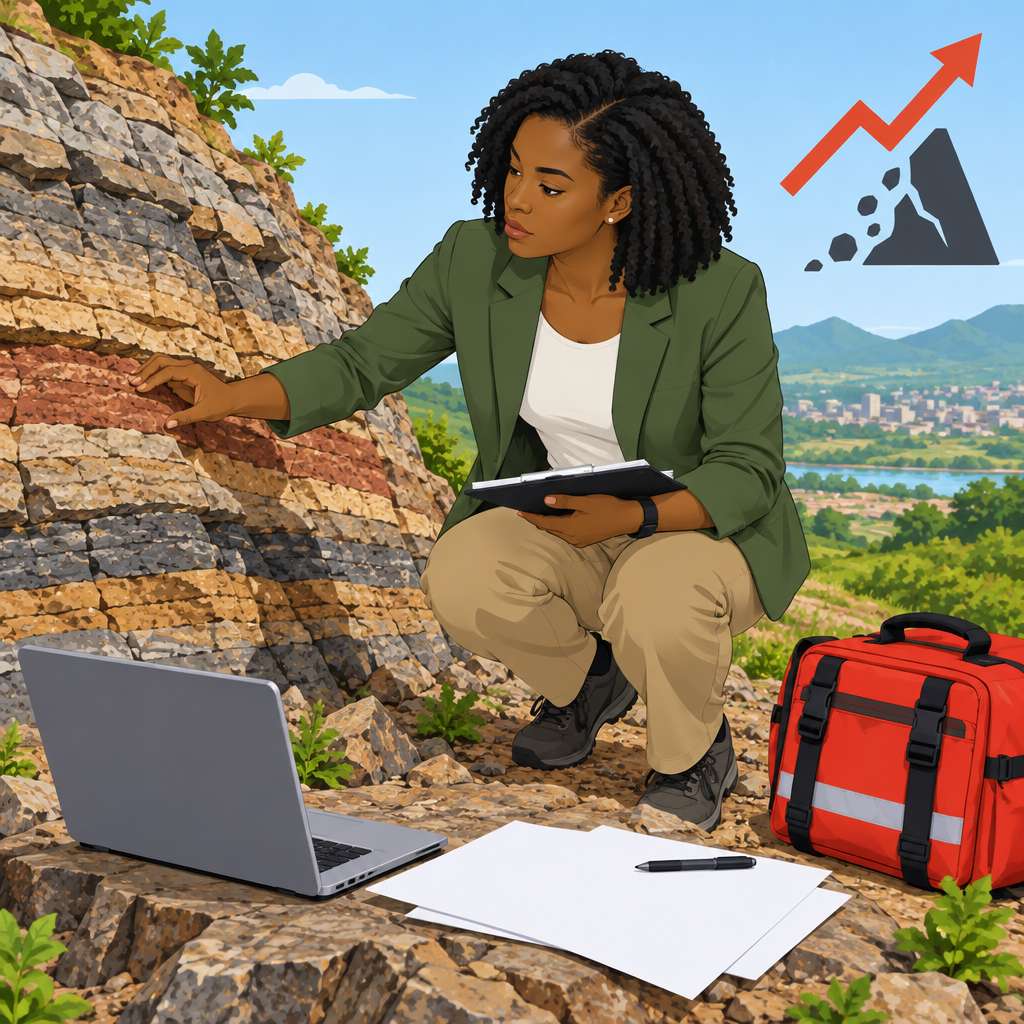
Geologists support disaster management by studying Earth’s processes and locating potential hazards.
They assess geological conditions through research and fieldwork.
Their findings help communities prepare for natural calamities.
- Identifying potential hazards
- Using geophysical surveys and monitoring techniques
- Collaborating with disaster management agencies
First, geologists investigate geological conditions to determine how hazards might affect an area.
They use field observations and research to evaluate the likelihood of natural calamities.
Through geophysical surveys, geologists examine conditions beneath the Earth’s surface.
Seismic imaging can reveal fault lines and indications of volcanic activity.
Ground-penetrating radar helps identify unstable soils and other hidden threats.
Furthermore, continuous monitoring helps geologists recognize changes that may signal approaching disasters.
They communicate warnings so communities can reduce potential damage.
Moreover, geologists work closely with disaster management agencies during planning and response activities.
They contribute geological information to preparedness plans and response strategies.
After disasters, their assessments support recovery efforts and informed decision-making.
In Nigeria, geologists apply these skills to strengthen disaster preparedness and community safety.
They share research findings with authorities responsible for protecting lives and property.
Transform Your Career with Expert Guidance
Get personalized mentorship consulting that’s tailored to your unique path. Our expert advice is actionable and exclusive.
Get StartedThrough research, analysis, monitoring, and communication, geologists strengthen disaster management efforts.
Effective cooperation between geologists and agencies supports a safer and more resilient society.
Gain More Insights: Challenges Facing Bioinformatics in Nigeria
Government Initiatives for Disaster Risk Reduction
The Nigerian government uses policies and regulations to manage geological hazards.
These initiatives aim to reduce disaster impacts on communities and infrastructure.
They also support preparedness, emergency response, and risk reduction efforts.
Policies Supporting Geological Hazard Management
The government established the National Geophysical Research Institute (NGRI) to monitor seismic activity.
NGRI provides early warnings for potential geological disasters.
The institute researches earthquakes, landslides, and volcanic eruptions.
The government also established the National Emergency Management Agency (NEMA).
NEMA coordinates disaster response and provides relief in affected areas.
Furthermore, NEMA works with state and local governments during emergencies.
Funding for Warning Systems and Response Teams
The government allocates funds for early warning systems and disaster response teams.
These resources support quick responses and evacuations in communities facing geological hazards.
The government invests in seismometers, GPS monitoring, and satellite imaging.
These technologies improve monitoring and strengthen early warning systems.
Authorities use these systems to assess risks and take proactive measures.
Challenges Affecting Disaster Management
Despite these efforts, the government faces challenges in disaster management.
Inadequate funding limits disaster preparedness and response activities.
The country also needs more trained personnel and disaster management resources.
Agencies face coordination difficulties when developing unified response strategies.
Limited public awareness also reduces the effectiveness of disaster management initiatives.
Community education can improve knowledge of geological hazards and evacuation procedures.
Addressing these challenges can strengthen government protection for populations facing geological hazards.
Explore Further: Anthropology Conferences and Workshops in Nigeria
Community Engagement and Resilience Building
- Communities need to understand the risks they face from geological hazards, such as landslides and earthquakes.
- Educational campaigns can raise awareness about these dangers and explain how communities can prepare.
- Preparedness includes developing evacuation plans, creating emergency kits, and conducting community drills.
- When communities prepare effectively, they can respond to disasters more efficiently.
Local Initiatives for Disaster Risk Reduction and Response
- Local governments can establish early warning systems that alert residents about potential hazards.
- Community drills and training sessions can teach residents how to respond during disasters.
- Building codes and land use planning can reduce vulnerability to geological hazards.
- By working together, communities can strengthen resilience and reduce disaster impacts.
Support from NGOs and International Agencies
- NGOs can provide funding, expertise, and resources for disaster preparation and response.
- International agencies can offer technical assistance for developing disaster risk reduction plans.
- NGOs and agencies can strengthen local capacities and build partnerships for long-term resilience.
- Collaboration among communities, NGOs, and international agencies remains crucial for building resilience.
Community Resilience and Disaster Management
Community engagement and resilience building are essential components of effective disaster management in Nigeria.
Increasing awareness, preparedness, and collaboration can reduce vulnerability and improve emergency responses.
Local initiatives, NGOs, and international agencies can strengthen resilience and protect residents during natural disasters.
Gain More Insights: Nigerian Boat Building: Export Opportunities
Case Studies of Geology and Disaster Management
Past geological disasters in Nigeria provide valuable lessons for disaster management.
These events show how geological knowledge can support preparedness and emergency response.
Success stories also demonstrate the value of mapping risks and educating communities.
- Examples of past geological disasters in Nigeria, including the Oyo State earthquake.
- Lessons learned from previous disasters and improvements in management strategies.
- Success stories involving geology-based disaster prevention and response.
Examples of Past Geological Disasters in Nigeria
One significant geological disaster in Nigeria was the Oyo State earthquake.
The earthquake occurred in 1984 and reached a magnitude of 6.3 on the Richter scale.
Consequently, the event caused widespread destruction and loss of lives in the region.
Lessons Learned from Previous Disasters
The Oyo State earthquake highlighted the importance of disaster preparedness.
It also demonstrated the need for effective early warning systems.
Since then, relevant agencies have improved strategies through monitoring, training, and response planning.
Geology-Based Disaster Prevention and Response
The Nigerian Geological Survey Agency has supported geology-based disaster prevention and response.
It conducts research and maps areas that face geological vulnerability.
Additionally, the agency educates the public about disaster preparedness.
These efforts have helped minimize the impact of geological disasters in Nigeria.
See Related Content: Core Subjects in Animal and Environmental Biology
Geology-Based Strategies for Sustainable Disaster Risk Reduction
Geology helps stakeholders understand natural hazards and strengthen disaster management in Nigeria.
Therefore, stakeholders should invest in early warning systems to mitigate geological hazards proactively.
Furthermore, integrating geology into urban planning and policymaking can help Nigeria build disaster resilience.
Additional Resources
Google search results for Geology and Disaster Management in Nigeria Sciences
Bing search results for Geology and Disaster Management in Nigeria Sciences


