




Women Advancing Marine Engineering in Nigeria
Women in Nigeria’s marine engineering industry make significant contributions.
Moreover, their unique perspectives and skills drive innovation throughout the sector.
Although the field remains traditionally male-dominated, women continue breaking barriers and creating opportunities.
Their presence promotes diversity and introduces fresh ideas to marine engineering.
Meanwhile, women contribute across design, construction, research, and development roles.
They also apply their expertise to support groundbreaking projects.
Additionally, their determination and passion have produced many success stories.
Despite stereotypes and challenges, women continue to excel and inspire others.
These achievements demonstrate their resilience and dedication to the profession.
Celebrating these professionals recognizes their invaluable contributions to Nigeria’s marine engineering sector.
Supporting their continued growth can strengthen diversity and innovation within the industry.
Their stories offer powerful examples of perseverance, excellence, and empowerment.
Historical Perspective
Women have played significant roles in Nigeria’s marine engineering development.
Historically, Nigerian women faced barriers when entering this male-dominated technical field.
Over time, attitudes toward gender equality in marine engineering have gradually changed.
- Brief history of women in Nigeria’s marine engineering sector
- Challenges women faced when entering the field
- Progress toward gender equality in marine engineering
Early Participation in Marine Engineering
Cultural and societal norms once discouraged Nigerian women from pursuing marine engineering careers.
These norms favored men in technical and engineering professions.
However, attitudes gradually shifted toward greater gender equality.
Engineer Jane Nwosu became a notable pioneer in Nigeria’s marine engineering field.
She challenged stereotypes and inspired other women to pursue similar careers.
Historical Barriers for Women
Women entering Nigeria’s marine engineering sector faced discrimination and limited institutional support.
They also had restricted access to training and educational opportunities.
Societal expectations discouraged many women from choosing technical careers.
Industry stereotypes further reinforced the belief that marine engineering suited men better.
Additionally, aspiring engineers lacked sufficient female role models and professional mentors.
This limited representation sometimes caused isolation and imposter syndrome among women engineers.
Progress Toward Greater Equality
Nigeria’s marine engineering sector has made progress toward greater gender equality.
Organizations and institutions now support programs that attract and retain women.
These efforts promote diversity and inclusion throughout the maritime industry.
Scholarships, mentorship programs, and networking events have helped reduce entry barriers.
They have also created more supportive professional environments for female engineers.
Consequently, more women now participate in research, innovation, and leadership roles.
Their perspectives and skills contribute to Nigeria’s evolving maritime industry.
Continued inclusion can support a more diverse future for marine engineering.
Success Stories
These profiles highlight women whose leadership, expertise, and advocacy influence engineering, policy, and maritime sustainability in Nigeria.
Their experiences show how professional achievement can encourage wider participation in technical fields.
Together, their stories emphasize leadership, innovation, and inclusion.
Profiles of Notable Women in Marine Engineering in Nigeria
Dr. Ngozi Okonjo-Iweala is a renowned economist and the first female Director-General of the World Trade Organization.
She holds a Bachelor’s degree in Economics from Harvard University.
She also holds a Ph.D. in Regional Economics and Development from the Massachusetts Institute of Technology.
Transform Your Career with Expert Guidance
Get personalized mentorship consulting that’s tailored to your unique path. Our expert advice is actionable and exclusive.
Get StartedDr. Okonjo-Iweala has held several leadership positions in the Nigerian government.
She served as Nigeria’s Minister of Finance.
Her work has shaped economic policies and supported sustainable development in Nigeria.
Engr. Funke Agbor is a trailblazer in Nigeria’s marine engineering field.
She became the first female President of the Nigerian Society of Engineers.
Engr. Agbor has more than twenty years of industry experience.
She has worked on major maritime projects.
Her advocacy promotes gender inclusivity throughout the engineering sector.
Engr. Oluwatoyin Kola-Olaisi is a marine engineer committed to environmental sustainability.
She holds a Master’s degree in Marine Engineering from the University of Lagos.
She has led projects focused on reducing carbon emissions in maritime operations.
Her innovative solutions have earned recognition locally and internationally.
Her work provides an example for women seeking meaningful careers in marine engineering.
Achievements and Contributions to Marine Engineering
These women have contributed significantly to Nigeria’s maritime sector through expertise, leadership, and advocacy.
Their efforts have supported innovation and sustainability across maritime projects.
Dr. Okonjo-Iweala’s economic policy work has influenced Nigeria’s financial landscape.
Her efforts to address corruption and promote transparency have earned global recognition.
As World Trade Organization Director-General, she advocates fair trade and economic empowerment.
Engr. Agbor has advanced gender equality within engineering through professional advocacy.
Her leadership has expanded opportunities for female engineers in a traditionally male-dominated industry.
Engr. Kola-Olaisi brings environmental priorities into marine engineering practice.
Her research addresses carbon reduction and marine ecosystem protection.
These efforts have promoted greener practices across the maritime industry.
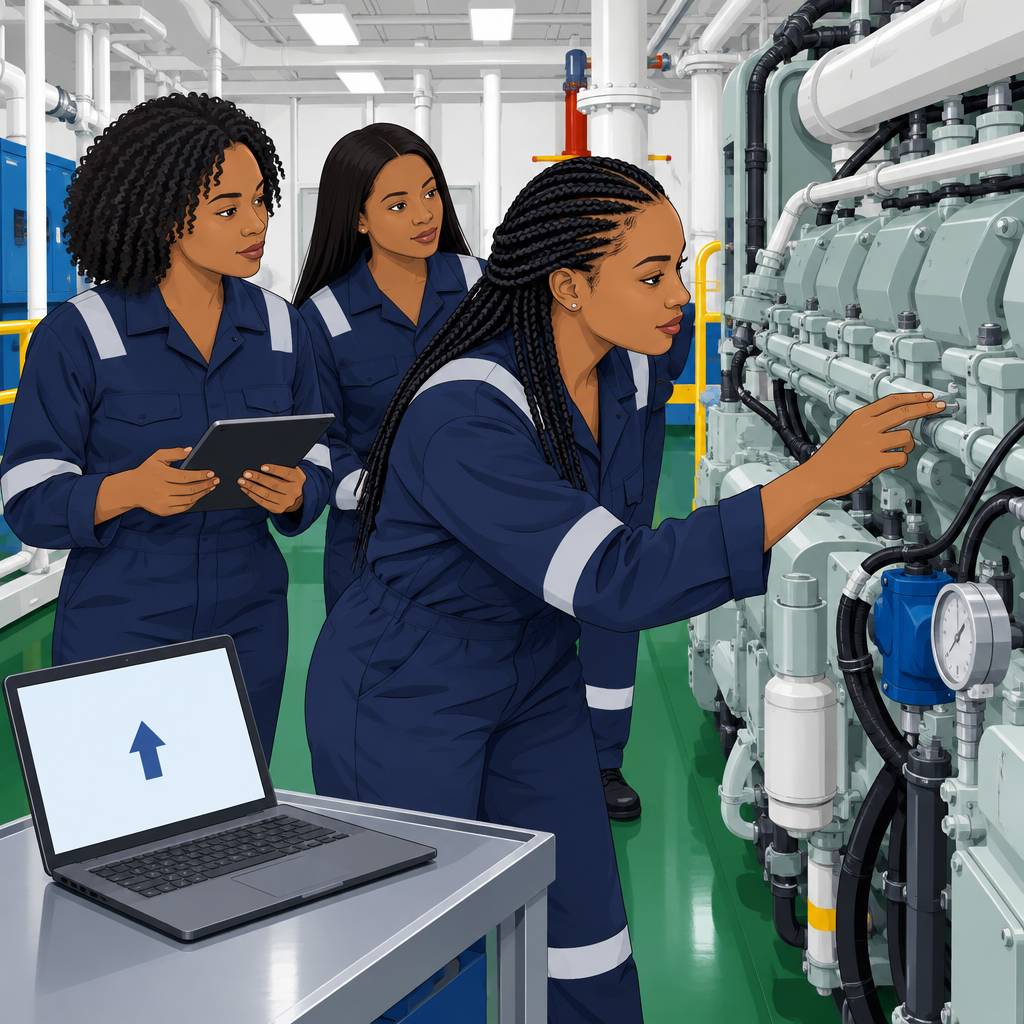
Breaking Barriers and Inspiring Future Engineers
Dr. Okonjo-Iweala’s career challenges assumptions about women’s leadership in male-dominated professions.
Her resilience has encouraged women in Nigeria and beyond to pursue finance and economics.
Her example demonstrates that women can excel in traditionally male leadership roles.
Engr. Agbor’s presidency of the Nigerian Society of Engineers offers encouragement to aspiring female engineers.
Her advocacy supports gender inclusion and professional development.
Through mentorship and support, she has encouraged young women to challenge industry stereotypes.
Engr. Kola-Olaisi has inspired environmentally conscious engineers through innovative marine projects.
Her commitment to green technology encourages women to develop cleaner maritime solutions.
Her example shows aspiring engineers that their work can drive positive environmental change.
These achievements demonstrate how representation, advocacy, and technical expertise can strengthen Nigeria’s maritime future.
Delve into the Subject: Interview with a Nigerian Metallurgical Engineering Expert
Challenges and Barriers
Women in marine engineering encounter numerous challenges that can hinder their progress and success.
These obstacles often reflect deep-rooted gender biases and workplace stereotypes.
Additionally, limited representation and support can restrict women’s opportunities throughout the sector.
Existing Obstacles for Women in Marine Engineering
Workplace practices can limit women’s access to career advancement and professional development.
Furthermore, discrimination and harassment can create unsafe and unequal working environments.
These conditions can also affect pay, leadership access, networking, and mentorship opportunities.
- Lack of equal opportunities for career advancement and professional growth.
- Discrimination and harassment based on gender in the workplace.
- Unequal pay compared with male counterparts performing similar work.
- Underrepresentation in leadership positions and decision-making roles.
- Limited networking and mentorship opportunities designed for women.
Gender Biases and Stereotypes
Gender stereotypes often question women’s technical abilities and practical skills.
They may also pressure women to place family responsibilities before professional goals.
Moreover, implicit bias can influence hiring decisions and career progression.
- Assumptions that women lack technical and practical capabilities.
- Expectations that women should prioritize domestic responsibilities over careers.
- Perceptions that women lack the physical strength needed for maritime roles.
- Stereotypes that portray women engineers as unusual exceptions.
- Implicit biases affecting hiring and career progression opportunities.
Representation and Support for Women
Women often lack visible role models who can inspire and guide their careers.
Meanwhile, some companies provide inadequate support for challenges affecting women.
Stronger inclusion programs and training could help organizations address these barriers.
- Scarcity of female role models and mentors in the sector.
- Inadequate company support for challenges faced by women.
- Limited initiatives promoting gender diversity and inclusion.
- Resistance to change within male-dominated leadership structures.
- Insufficient training and development opportunities for women.
All stakeholders must work together to create a more inclusive marine engineering environment.
With stronger support, women can thrive and excel in this traditionally male-dominated field.
Learn More: Steps to Become a Licensed Surveyor in Nigeria
Empowering Women in Marine Engineering
Women in marine engineering face unique challenges.
The industry remains male dominated.
Various initiatives and programs support and encourage women to excel in their careers.
Initiatives and Programs
Several initiatives support women’s participation in marine engineering.
These programs address professional development, practical experience, and representation.
They also create opportunities for guidance and career preparation.
- Organizations like the Society of Women Engineers provide resources and networking opportunities for women.
- Scholarships for women pursuing marine engineering degrees help increase representation.
- Workshops and seminars address women’s needs and concerns while promoting professional development.
- Mentorship programs pair women with experienced professionals who offer career guidance and support.
- Internships give women hands-on experience and help them build valuable skills.
Opportunities for Mentorship and Networking
Mentorship and networking help women thrive in marine engineering careers.
Mentors provide insights, advice, and support as women navigate professional challenges.
Meanwhile, networking connects women with professionals who can support collaboration and career growth.
- Mentors offer valuable insights, advice, and support for navigating workplace challenges.
- Networking connects women with professionals and creates opportunities for collaboration and career growth.
- Conferences and industry events help women meet potential mentors and expand professional networks.
Importance of a More Inclusive Workforce
A more inclusive workforce strengthens the marine engineering industry.
Diverse teams bring different perspectives and ideas to complex problems.
Inclusive workplaces encourage employees to contribute their unique skills and talents.
- Diversity brings varied perspectives that support creative solutions to complex problems.
- Inclusive environments foster belonging and encourage employees to contribute their skills.
- Greater diversity can attract talent and improve employee morale.
- Engaged employees can help create a more productive workforce.
- Gender equality can strengthen companies’ reputations and attract broader customer bases.
Uncover the Details: Impact of Mechatronics on Nigerian Technology
Future Prospects
Nigeria’s marine engineering sector continues to create opportunities for skilled professionals.
Women can support innovation, sustainability, and technical development across maritime operations.
However, the industry must create accessible pathways for women to enter and progress within the profession.
Potential Growth and Opportunities for Women in Marine Engineering
Industry growth increases demand for professionals with strong marine engineering knowledge.
Women can apply their skills in offshore operations, ship design, maintenance, and marine renewable energy.
Additionally, environmental priorities create opportunities to develop greener technologies and sustainable maritime practices.
Strategies for Increasing Female Participation
Several strategies can encourage more girls and women to pursue marine engineering careers.
These strategies should combine education, professional guidance, and supportive workplace policies.
Consequently, coordinated action can help women build confidence and advance within the sector.
- Schools should encourage girls to study science, technology, engineering, and mathematics subjects.
- Mentorship programs can connect aspiring engineers with experienced professionals for guidance and encouragement.
- Networking platforms can help female engineers share knowledge and develop professional relationships.
- Employers should provide inclusive workplaces that support professional development and career advancement.
- Flexible workplace policies can help employees manage professional and personal responsibilities.
Approaches to Closing the Gender Gap
Organizations can address gender disparities through fair recruitment, retention, and promotion practices.
Training opportunities can strengthen women’s technical expertise and prepare them for leadership responsibilities.
Moreover, clear equality policies can reduce bias and support a more diverse marine engineering workforce.
- Companies can establish targeted recruitment initiatives for qualified female engineers.
- Leadership training can prepare women for supervisory and decision-making positions.
- Workshops can provide practical skills and encourage continuing professional development.
- Industry leaders can advocate equal opportunities across marine engineering workplaces.
- Diversity campaigns can promote respect, inclusion, and fair treatment throughout the sector.
Uncover the Details: Mechanical Engineering Curriculum: What to Expect
A More Inclusive Future for Marine Engineering
Women in Nigeria’s marine engineering field have challenged barriers through determination, resilience, and passion.
Their experiences demonstrate how persistence can expand participation in a traditionally male-dominated industry.
Mentorship and support networks can further strengthen access, confidence, and professional growth.
The discussion highlighted three priorities for advancing women in marine engineering.
- Women continue to encounter challenges within the marine engineering profession.
- Nigerian women are making meaningful progress across the field.
- Mentorship and support networks can help women pursue lasting careers.
Stakeholders should promote equal opportunities and stronger representation throughout marine engineering.
These efforts can empower more women to pursue and advance within the field.
Celebrating achievements and valuing diversity can create a welcoming future for aspiring marine engineers.
Additional Resources
Google search results for Women in Marine Engineering: Stories from Nigeria Engineering
Bing search results for Women in Marine Engineering: Stories from Nigeria Engineering


