




Sustainable Development Goals in Nigeria
The Sustainable Development Goals are global goals established by the United Nations.
They address challenges including poverty, inequality, and climate change.
Nigeria has committed to pursuing these goals within its development agenda.
Importance of Sustainable Development Goals
These goals help countries address global issues affecting people and the planet.
Furthermore, sustainable development can improve citizens’ quality of life.
It also protects the environment for future generations.
Nigeria’s Progress Toward the SDGs
Nigeria has advanced efforts involving education, healthcare, and gender equality.
These efforts also target poverty reduction and better access to clean water.
Additionally, the country promotes economic growth through targeted interventions.
Through these efforts, Nigeria seeks a more sustainable and inclusive society.
Targeted interventions support a better future for all its citizens.
Current Progress Toward the Sustainable Development Goals
Nigeria continues pursuing SDG targets through national development efforts.
Recent progress appears across poverty reduction, education, gender participation, healthcare, and climate action.
However, persistent inequalities continue to slow progress toward 2030.
Significant Advancements Across Key Development Areas
Several initiatives have expanded opportunities and improved essential services for many Nigerians.
Primary school enrollment has increased, while healthcare access has improved in several areas.
Furthermore, women participate more actively in politics and the workforce.
- Nigeria has reduced poverty levels over the past decade.
- More children now enroll in primary schools.
- Female participation in politics and employment has increased.
- Improved healthcare access has reduced child mortality rates.
- Sustainable practices support the country’s response to climate change.
Continuing Challenges Affecting Sustainable Development
Despite these gains, serious barriers continue affecting millions of Nigerians.
Rural communities often experience deeper poverty and weaker access to essential services.
Meanwhile, environmental degradation and pollution threaten long-term development.
- Poverty remains especially serious in rural areas.
- Urban and rural regions still experience unequal education quality.
- Gender inequality limits women’s empowerment and representation.
- Healthcare infrastructure requires further development.
- Pollution and environmental damage continue threatening sustainable development.
Statistical Indicators of Nigeria’s SDG Position
Available statistics show mixed results across Nigeria’s development priorities.
The poverty rate fell from 46 percent in 2009 to 40 percent in 2019.
Primary school net enrollment reached 70 percent.
Gender parity reached 95 girls for every 100 boys in primary education.
Nevertheless, unemployment remains high at 27.1 percent.
Youth unemployment stands even higher at 35.2 percent.
Maternal mortality remains high at 512 deaths per 100,000 live births.
Only 26 percent of households have access to basic sanitation services.
Coordinated Action for Sustainable Progress
Nigeria needs coordinated action to address persistent development gaps.
Government institutions, civil society, and private businesses each have important responsibilities.
Stronger cooperation can expand opportunity and improve living conditions for all Nigerians.
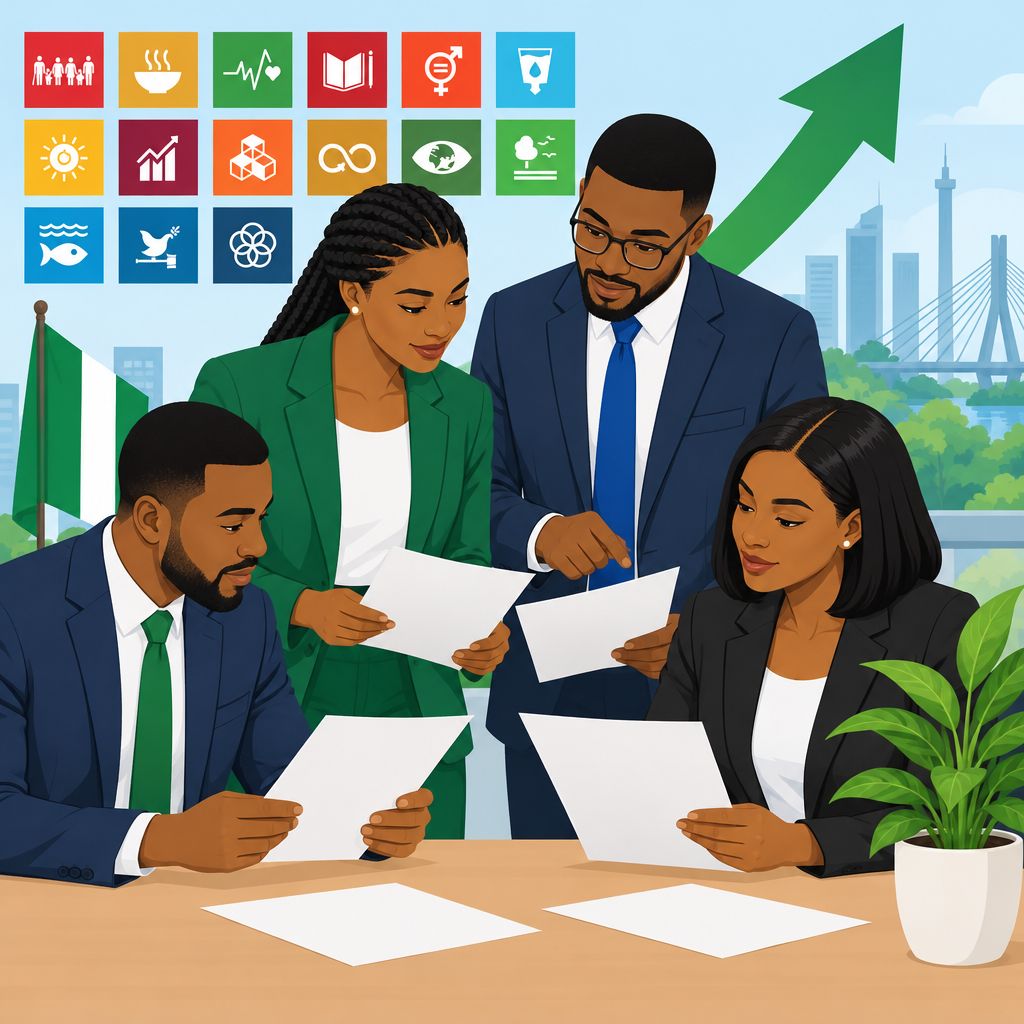
Government Initiatives and Policies
Nigeria’s government has adopted initiatives and policies that support sustainable development.
These measures address national priorities across multiple sectors.
Government agencies coordinate implementation, while specific programs support sustainable development objectives.
- The National Planning Commission helps coordinate national efforts toward the SDGs.
- Government initiatives address poverty, employment, health, education, and environmental sustainability.
- Specific projects connect national development priorities with selected SDG targets.
Initiatives Supporting Economic and Social Development
The National Economic Recovery and Growth Plan supports economic recovery, growth, and sustainable development.
In addition, the Social Investment Program addresses poverty, hunger, and unemployment.
The program includes Conditional Cash Transfer, N-Power, and school feeding initiatives.
Furthermore, the National Climate Change Policy and Response Strategy promotes climate action.
Government Agencies Coordinating Sustainable Development
The National Planning Commission coordinates government efforts toward the SDGs.
It develops strategies, policies, and frameworks that support sustainable development.
Transform Your Career with Expert Guidance
Get personalized mentorship consulting that’s tailored to your unique path. Our expert advice is actionable and exclusive.
Get StartedMeanwhile, the Ministry of Environment promotes environmental sustainability and climate action.
The Ministry of Health supports health objectives, while the Ministry of Education advances education and gender equality.
Programs Supporting Specific SDG Targets
The National Health Insurance Scheme aims to provide affordable healthcare for all citizens.
This initiative supports SDG 3, which focuses on good health and well-being.
The National Social Housing Program provides affordable housing for low-income earners.
Consequently, the project supports SDG 11 and sustainable communities.
Additionally, the Government Enterprise and Empowerment Program provides interest-free loans to small businesses.
These loans promote economic growth and poverty alleviation in line with the SDGs.
Collaboration among government agencies and stakeholders remains essential for successful implementation.
Delve into the Subject: Workshops and Training in Environmental Safety
Challenges Affecting SDG Achievement
Nigeria faces several challenges that slow progress toward the SDGs.
Corruption, infrastructure shortages, and political instability affect development efforts.
These challenges influence economic growth, social progress, and environmental sustainability.
- Identifying key challenges and obstacles affecting Nigeria’s SDG achievement.
- Addressing corruption, infrastructure shortages, and political instability hindering SDG progress.
- Analyzing how these challenges affect Nigeria’s broader development.
Corruption and Development Resources
Corruption remains a significant challenge in Nigeria.
Public officials sometimes embezzle funds intended for development projects.
Consequently, resource mismanagement weakens accountability and transparency.
Infrastructure Shortages and Basic Services
Nigeria faces a severe infrastructure deficit, particularly in rural areas.
Many communities lack adequate roads, schools, hospitals, and other essential facilities.
As a result, limited infrastructure hinders progress toward sustainable development.
Political Instability and Planning Challenges
Nigeria has experienced political instability and persistent governance challenges.
Frequent government changes can create uncertainty for development planning.
This uncertainty disrupts long-term implementation of development initiatives.
Effects on Nigeria’s Development
These challenges significantly affect Nigeria’s development trajectory.
They hinder economic growth and restrict social progress.
They also make environmental sustainability and timely SDG achievement more difficult.
You Might Also Like: Estate Management: Ethical Issues and Solutions
Role of Civil Society and Private Sector
Civil society organizations and private businesses play crucial roles in advancing the Sustainable Development Goals in Nigeria.
They help communities pursue sustainability through awareness, projects, partnerships, and accountability.
Together, these groups support development efforts across social, economic, and environmental priorities.
Contributions of NGOs
NGOs raise awareness about various Sustainable Development Goals among people across Nigeria.
They implement projects addressing healthcare, education, gender equality, and other development priorities.
Additionally, NGOs advocate for policies that support the SDGs and monitor government commitments.
- NGOs in Nigeria raise awareness about various SDGs among the population.
- They implement projects that address healthcare, education, and gender equality.
- NGOs advocate for policy changes and hold the government accountable for its commitments.
Community Groups
Community groups often drive sustainable development initiatives at the grassroots level.
They mobilize resources, engage local stakeholders, and implement projects within their communities.
As a result, these groups encourage local ownership and support long-term sustainability.
- Community groups often drive sustainable development initiatives at the grassroots level.
- They mobilize resources, engage local stakeholders, and implement projects affecting their communities.
- These groups empower individuals to own the development process and support long-term sustainability.
Business Contributions
Businesses in Nigeria increasingly recognize sustainability and corporate social responsibility as important priorities.
They invest in projects supporting environmental protection, economic growth, and social welfare.
Furthermore, businesses form partnerships with government and civil society organizations to support sustainable development initiatives.
- The private sector increasingly recognizes sustainability and corporate social responsibility.
- Businesses invest in environmental protection, economic growth, and social welfare projects.
- They create partnerships with government and civil society for large-scale sustainable development initiatives.
Successful Collaboration Through Partnership
The Partnership for Sustainable Development provides an example of collaboration among major development stakeholders.
Launched in 2016, the initiative brings government, civil society, and private sector stakeholders together.
These partners work toward shared SDG targets and support projects affecting communities in Nigeria.
- The Partnership for Sustainable Development represents a collaborative approach to sustainable development.
- Government, civil society, and private sector stakeholders participate in the initiative.
- The initiative has supported projects with positive effects across various Nigerian communities.
These contributions strengthen sustainable development efforts and support progress toward Nigeria’s SDG targets.
Find Out More: Soil Conservation Techniques Used in Nigeria
Potential Solutions and Recommendations
- Education and awareness campaigns can promote understanding of the SDGs at every level.
- Additionally, international partnerships can provide expertise and funding for sustainable projects.
- Private sector investments can support sustainable development initiatives and encourage economic growth.
- Renewable energy policies can help mitigate the impacts of climate change.
Importance of Innovative Approaches, Partnerships, and Investments
- Innovative approaches can produce creative solutions to complex development challenges.
- Furthermore, partnerships with NGOs and civil society groups can combine resources and expertise.
- Investments in sustainable infrastructure and technologies can support long-term development goals.
- Collaboration with research institutions can advance science and strengthen sustainable practices.
Suggestions to Accelerate Progress towards Achieving the SDGs
- Clear targets and timelines can help stakeholders track SDG implementation effectively.
- Moreover, stronger governance and accountability mechanisms can promote transparency and the rule of law.
- Government agencies, businesses, and civil society can coordinate their efforts through sustained collaboration.
- Reliable data collection and monitoring can help stakeholders assess impacts and adjust strategies.
By applying these measures, Nigeria can advance the SDGs and build a more prosperous, sustainable future for its citizens.
Explore Further: Environmental Management Certification Programs Nigeria
Nigeria’s Commitment to Sustainable Development
Nigeria has made significant progress aligning its national development plans with the United Nations Sustainable Development Goals.
This commitment supports long-term development while addressing poverty, inequality, and climate change.
Therefore, Nigeria must continue prioritizing the SDGs and collaborating with stakeholders to achieve them.
By maintaining this commitment, Nigeria can build a more prosperous and inclusive society for future generations.
Additional Resources
Google search results for Nigeria's Approach to Sustainable Development Goals Environmental
Bing search results for Nigeria's Approach to Sustainable Development Goals Environmental


