

Good N-Power programme evaluation research methods begin with the claim you want to make. Understanding a participant’s experience, estimating a population percentage and identifying a programme’s effect require different evidence. A new Enugu study offers a useful case for learning those distinctions.
This guide is for Nigerian undergraduate and postgraduate researchers designing or critiquing a dissertation. It is not a registration notice or an assessment of your personal eligibility for support. We explain the accessible study evidence, then provide five figures and three CSV tools for transparent research planning.
Research snapshot: 28 October 2026. Our analysis uses the public abstract and metadata. We did not access the subscription full text, interview transcripts or coding records. Publication during October does not establish that participants were interviewed that month.
N-Power programme evaluation research methods: the study’s design
The SN Social Sciences study by Ani and colleagues was published on 22 October 2026. Its abstract describes a qualitative case study of 25 former beneficiaries in Enugu State, selected purposively across programme batches and streams. The reported sample comprises 13 males and 12 females, including N-Teach and N-Health beneficiaries.
The authors describe semi-structured interviews and thematic analysis. They selected ten information-rich cases for deeper narrative illustration from the broader accounts. Those ten are not additional participants. The accessible abstract does not give fieldwork dates or counts for each employment outcome.
| Reported measure | Count | Interpretation |
|---|---|---|
| Interview participants | 25 | Total purposive sample |
| Male participants | 13 | Part of the 25 |
| Female participants | 12 | Part of the 25 |
| Detailed narrative cases | 10 | Selected subset, not an extra sample |
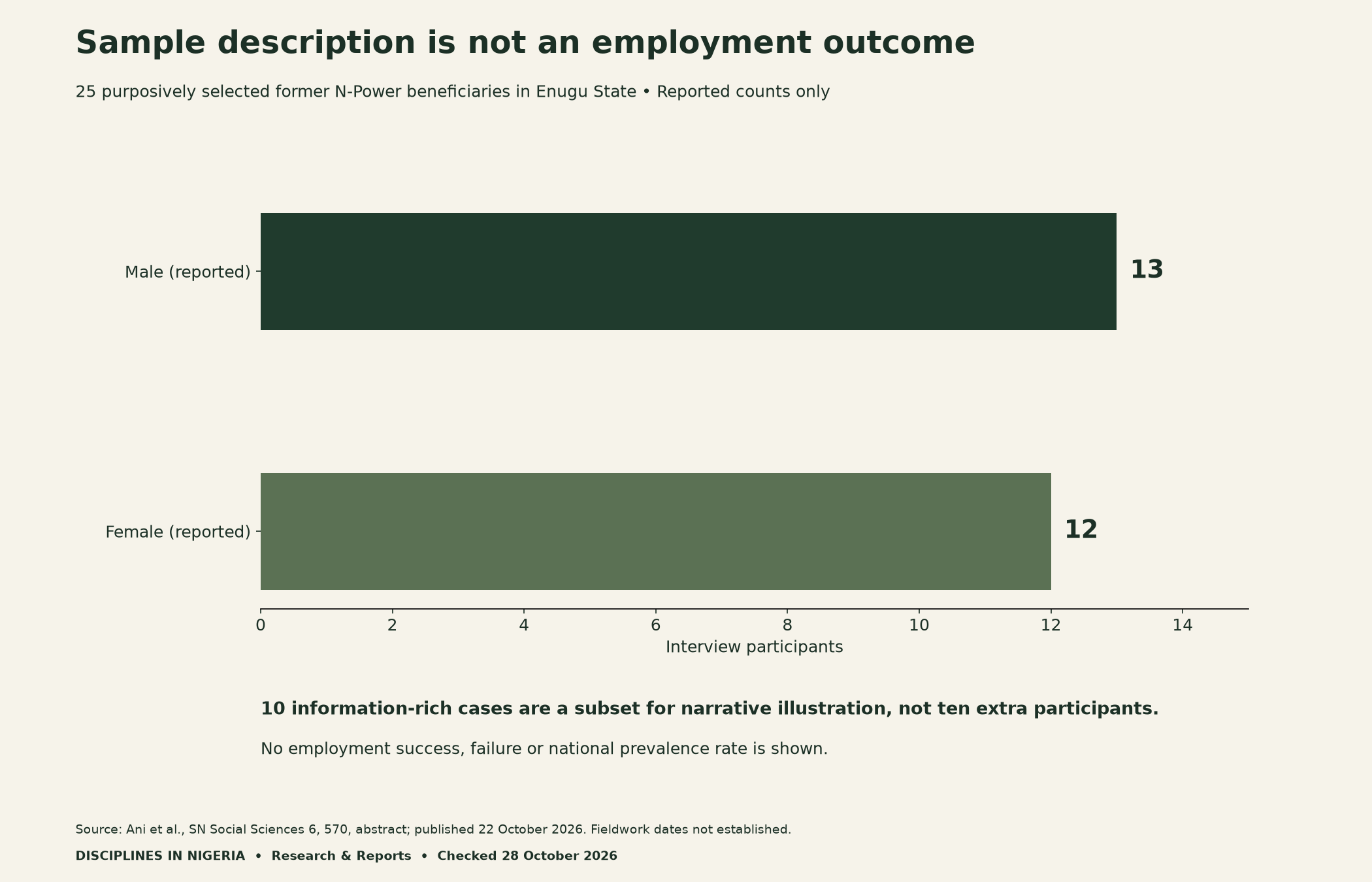
The arithmetic check is simple: 13 + 12 = 25. However, that agreement tells us nothing about national employment outcomes. A sample’s size and composition describe who participated; they do not convert a purposive design into a population survey.
What participant narratives can contribute
The abstract reports varied post-programme experiences. We do not turn that description into a success percentage. Instead, the methodological question is how participants explain their transitions and which conditions they describe as relevant. Such accounts can help refine questions for further research.
A small qualitative study is not automatically a poor study. Judge whether the sampling and analysis fit its stated purpose. Campbell and colleagues’ methods paper explains purposive sampling through research case examples. Its central relevance here is alignment between the question, participant selection and analytical aim—not a universal minimum sample size.
Also separate a participant’s explanation from the researcher’s interpretation. An account may describe a perceived barrier without establishing how common that barrier is. Preserve variation and contrary experiences rather than forcing every narrative into one conclusion. We cannot independently audit how the Enugu authors handled that task from the abstract alone.
Choose N-Power programme evaluation research methods by the claim
Start by writing your intended claim in one sentence. Then ask what observations would support it and which alternative explanations remain. Our claim-design matrix separates four aims: lived experience, prevalence, association and causal effect. It is an editorial teaching framework, not a scoring tool applied to the original study.
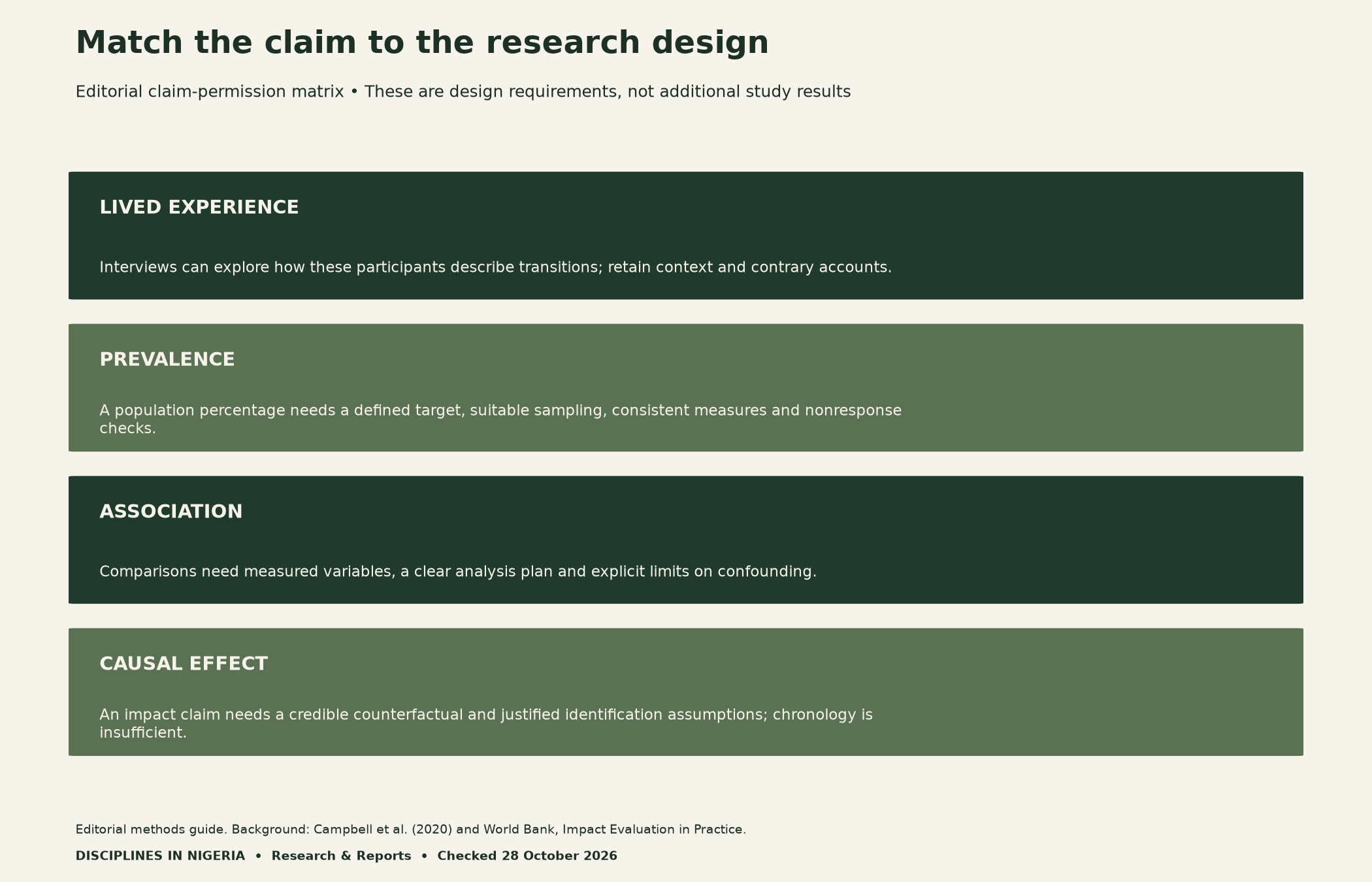
For prevalence, define the population, sampling frame and outcome before calculating a percentage. Also address coverage and nonresponse. A larger convenience sample can still fail to represent the target population. Increasing the number of interviews alone does not solve that design problem.
For a causal claim, ask what would have happened without the programme. The World Bank’s impact-evaluation text explains this counterfactual problem. A before-and-after story or an unmatched comparison group does not automatically answer it. A credible design needs justified assumptions and appropriate evidence; we implement no such evaluation here.
Define the outcome and the observation period
Training completion, work activity, hours, income and stability answer different questions. A person can complete training without having a stable subsequent work arrangement. Conversely, recording some paid activity does not establish its duration or whether it uses the acquired skills.
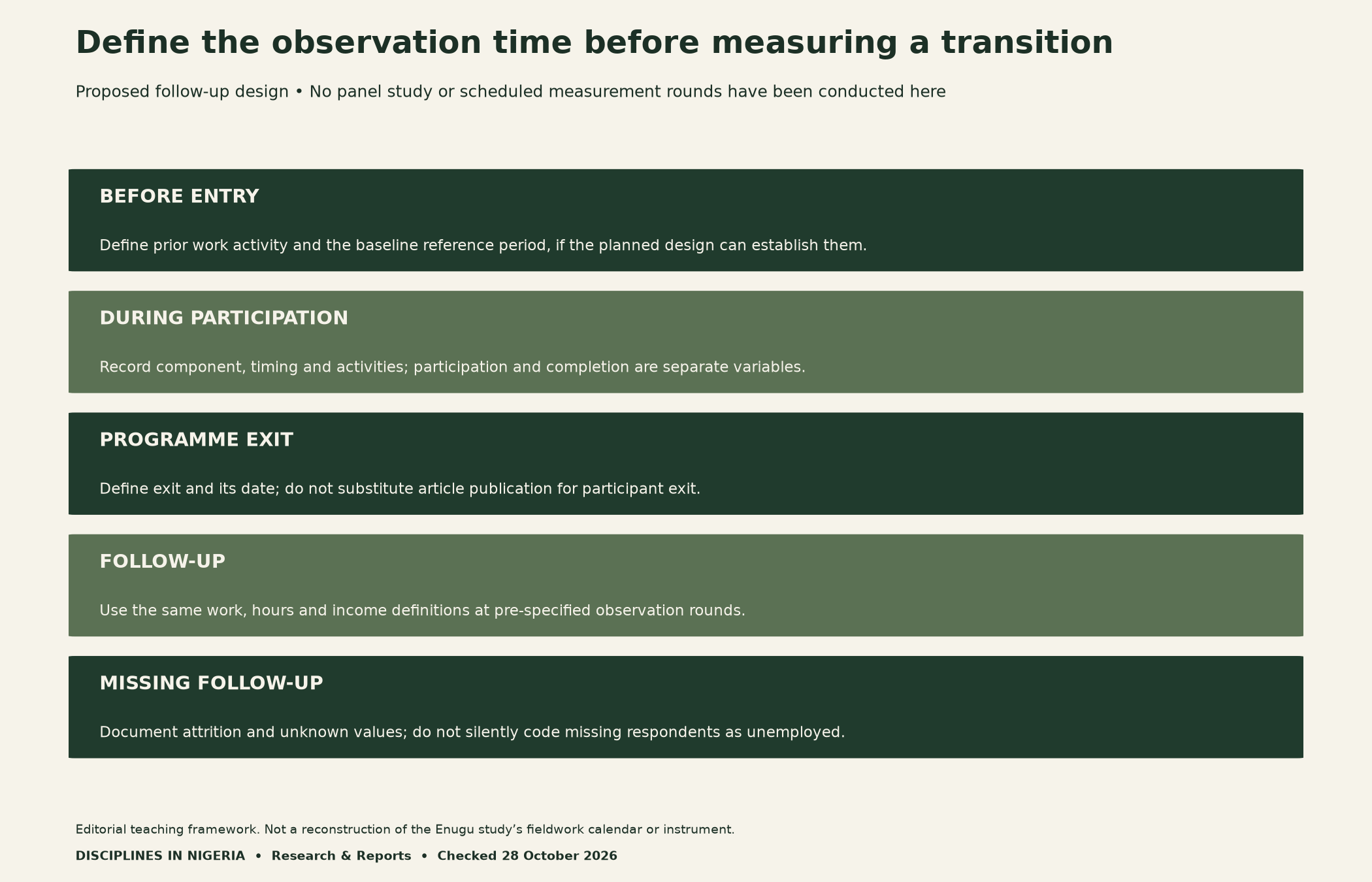
For a proposed follow-up study, specify each reference period in advance. Ask about work activity and hours for the same defined period. If collecting income, record the currency and whether the amount is weekly, monthly or another period. Allow unknown values and refusal instead of treating them as zero.
Next, decide what you mean by continuity. One interview date cannot reveal every change over a later period. Repeated observations may help describe transitions, but researchers must track missing follow-up and changes in measurement. Do not silently classify an unreachable respondent as unemployed.

Treat SEAM as a framework to test
The authors propose the Sustainable Employment Advancement Model, or SEAM. Its four dimensions are skills development, economic enablement, labour-market absorption and management continuity. The abstract explicitly describes it as conceptual rather than empirically validated. We therefore show the dimensions without an effectiveness score or causal arrows.
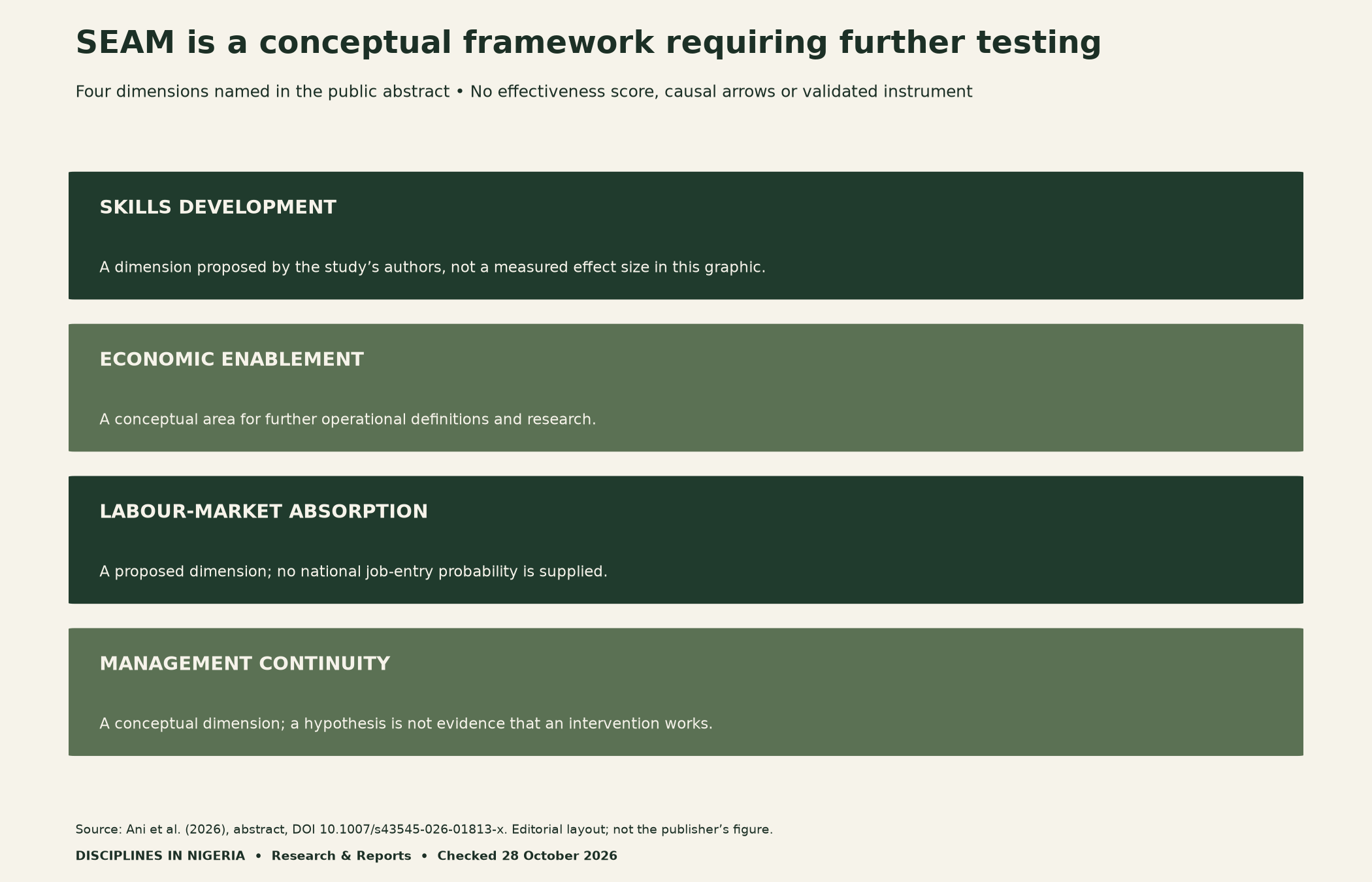
To plan a test, first define an observable indicator for each proposed concept. Then specify the relationships being examined and the evidence needed to challenge them. A neat diagram does not establish that an intervention improves outcomes. Further research may support, modify or reject particular relationships.
Keep a coding trail without inventing quotations
A transparent audit trail connects a permitted excerpt to an initial code, a candidate theme and a reviewer’s decision. It should also retain contradictory evidence. Our blank template offers fields for that process, but contains no transcript material or simulated participant statements.
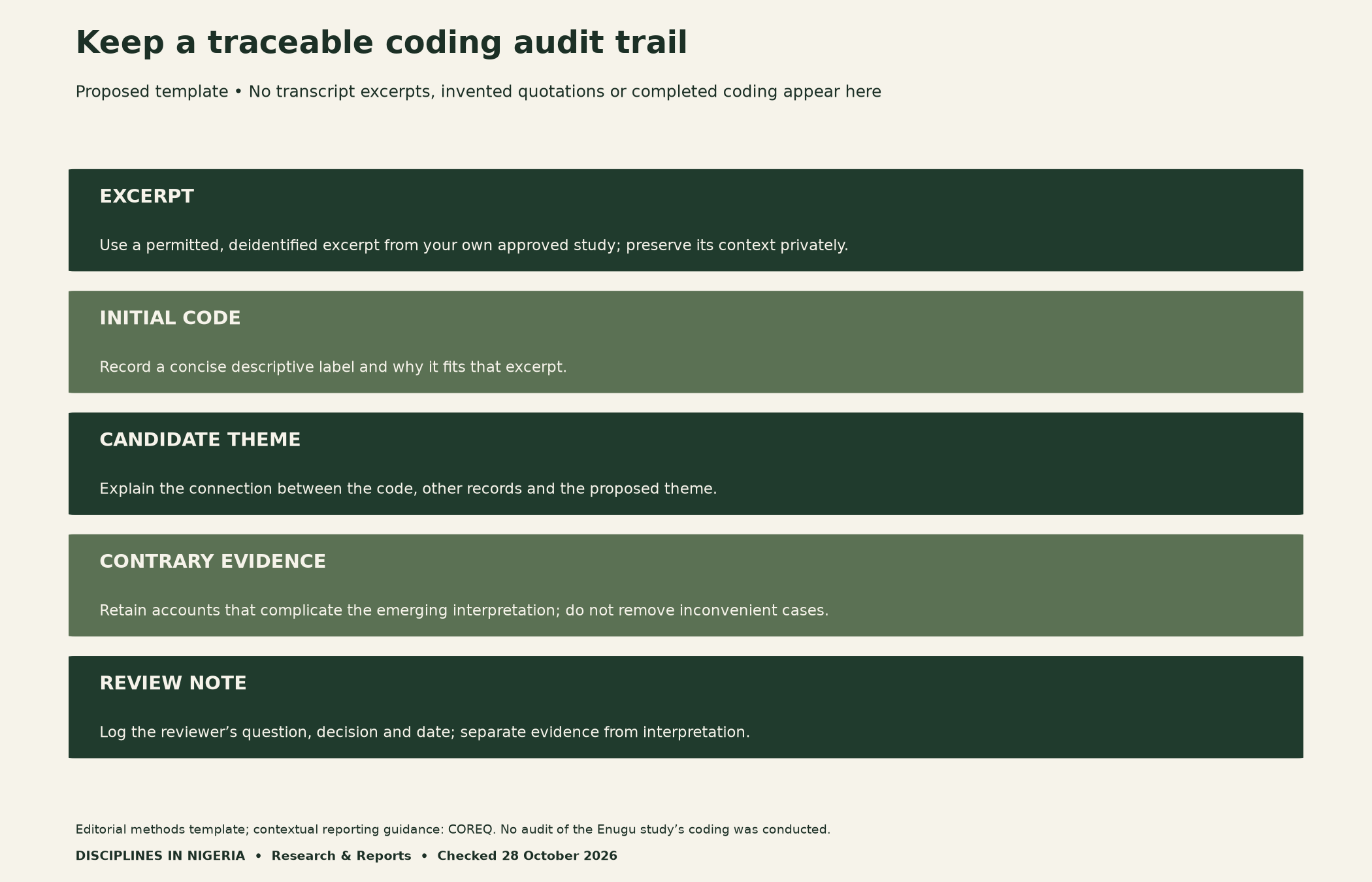
The COREQ reporting guideline provides a useful reference for interview and focus-group reporting. Use reporting prompts to identify what your own write-up should explain. Do not claim that the Enugu study passed or failed a checklist when the necessary full-text details were unavailable to us.
Before collecting new data, agree the consent, confidentiality, storage and review arrangements with the appropriate institutional supervisor or ethics process. Keep contact details separate from analytical extracts. Removing names alone may not prevent identification when an account contains a distinctive location or personal history.
Methods, limitations and reusable research tools
Our N-Power programme evaluation research methods guide transcribes four reported counts and checks their relationships. We calculate no employment rate, causal effect or national success figure. The questionnaires, claim matrix and coding trail are proposed educational tools: unvalidated, not administered and not substitutes for supervision.
For a related lesson in separating evidence from assumptions, see our NGO economic-impact measurement case study. Researchers can also use the project evidence register to check the support and permissions their chosen methods need. These resources address planning, not approval of a particular dissertation.
Download the study evidence card (CSV): four reported count rows with source links, subset relationships and the unavailable fieldwork-date label. These are descriptive counts, not employment outcomes.
Get the proposed follow-up questionnaire (CSV): twelve prompts with blank response fields. It has not been piloted, validated or administered and is not an official labour-force questionnaire.
Use the blank coding-audit template (CSV): five empty working rows for an appropriately approved study. The rows are placeholders, not participants, quotations or completed codes.
Suggested citation: Naija Scholar, Disciplines In Nigeria (28 October 2026), “Evaluating N-Power Outcomes: What a 25-Participant Study Can and Cannot Tell Nigerian Researchers.” Credit Ani and colleagues separately for their published study. Cite this guide for its editorial methods diagrams and proposed tools.