




Medical microbiology plays a crucial role in diagnosing infectious diseases in Nigeria.
It also aids in treating infectious diseases effectively.
Understanding the history of medical microbiology in Nigeria is essential.
Such knowledge helps shape future advancements in the field.
Early Beginnings of Medical Microbiology in Nigeria
Medical microbiology began to gain recognition in Nigeria in the late 19th century.
The establishment of laboratories marked this important phase.
These laboratories studied infectious diseases prevalent in the region.
They also focused on developing effective diagnostic techniques.
Significant Role in Public Health
Medical microbiology has addressed many public health challenges in Nigeria.
Identification of pathogens has been crucial in understanding disease transmission.
Consequently, preventative measures have been implemented nationwide.
Contributions to Medical Research
The history of medical microbiology in Nigeria has led to groundbreaking research.
Researchers made significant discoveries improving medical knowledge.
These advances have enhanced healthcare practices across the country.
Current Challenges and Future Directions
Despite progress, challenges still face medical microbiology in Nigeria.
Limited resources remain a major obstacle to further development.
In addition, infrastructure improvements are necessary to advance research.
Pre-colonial era
- Early practices of traditional medicine involved the use of herbs, roots, and other natural remedies.
- The role of microorganisms in diseases was not understood, leading to superstitions and misconceptions.
- Illnesses were often attributed to curses, evil spirits, or punishment from the gods.
- Healers and medicine men relied on rituals, incantations, and spiritual practices to treat ailments.
- There was a lack of scientific knowledge about the causes of infectious diseases.
Colonial era
- With the arrival of colonial powers, Western medicine and practices began to influence healthcare in Nigeria.
- Missionaries and colonial officials introduced modern medical practices and advancements to the local population.
- Mission hospitals and clinics were established, providing medical care using Western approaches and techniques.
- Microbiology started to gain recognition as a field of study, especially in relation to infectious diseases.
- European scientists and researchers conducted studies on tropical diseases prevalent in Nigeria.
Post-colonial era
- After gaining independence, Nigeria continued to develop its healthcare system and medical infrastructure.
- Government initiatives focused on improving public health and disease prevention strategies.
- Medical schools and universities started offering programs in microbiology and related fields.
- Nigerian scientists and researchers made significant contributions to the study of medical microbiology.
- Collaborations with international organizations and institutions led to advancements in research and healthcare delivery.
Current status of medical microbiology in Nigeria
- Today, Nigeria has made progress in the field of medical microbiology, with specialized laboratories and research centers.
- Diagnostic techniques have improved, allowing for the accurate identification and treatment of infectious diseases.
- Public health campaigns and vaccination programs have helped control the spread of communicable diseases.
- Ongoing research focuses on emerging infectious diseases, antimicrobial resistance, and global health challenges.
- Training programs and workshops aim to educate healthcare professionals and scientists in the latest microbiology practices.
Colonial era
During the colonial era, Western medicine was introduced to Nigeria.
This marked a significant shift in medical practices in the country.
Western medicine brought new treatment methods and technologies to Nigeria.
It also influenced the establishment of medical laboratories in the country.
Medical laboratories played a crucial role in the advancement of healthcare.
They allowed for the testing and diagnosis of various diseases and conditions.
With the establishment of medical laboratories, microbiology research began in Nigeria.
Microbiology research aimed at studying microorganisms and their impact on health.
Researchers in Nigeria started to explore the field of medical microbiology.
They conducted studies on bacteria, viruses, and other pathogens in the country.
This period laid the foundation for the development of medical microbiology in Nigeria.
You Might Also Like: The Evolving Medical Disciplines Shaping Nigeria’s Health Sector
Independence era:
After gaining independence from British colonial rule, Nigeria saw significant advancements in the field of medical microbiology.
Local professionals were trained to contribute to the country’s healthcare system.
Advancements in Medical Microbiology Post-Independence:
- Nigeria established research institutions focused on studying infectious diseases.
- Medical laboratories were equipped with modern technology for accurate diagnosis.
- Local scientists and researchers conducted groundbreaking studies on new pathogens.
- Vaccines were developed to combat prevalent diseases like yellow fever and cholera.
- Nigerian microbiologists collaborated with international experts for knowledge exchange.
Importance of Training Local Professionals in Microbiology:
- Building a pool of skilled microbiologists enhances the country’s disease surveillance capabilities.
- Local professionals understand the unique health challenges faced by the Nigerian population.
- Training programs empower indigenous experts to lead research projects and clinical trials.
- Investing in local talent fosters innovation and drives scientific discovery in the field.
- By training Nigerian professionals, the country reduces its dependence on foreign experts.
Delve into the Subject: Restorative Dentistry for Aging Population
Development of Medical Microbiology Institutions
Medical microbiology institutions have played a crucial role in shaping medical microbiology in Nigeria.
These institutions were established to provide training, research, and diagnostic services in microbiology.
Establishment of Microbiology Departments in Universities and Research Institutes
- University of Ibadan: One of the first institutions to establish a microbiology department in Nigeria.
- University of Lagos: Known for its strong emphasis on medical microbiology research and education.
- University of Nigeria, Nsukka: Another pioneer in medical microbiology education.
- Nigerian Institute of Medical Research (NIMR): Focuses on research in infectious diseases and microbiology.
- Federal Medical Centre, Ebute Metta: Provides diagnostic services in microbiology for patients.
Role of These Institutions in Contributing to Medical Microbiology in Nigeria
These institutions have made significant contributions to medical microbiology in Nigeria.
The contributions include research, education, diagnostic services, collaboration, and policy development.
- Research: Conducting research on various aspects of medical microbiology, leading to new discoveries and advancements.
- Education: Training a new generation of microbiologists and healthcare professionals.
- Diagnostic services: Offering diagnostic services to healthcare facilities and patients for infectious diseases.
- Collaboration: Partnering with international institutions to improve knowledge exchange and research outcomes.
- Policy development: Providing expertise for policy development related to infectious diseases and microbiology.
The development of medical microbiology institutions in Nigeria has advanced research, education, and healthcare services in microbiology.
Learn More: Key Biomedical Technology Courses in Nigeria
Challenges Faced in Medical Microbiology
Infrastructure
In Nigeria, the lack of adequate infrastructure poses a significant challenge in conducting medical microbiology research.
Funding
Limited financial resources hinder the acquisition of essential equipment and supplies necessary for conducting research in this field.
Transform Your Career with Expert Guidance
Get personalized mentorship consulting that’s tailored to your unique path. Our expert advice is actionable and exclusive.
Get StartedAccess to Technology
The unavailability of state-of-the-art technology and modern laboratory facilities restricts the capacity to perform advanced microbiological studies.
Impact of Challenges on the Advancement of the Field
These challenges have a detrimental effect on the progression of medical microbiology in Nigeria.
The challenges affect both research outcomes and the quality of healthcare delivery.
Infrastructure Obstacles in Research Development
Without proper laboratory facilities, researchers face obstacles in conducting experiments and investigations.
This situation prevents groundbreaking discoveries in medical microbiology.
Funding Constraints on Research Progress
Insufficient funding limits the ability to hire skilled personnel.
It also restricts purchasing necessary reagents and maintaining laboratory equipment.
Therefore, progress in the field is impeded.
Limitations Due to Lack of Technology Access
The lack of access to cutting-edge technology and specialized tools restricts the scope of research.
This constraint inhibits the development of innovative solutions to microbiological challenges.
Impact of Challenges on Healthcare Delivery
The challenges faced in medical microbiology research directly impact healthcare delivery in Nigeria.
These issues lead to delays in diagnosis, treatment, and prevention of infectious diseases.
Effect of Infrastructure Deficiencies on Healthcare
Inadequate infrastructure results in delays in obtaining accurate diagnostic results.
This delay leads to misdiagnosis and inappropriate treatment of infectious diseases.
Consequences of Funding Limitations on Public Health
Limited financial support hampers the development of new treatments and interventions.
This situation hinders progress in improving public health outcomes.
Challenges from Lack of Advanced Technology in Healthcare
The absence of advanced technology limits the capacity to conduct rapid and accurate microbiological testing.
This limitation contributes to the spread of infections and outbreaks within communities.
Addressing the challenges of infrastructure, funding, and access to technology in medical microbiology research is crucial for advancing the field in Nigeria.
Investment in these areas will enhance the country’s capacity to combat infectious diseases effectively.
Such efforts will also improve overall healthcare outcomes for the population.
Learn More: Optometry Outreach Programs in Rural Nigeria
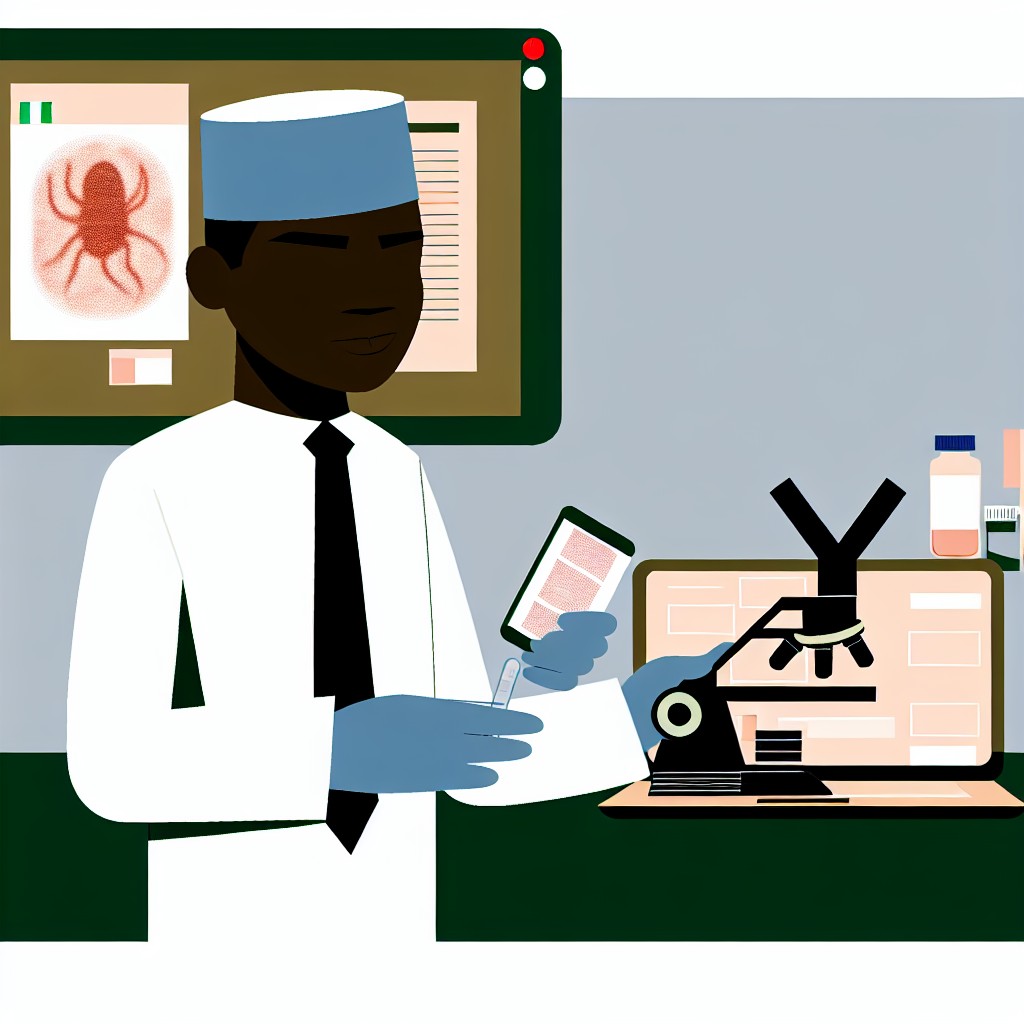
Contributions to Global Microbiology
Over the years, Nigerian researchers and scientists have made significant contributions to medical microbiology.
Their research has advanced the understanding of various diseases worldwide.
Their work has also directly impacted global health and disease prevention strategies.
Contributions of Nigerian Researchers to Medical Microbiology
- Nigerian researchers have conducted groundbreaking studies on malaria, HIV/AIDS, tuberculosis, and Ebola.
- They have discovered new pathogen strains and identified drug resistance patterns.
- Research by Nigerian scientists has contributed to global efforts to eradicate polio and other preventable diseases.
- Their work on antimicrobial resistance has raised awareness of drug-resistant bacteria worldwide.
- Nigerian microbiologists have collaborated with international organizations to study emerging infectious diseases and develop vaccines.
Impact of Nigerian Research on Global Health and Disease Prevention
- Findings from Nigerian studies have helped shape global health policies and disease prevention guidelines.
- Research on tropical diseases has led to new diagnostic tools and treatment strategies.
- Nigerian experts have shared knowledge with international collaborators to build global microbiology capacity.
- Their research has improved infectious disease surveillance, allowing faster outbreak responses.
- Collaborations with global health organizations have resulted in successful vaccination campaigns and disease control.
Nigerian researchers and scientists play a crucial role in advancing medical microbiology globally.
Their contributions have deepened understanding of infectious diseases.
Moreover, their work has had tangible impacts on public health and disease prevention worldwide.
Future prospects
Medical microbiology in Nigeria has a promising future ahead.
Many potential areas exist for growth and development.
It is essential to explore these prospects to improve public health in the country.
Exploring growth potential
- Expansion of microbiology laboratories in healthcare facilities to enhance diagnostic capabilities.
- Increasing collaboration with international research institutions for knowledge exchange and capacity building.
- Implementation of advanced technologies such as genomics and bioinformatics for research and diagnostics.
- Training and capacity building programs for healthcare professionals to improve skills in medical microbiology.
- Establishment of quality control measures to ensure accuracy and reliability of microbiology testing results.
Importance of research and investment
- Continued research is crucial to address emerging infectious diseases and antimicrobial resistance.
- Investment in research and development will lead to the discovery of new treatments and vaccines.
- Research in medical microbiology will contribute to understanding disease epidemiology and transmission patterns.
- Funding for research will advance medical microbiology in Nigeria and improve healthcare outcomes.
- Investment in infrastructure and technology will enhance healthcare facilities’ capacity to combat infectious diseases.
The future of medical microbiology in Nigeria holds great promise.
There are many opportunities for growth and development.
Ongoing research and investment are essential for improving public health outcomes.
These efforts will address challenges posed by infectious diseases and antimicrobial resistance.
Historical Insights into Medical Microbiology Development in Nigeria
Understanding the history of medical microbiology in Nigeria is crucial for future advancements in the field.
It provides insights into the challenges faced.
It also reveals the progress made over time.
Furthermore, it highlights the potential for further development.
By summarizing key points discussed in this blog post, we recognize the contributions of early pioneers.
We also acknowledge the establishment of important institutions.
The current state of medical microbiology in Nigeria is equally significant.
This historical perspective helps us appreciate the importance of research.
Collaboration plays a vital role in shaping the future of healthcare.
Continued education also drives improvement in healthcare practices.
It contributes to the prevention of infectious diseases.
Ultimately, knowledge of the history of medical microbiology in Nigeria empowers healthcare professionals and researchers.
They can build upon past achievements effectively.
Addressing current challenges becomes more feasible.
This knowledge motivates striving towards a healthier future for the Nigerian population.
Additional Resources
Oladele Adebayo Ajose (September 20, 1907 July 2, 1978) was …
The Nigerian Institute Of Medical Research – Research For National …


