



Biochemistry in Nigeria
Biochemistry in Nigeria is a crucial field of study that focuses on chemical processes within and related to living organisms.
It plays a significant role in pharmaceuticals, agriculture, food and beverage, and medical research.
Effective biochemistry research requires suitable tools and equipment.
Microscopy Tools for Biochemical Research
Microscopes help biochemists examine cells, tissues, and molecules at microscopic scales.
These instruments support research by revealing structures that remain invisible to the unaided eye.
Furthermore, microscopy enables researchers to investigate cellular organization and molecular activity.
Types of Microscopes Used in Biochemistry
Biochemistry laboratories use several microscope types, including electron, confocal, fluorescence, and phase-contrast microscopes.
Electron microscopes use electron beams to produce high-resolution images of biological samples.
Therefore, researchers can examine structures at nanometer scales.
Confocal microscopes create detailed three-dimensional images from fluorescently labeled samples.
They suit studies of molecular distribution within cells.
Fluorescence microscopes reveal selected molecules by exciting them with specific wavelengths of light.
Meanwhile, phase-contrast microscopes improve contrast in transparent specimens.
This capability makes them useful for observing living cells in real time.
Microscope Applications in Biochemistry
Microscopes allow researchers to study cellular and subcellular structures in detail.
They also provide information about the organization and function of biological systems.
By examining cells and molecules, biochemists can assess their characteristics, behaviors, and interactions.
This information helps researchers investigate biological processes and diseases.
Additionally, microscopy supports the development of therapeutic strategies.
Researchers can observe organelles, proteins, and nucleic acids through suitable imaging techniques.
Such observations help clarify the complexity of living organisms.
Microscopy can also reveal abnormalities in cells, tissues, and molecules.
These findings may provide diagnostic and prognostic insights.
Selecting Microscopes for Nigerian Laboratories
Laboratories should select microscopes that deliver accurate and reliable results.
Reputable manufacturers include Nikon, Leica, and Olympus.
These brands offer optical quality, ergonomic designs, and advanced imaging capabilities.
Nikon microscopes provide high-resolution imaging, user-friendly interfaces, and versatility for biological research.
Leica microscopes include automated workflows, multimodal imaging, and digital documentation features.
These features support complex biochemical studies.
Olympus microscopes offer optical performance, intuitive controls, and modular configurations.
Consequently, laboratories can select configurations that match their research requirements.
Reliable instruments can improve consistency and precision during microscopy applications.
Molecular Biology Kits and Reagents
Molecular biology kits and reagents support biochemical research.
These tools help researchers examine DNA, RNA, proteins, and other biomolecules.
Researchers use them in diagnosis, treatment, genetic engineering, agriculture, forensics, and environmental monitoring.
Importance of Molecular Biology in Biochemistry Research
Molecular biology helps biochemists understand complex mechanisms within living organisms.
It enables researchers to study biomolecules and examine how cells function and respond to stimuli.
Additionally, these techniques support disease research, drug development, and genetic mutation analysis.
Common Kits and Reagents for Molecular Biology Experiments
Laboratories use various kits and reagents for extraction, amplification, detection, and separation procedures.
Each kit supports specific experimental tasks and downstream molecular biology applications.
Transform Your Career with Expert Guidance
Get personalized mentorship consulting that’s tailored to your unique path. Our expert advice is actionable and exclusive.
Get StartedResearchers select suitable products according to their samples and analytical goals.
- DNA extraction kits isolate DNA from cells or tissues for downstream applications.
- PCR kits amplify specific DNA sequences for analysis and cloning.
- RT-PCR kits amplify RNA to support gene expression studies.
- Western blot kits detect and quantify specific proteins through antibody-based assays.
- Gel electrophoresis kits separate DNA, RNA, or proteins by size and charge.
Affordable and Reliable Kits Available in Nigeria
Nigerian researchers can consider several kits for routine molecular biology work.
These options support DNA extraction, RNA amplification, and complementary DNA preparation.
Researchers should match each product with their experimental requirements and available laboratory resources.
- GeneJET DNA Purification Kit offers an affordable option for DNA extraction studies.
- PrimeScript RT-PCR Kit supports gene expression analysis and RNA amplification.
- iScript cDNA Synthesis Kit prepares complementary DNA from RNA templates.
- QuickExtract DNA Extraction Solution provides a cost-effective approach to DNA extraction.
- TIANamp Genomic DNA Kit supports high-quality genomic DNA extraction in research laboratories.
Reliable molecular biology kits expand researchers’ experimental capabilities.
Moreover, affordable reagents help Nigerian biochemists conduct studies across diverse research fields.
These resources can support scientific advancement in biochemistry and related disciplines.
Explore Further: Challenges Facing Applied Microbiology in Nigeria
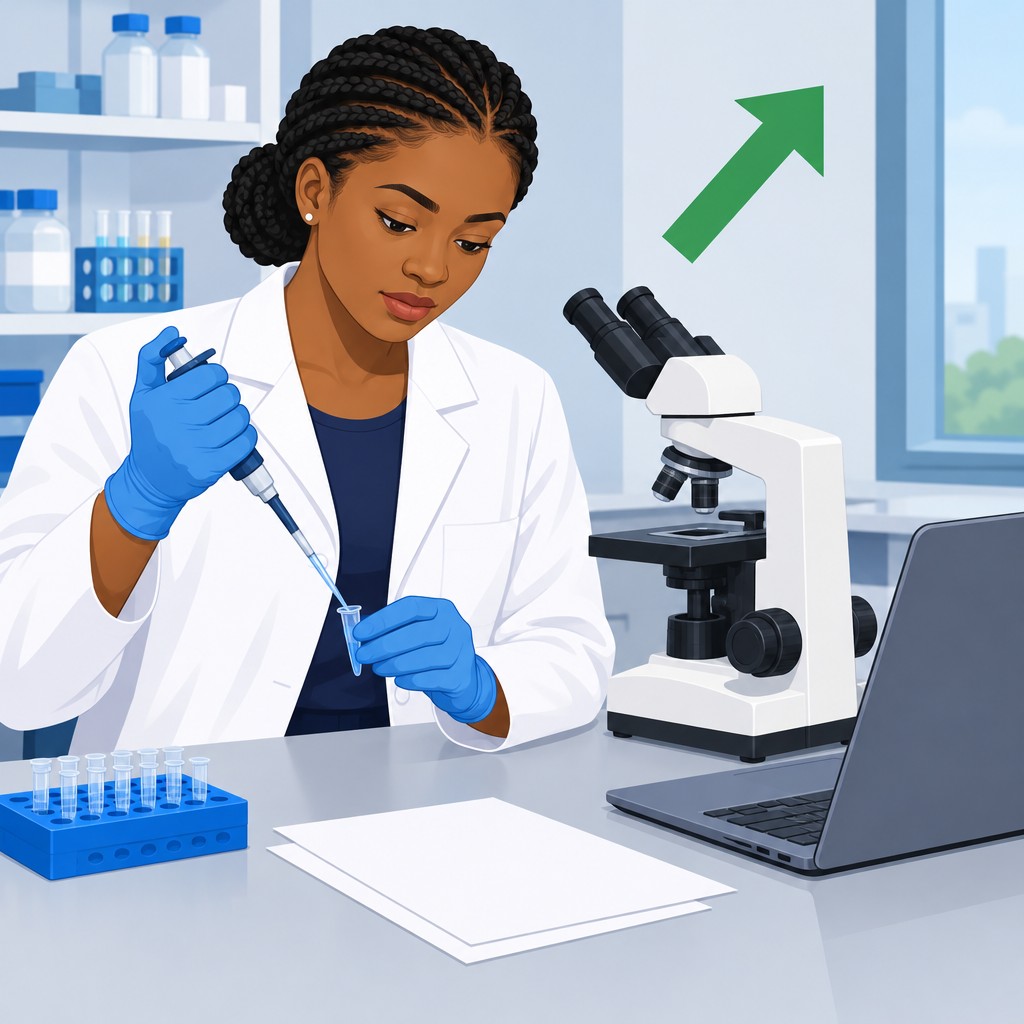
Spectrophotometers and Chromatography Systems
Spectrophotometers help Nigerian biochemists measure biomolecule absorbance and concentration.
These instruments use light absorption at specific wavelengths to determine substance quantities.
Chromatography systems separate and analyze complex biomolecule mixtures through differential migration.
Roles of Spectrophotometers
Spectrophotometers support accurate absorbance measurements and quantitative sample analysis.
They also help researchers determine biomolecule purity and concentration.
Furthermore, these instruments support enzyme kinetics, protein assays, and compound identification.
- Measure biomolecule absorbance and concentration accurately.
- Facilitate quantitative sample analysis for research purposes.
- Determine biomolecule purity and concentration within samples.
- Monitor enzyme kinetics and protein assays.
- Identify and quantify specific sample compounds.
Importance of Chromatography Systems
Chromatography systems separate mixture components according to their interactions with stationary and mobile phases.
Researchers can then purify biomolecules and examine their individual properties.
Additionally, these systems help identify unknown compounds and measure component concentrations.
- Separate complex mixtures into individual components for analysis.
- Enable biomolecule purification for further studies.
- Identify unknown compounds within samples.
- Characterize biomolecule structures and properties.
- Quantify different mixture components.
Recommendations for Advanced Analytical Systems
Laboratories can improve analytical performance by selecting instruments suited to their research requirements.
UV-Vis and fluorescence systems provide complementary approaches for biomolecule analysis.
Meanwhile, HPLC and GC-MS systems expand separation and compound analysis capabilities.
- Invest in UV-Vis spectrophotometers with broad detection capabilities.
- Consider fluorescence spectrophotometers for fluorescent biomolecule analysis.
- Upgrade to HPLC systems for improved separation efficiency.
- Explore GC-MS systems for volatile compound analysis.
- Maintain and calibrate instruments regularly for accurate results.
Building Stronger Analytical Capabilities
These instruments enable Nigerian laboratories to conduct research and analyze biochemical samples effectively.
They also support biomolecule characterization across diverse laboratory investigations.
Regular maintenance, calibration, and technology updates help laboratories sustain reliable analytical work.
Gain More Insights: Customer Trends in Nigerian Boat Building Market
Bioinformatics Software and Databases
Bioinformatics helps researchers process and interpret large biological datasets efficiently.
It supports the integration of different biological information types.
This integration enables deeper understanding of complex biological systems.
Significance of Bioinformatics in Biological Data Analysis
Bioinformatics provides important methods for analyzing biological data.
Researchers use these methods to manage large datasets more efficiently.
Additionally, bioinformatics connects different data types for biological interpretation.
Popular Bioinformatics Tools and Databases
Nigerian biochemists use several software tools and databases in bioinformatics research.
These resources support sequence analysis, protein research, and biological information management.
Moreover, each resource provides functions suited to specific research tasks.
- BLAST supports sequence similarity searches.
- NCBI provides numerous bioinformatics resources.
- Geneious supports sequence analysis and manipulation.
- Expasy provides tools for protein analysis.
Free and Low-Cost Bioinformatics Resources
Nigerian biochemists can access several free or low-cost bioinformatics resources.
These resources can support biological computation, sequence analysis, and reproducible research.
Furthermore, they provide practical options for expanding bioinformatics research capabilities.
- Biopython provides a free, open-source library for biological computation in Python.
- EMBOSS offers a range of bioinformatics tools.
- Galaxy supports accessible, reproducible, and transparent bioinformatics research.
- EMBnet offers free resources and training programs through its global network.
Explore Further: Boat Building Associations and Networks in Nigeria
Centrifuges and Incubators for Biochemical Analysis
Centrifuges and incubators support important activities in biochemical analysis.
Researchers use centrifuges to separate biological molecules and incubators to support cell cultures.
Together, these instruments help biochemists conduct controlled and reliable laboratory experiments.
Functions of Centrifuges in Separating Biological Molecules
Centrifuges separate biological molecules according to differences in density.
During high-speed spinning, denser molecules move toward the bottom of the container.
Meanwhile, lighter molecules remain closer to the top, allowing researchers to isolate specific components.
Importance of Incubators for Controlled Cell Culture
Incubators provide controlled environments for cell culture experiments.
They maintain suitable temperature, humidity, and carbon dioxide levels for cell growth.
Consequently, researchers can support cell viability and conduct accurate, reproducible experiments.
Recommendations for Nigerian Biochemists
Nigerian biochemists should consider reliability, performance, and ease of use when selecting equipment.
They should also match each instrument to their sample types and experimental requirements.
The following centrifuges and incubators offer suitable options for biochemical analysis.
Reliable Centrifuges
These centrifuges support dependable separation of biological molecules during laboratory analysis.
They provide different speed and rotor options for various sample sizes and types.
Researchers can select among these models according to their operational needs.
- Beckman Coulter Avanti J-E Centrifuge
- Eppendorf 5810R Refrigerated Centrifuge
- Hettich Mikro 220R Benchtop Centrifuge
Suitable Incubators
These incubators provide controlled conditions for cell culture experiments.
They regulate temperature, humidity, and carbon dioxide levels to support cell growth.
Additionally, their stable environments help researchers maintain suitable conditions for in vitro cultures.
- Thermo Fisher Scientific Heracell VIOS CO2 Incubator
- Binder CB Series Air-Jacketed CO2 Incubator
- Memmert ICOmed Twin Display Incubator
Reliable centrifuges and incubators can strengthen biochemical analysis in Nigerian laboratories.
By choosing suitable equipment, biochemists can improve experimental control and analytical accuracy.
Gain More Insights: Career Opportunities for Zoology Graduates in Nigeria
Personal Protective Equipment for Biochemistry Labs
Wearing proper PPE helps prevent exposure to hazardous chemicals in biochemistry laboratories.
Proper PPE protects biochemists from harmful chemicals and supports their safety and well-being.
Therefore, laboratory workers should use suitable protective equipment during potentially hazardous tasks.
Importance of Proper PPE
Biochemists need protection when they handle biohazardous materials and chemicals.
Gloves, lab coats, goggles, and masks help reduce contact with hazardous substances.
Using these items consistently helps biochemists maintain safer laboratory practices.
PPE Selection and Maintenance
Choose PPE that fits properly to provide effective protection.
Regular inspections help identify damaged or worn-out equipment.
Additionally, proper cleaning, storage, and care help maintain PPE effectiveness.
Follow these guidelines when selecting and maintaining protective equipment.
- Choose PPE that fits properly to provide maximum protection.
- Regularly inspect and replace damaged or worn-out PPE.
- Clean and disinfect PPE after each use to prevent cross-contamination.
- Store PPE in a designated area away from chemicals.
- Follow manufacturer guidelines for proper care and maintenance.
In Nigerian biochemistry labs, safety remains a top priority.
By following these guidelines, biochemists can protect themselves and others from potential hazards.
Prevention remains essential when workers handle hazardous materials.
Essential Equipment for Reliable Biochemistry Research
Essential laboratory equipment supports reliable biochemistry research in Nigeria.
Microscopes, centrifuges, and spectrophotometers help biochemists pursue accurate results.
Therefore, Nigerian biochemists should invest in high-quality equipment and consider timely laboratory upgrades.
Additional Resources
Google search results for Essential Tools for Nigerian Biochemists Sciences
Bing search results for Essential Tools for Nigerian Biochemists Sciences


