



Automotive Design and Manufacturing Education
- Automotive design creates vehicle appearances and supports their functionality.
- Manufacturing courses teach production processes and quality control for vehicle production.
- These courses support Nigeria’s industrial development and economic growth.
- They also strengthen the country’s automotive sector.
- Furthermore, these courses develop skilled professionals for Nigeria’s automotive industry.
- Consequently, graduates can access more job opportunities and compete globally.
- Automotive courses provide students with practical skills and technical knowledge.
- They also introduce current trends and technologies in the automotive industry.
- Additionally, these courses encourage innovation and creativity in vehicle production.
- Therefore, automotive education remains essential to Nigeria’s industrial progress.
Automotive Design and Manufacturing Education in Nigeria
Demand for skilled automotive professionals has increased interest in related courses across Nigeria.
These programs combine engineering knowledge with practical training for vehicle development and production.
Students also learn to troubleshoot technical challenges and improve automotive manufacturing processes.
Institutions Offering Automotive Engineering Courses
- The University of Lagos offers a Bachelor of Science in Automotive Engineering, covering vehicle design, propulsion systems, and manufacturing processes.
- Federal University of Technology, Owerri, offers automotive courses through Mechanical Engineering, focusing on engines, vehicle dynamics, and materials selection.
- Ladoke Akintola University of Technology offers a Bachelor of Technology in Automotive Engineering, including design, manufacturing, and testing.
Curriculum and Specialization Options
The curriculum combines theoretical lessons with practical engineering activities.
Students study vehicle dynamics, aerodynamics, materials science, manufacturing processes, and computer-aided design software.
Depending on the institution, students may focus on automotive design, manufacturing processes, engine design, or vehicle testing.
Additionally, internships and industry projects can provide practical experience.
Graduates can pursue roles in vehicle design, manufacturing, research and development, or quality control.
Admission Requirements for Automotive Courses
Applicants must satisfy academic conditions before enrolling in automotive design and manufacturing courses in Nigeria.
These conditions establish foundational knowledge for technical study.
Institutions may also assess applicants through additional admission procedures.
Academic Qualifications for Enrollment
Most applicants need at least five O’Level credit passes.
These credits commonly include Mathematics, English Language, Physics, Chemistry, and Technical Drawing.
Furthermore, a strong science background helps students manage the course requirements.
Entrance Examinations and Portfolio Requirements
Some institutions require prospective students to pass entrance examinations.
These examinations assess each applicant’s aptitude and readiness for the program.
Some institutions may also request portfolios showing design or technical skills.
Materials That Demonstrate Applicant Skills
Applicants can present drawings, sketches, CAD models, or other relevant projects.
Such materials demonstrate creativity and technical ability.
Meeting these requirements allows aspiring students to begin their automotive industry journey.
Uncover the Details: Top Mechanical Engineering Projects in Nigerian Universities
Career Opportunities
- Automotive design and manufacturing graduates can pursue varied careers.
- These courses provide skills for several roles across the automotive industry.
- Available opportunities include engineering, design, production, quality assurance, maintenance, research, sales, and marketing.
Automotive Engineer
- Automotive engineers design, develop, and test vehicles and their components.
- They improve vehicle fuel efficiency, safety, and overall performance.
- Automotive design and manufacturing graduates suit this technical role.
Automotive Designer
- Automotive designers create the visual appearance and aesthetics of vehicles.
- They develop concepts, sketches, and three-dimensional models for vehicle interiors and exteriors.
- Creative ability and technical knowledge support success in this profession.
Production Manager
- Production managers oversee vehicle manufacturing processes in factories.
- They manage production targets, quality standards, and operational costs.
- Manufacturing knowledge prepares graduates for this supervisory position.
Quality Assurance Specialist
- Quality assurance specialists monitor vehicle quality during production.
- They identify defects and introduce corrective actions.
- They also ensure compliance with relevant industry standards.
Maintenance Engineer
- Maintenance engineers keep machinery and equipment operating smoothly.
- They perform preventive maintenance and troubleshoot operational problems.
- They also repair mechanical systems within automotive plants.
Research and Development Engineer
- Research and development engineers create automotive technologies and improve existing systems.
- They conduct experiments and analyze technical data.
- They propose design enhancements for vehicles and their systems.
Sales and Marketing Specialist
- Sales and marketing specialists promote and sell vehicles through various channels.
- They analyze market trends and develop promotional strategies.
- They build relationships with customers and other clients.
Professional Growth in Automotive Careers
Automotive design and manufacturing graduates can enter several professional paths within the automotive industry.
They can apply technical, creative, analytical, or communication skills in different workplace settings.
These roles provide opportunities to develop rewarding careers across vehicle development, production, and commercial activities.
Find Out More: Professional Certifications for Surveyors in Nigeria
Industry Partnerships and Internship Opportunities
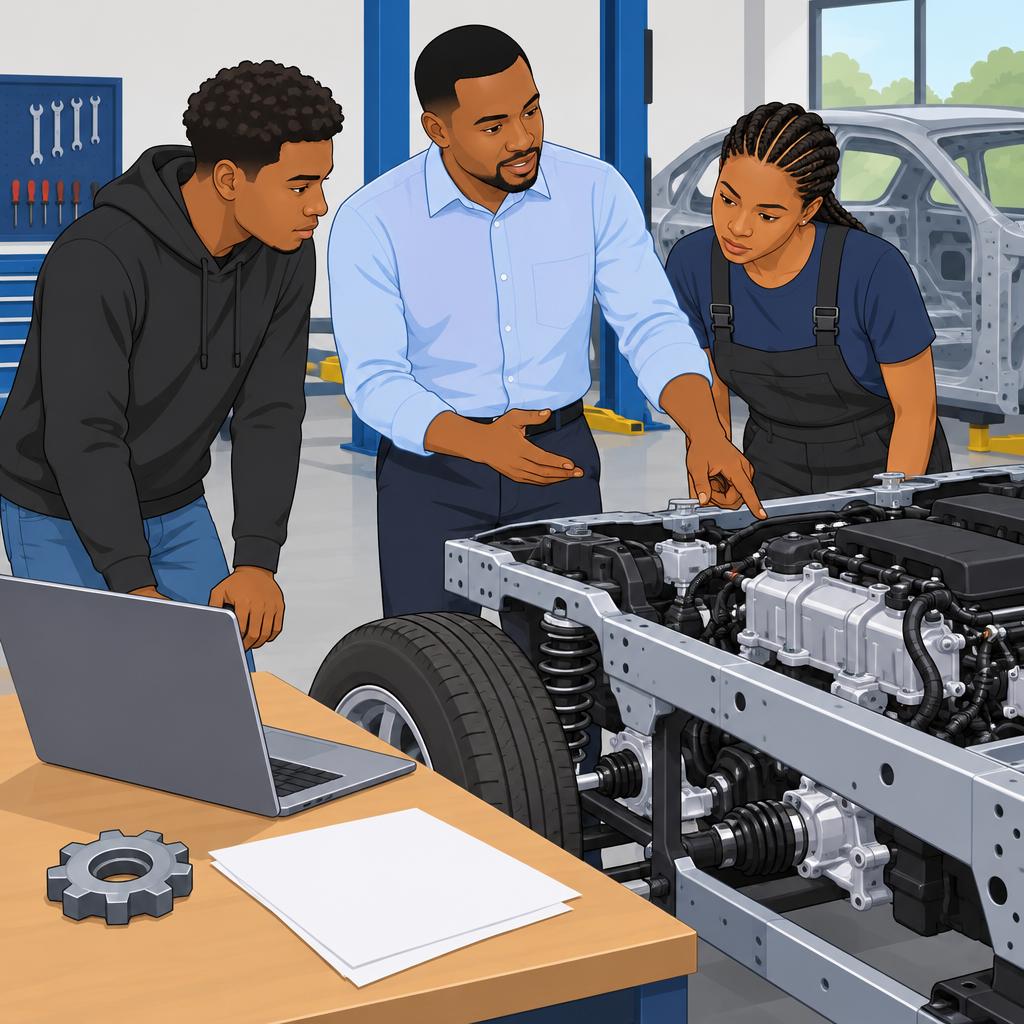
Automotive design and manufacturing courses in Nigeria emphasize practical training.
Meanwhile, industry partnerships connect classroom learning with real-world experience.
These relationships expose students to current automotive trends and technologies.
Collaboration with Industry Partners
Automotive companies and manufacturers support practical learning through industry collaboration.
Through these partnerships, students gain valuable insights into automotive work.
Additionally, collaboration helps institutions align training with industry developments.
- Automotive design and manufacturing courses in Nigeria prioritize practical training.
- These courses collaborate with industry partners to provide real-world experience.
- Partnerships with automotive companies and manufacturers help students gain industry insights.
- Collaboration ensures that students learn current trends and technologies.
Importance of Internships
Internships prepare students to enter the automotive workforce with practical experience.
They also help students apply theoretical knowledge in real-world settings.
Furthermore, workplace experience strengthens communication, teamwork, and problem-solving abilities.
- Internships play a crucial role in preparing students for the workforce.
- Students gain hands-on experience and apply their theoretical knowledge.
- Internships help students develop problem-solving and critical thinking skills.
- Working in real-world settings enhances communication and teamwork abilities.
- Internships provide networking opportunities that can support future job prospects.
Uncover the Details: Top Universities for Mechatronics in Nigeria
Access to Modern Automotive Equipment
Students may lack access to state-of-the-art equipment and technology during their automotive studies.
This limitation can reduce practical learning and restrict exposure to industry standards.
Therefore, educational institutions should invest in modern equipment and relevant technologies.
Industry partnerships and government infrastructure support can help institutions achieve this investment.
Qualified Instruction for Practical Learning
Students may also encounter a shortage of instructors with practical automotive experience.
Transform Your Career with Expert Guidance
Get personalized mentorship consulting that’s tailored to your unique path. Our expert advice is actionable and exclusive.
Get StartedThis shortage can affect education quality and limit students’ development of relevant industry skills.
Institutions should provide training programs that update instructors’ knowledge and technical abilities.
Additionally, professionals can deliver guest lectures and workshops that provide valuable practical insights.
Hands-On Training and Industry Exposure
Limited hands-on training can prevent students from applying theoretical concepts to real-world situations.
Without practical experience, learners may struggle to develop confidence and workplace competence.
Educational institutions should establish automotive partnerships that support internships and industrial attachments.
Work-study programs can strengthen practical skills while creating useful industry connections and references.
Curriculum Alignment with Industry Developments
Some automotive courses may use curricula that do not reflect current industry trends.
Outdated content can leave graduates without the skills employers require.
Institutions should review and update automotive curricula regularly.
Industry professionals can contribute insights about emerging technologies and changing workplace expectations.
Explore Further: Land Surveying Projects: Planning and Execution
Building a Future in Automotive Design and Manufacturing
These courses can help learners prepare for Nigeria’s growing automotive industry.
They provide knowledge and practical abilities for people interested in vehicle design and manufacturing.
Furthermore, students can develop expertise that supports long-term professional growth.
Studying in this field can connect personal interests with meaningful career goals.
Passionate learners can therefore begin developing skills for the automotive sector.
Choosing a suitable course represents an important step toward professional development.
Each program offers a pathway for strengthening technical knowledge and practical confidence.
Moreover, continued learning can help graduates respond to changing automotive industry needs.
These opportunities allow determined individuals to contribute to Nigeria’s automotive future.
Prospective students should consider their interests before selecting an automotive course.
They can then begin a focused journey toward automotive design and manufacturing.
Ultimately, the right education can support a rewarding career in this dynamic field.
Additional Resources
Google search results for Automotive Design and Manufacturing Courses in Nigeria Engineering
Bing search results for Automotive Design and Manufacturing Courses in Nigeria Engineering


