






Peer focus group research reflexivity Nigeria projects should make existing relationships visible before you ask the first question. Interviewing classmates may make discussion easier. It may also make someone hesitate to disagree, disclose a concern or criticise a shared institution. Consider both possibilities.
A University of Ibadan study published on 13 November 2026 provides a useful methods example. It reports three discussions with 7, 10 and 6 female clinical students: 23 participants from 30 invitations. Fellow students moderated the discussions, and the team disclosed academic relationships. Our focus is research design, not the clinical validity of participant suggestions.
Peer focus group research reflexivity Nigeria: define the relationship
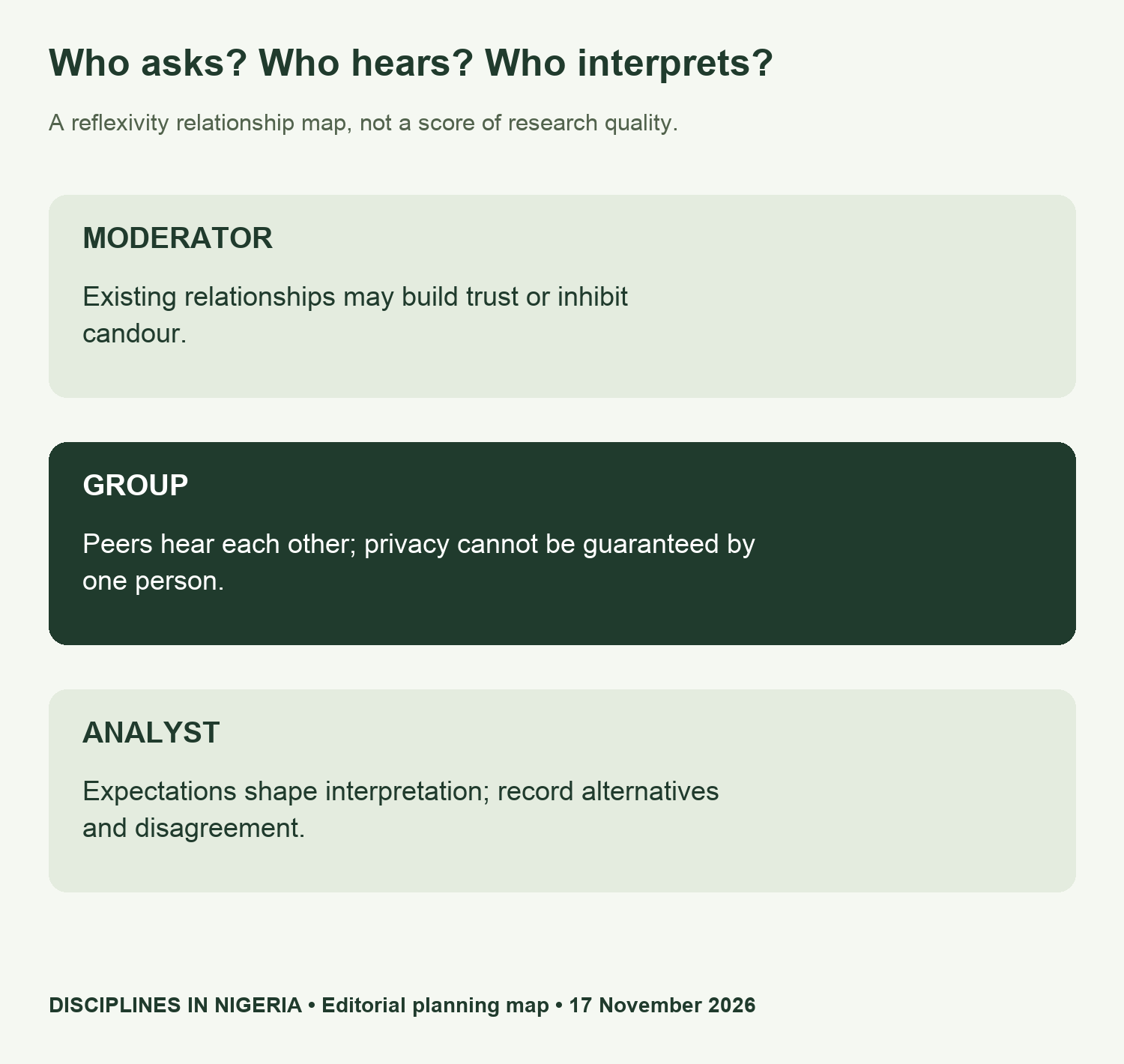
Begin with roles rather than names. Ask who recruits, who moderates, who hears the discussion and who interprets the transcript. A person can occupy several roles. The blank map allows you to record a possible influence, a response to review with your supervisor and the limit that remains.
Familiarity can provide shared language and context. However, participants may worry about later classroom contact or how an answer affects a relationship. An outsider may reduce some pressures while introducing others. Explain the trade-off for your question instead of declaring either moderator type automatically superior.
Keep the public map anonymous. A relationship category can be useful without disclosing a classmate’s identity or sensitive experience. Instead, store any necessary identifying key only within the approved research system. The downloadable worksheets contain no participant records and are not requests for personal disclosures.
Calculate participation without claiming representativeness
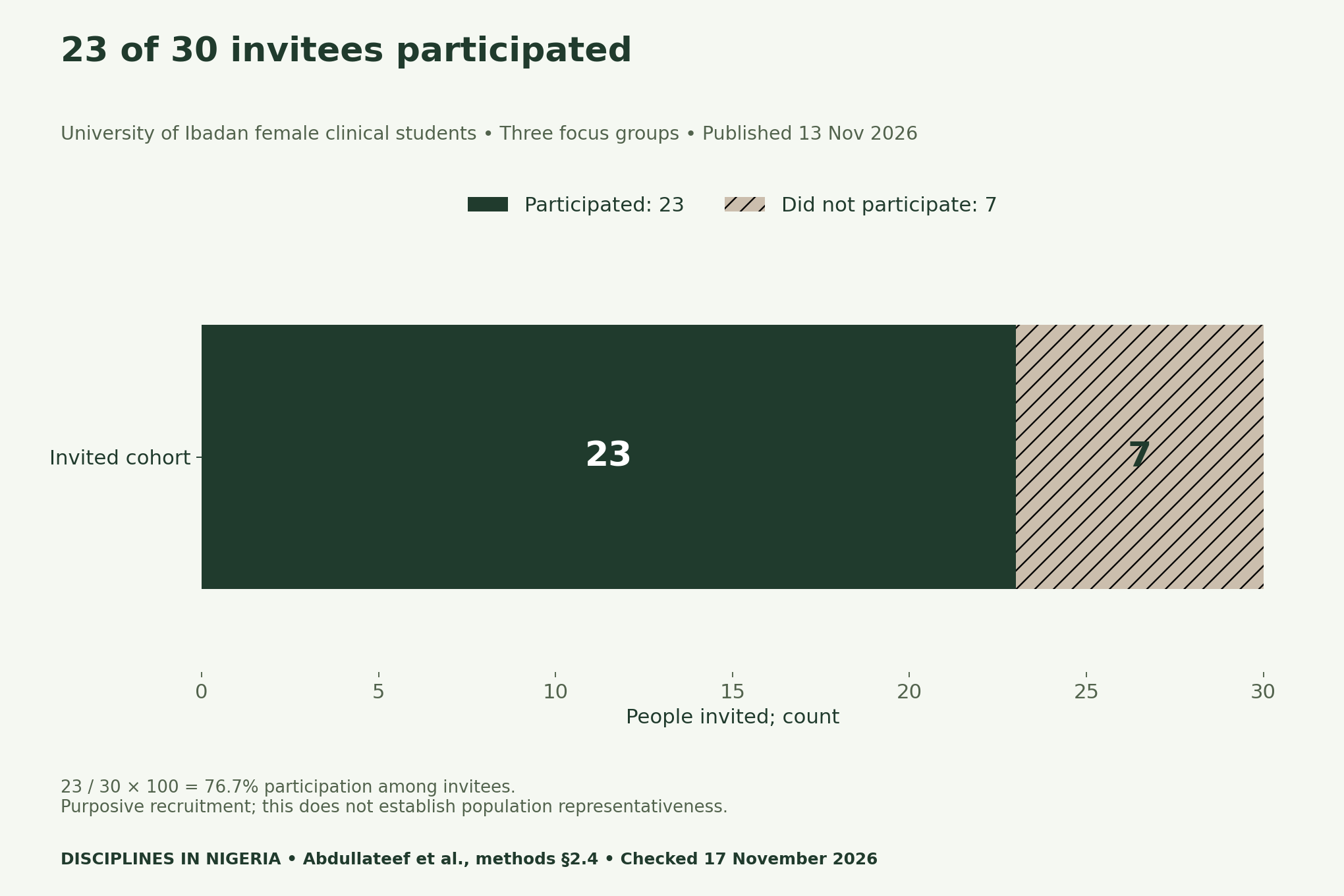
Divide 23 by 30 and multiply by 100 to obtain 76.7%, rounded to one decimal. The subtraction 30 minus 23 gives seven nonparticipants. Those calculations describe recruitment. They do not show what nonparticipants would have said or whether views are balanced across a wider population.
Researchers select a purposive qualitative sample for a research purpose. They do not use it to estimate a population percentage through random sampling. Describe the selection logic and relevant context. Do not turn an easy-to-calculate fraction into a claim that the study measured how all students think or behave.
Keep group size separate from theme importance
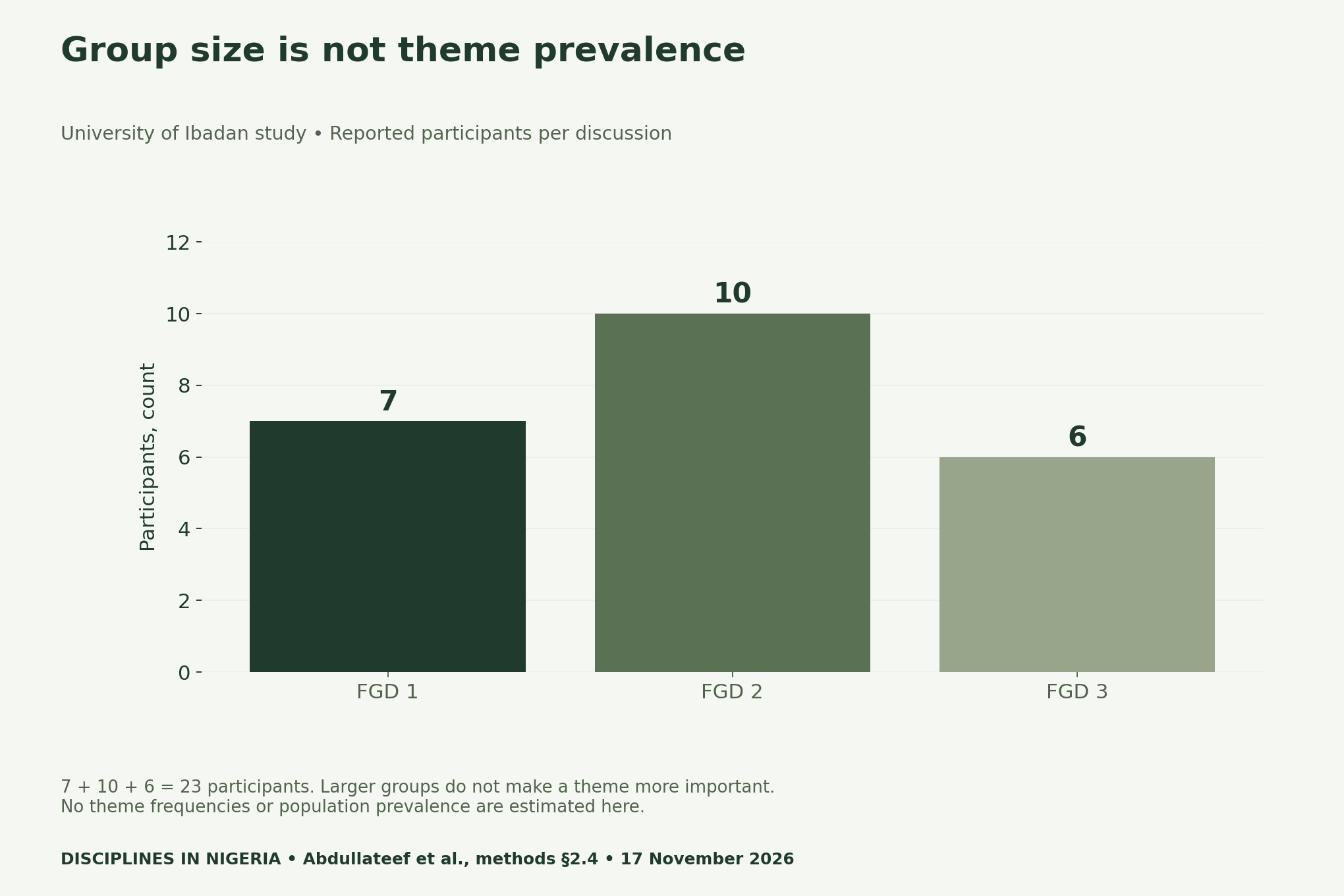
For example, a larger discussion can produce more speech while still leaving some participants unheard. Meanwhile, a smaller group can generate a rich disagreement. Group size alone cannot settle either question. Record interaction, silence, prompting and divergent accounts in a session memo rather than treating every group as an identical data container.
Likewise, a striking quotation should not become a prevalence estimate. A theme concerns an interpretation of meaning in context. Explain how the analysis was developed and retain evidence that challenges your preferred reading. Frequency can be relevant to some designs, but researchers must define and justify its use rather than infer it from these bars.
Explain consent and the limits of group confidentiality
Protect voluntary participation through the institution’s approved process. Consider who delivers invitations and whether declining could feel consequential. Explain relevant researcher relationships and what will happen to recordings, notes and transcripts. Use the approved protocol for withdrawal and access arrangements.
A moderator can control research-team handling of records. However, the moderator cannot guarantee that every participant will keep everything heard in the room private. Explain that limit plainly and agree group expectations without promising perfect confidentiality. A sensitive topic may require a different collection method after supervisory and ethics review.
The checklist is a starting point for discussion with your institution, not a substitute for approval. It asks about voluntariness, recording, access, privacy and interpretation. Adapt it to the actual topic and setting before recruitment. No real research session or consent process has been conducted for this article.
Write a post-session memo before interpretation hardens
After a session, separate the observation from your explanation. For example, a long pause is an observation; assuming it means agreement is an interpretation. Note the prompt, interaction and alternative explanations while the context is fresh. Avoid assigning a motive without supporting evidence.
In addition, record the moderator’s own expectations. What answer did you anticipate? Which account felt surprising or uncomfortable? Discuss those reactions with the research team and compare interpretations against the material. A reflexivity memo does not eliminate judgment; it makes the reasoning more visible.
Our Education archive offers wider student-research context. This guide helps readers plan a transparent record. It does not certify a method as ethical or suitable for every topic, nor does it validate the study participants’ health recommendations.
Method, limits and downloadable worksheets
We inspected the primary paper’s recruitment, reflexivity, data-collection and ethics sections on 17 November 2026. Our calculations reconcile the participation fraction and the three group counts. The review did not analyse participant-level data, raw transcripts or new interviews. Finally, we distinguish publication date from the timing of data collection.
The original study concerns one institution and a particular group. Our diagrams and blank tools are editorial teaching aids requiring institutional adaptation. They do not establish causal effects of peer moderation or provide clinical advice. Keep any operational research plan subject to the relevant supervisory and ethics process.
- Recruitment counts and participation arithmetic (CSV)
- Blank anonymous researcher-relationship map (CSV)
- Blank post-session reflexivity memo (CSV)
- Consent and group-confidentiality planning checklist (CSV)
Suggested citation: Disciplines In Nigeria, “Interviewing Your Classmates: A Reflexivity Checklist for Nigerian Student Researchers”, 17 November 2026. Methods example: Abdullateef et al., DOI 10.1186/s12982-026-03145-w; arithmetic and teaching tools by this publication.


