







Research on ceramic tile waste concrete in Nigeria needs more than one strength result. A useful appraisal checks the arithmetic, compares the measured properties and records unresolved claims. This article provides an original calculation audit and four CSV tools for engineering students. It gives no construction recipe or structural specification.
Evidence checked: 5 November 2026. Treat the findings as laboratory observations under the study's conditions. They do not approve a material for a particular building or exposure.
What the ceramic tile waste concrete study in Nigeria tested
Umasabor, Ikponmwosa and Olalekan published their University of Benin study on 3 November 2026. They tested ceramic tile waste replacing granite at 0%, 10%, 20%, 30% and 40% by mass, with a water–cement ratio of 0.5. At 10% replacement, the reported 28-day compressive strength was 20.3 N/mm². Read the primary experiment.
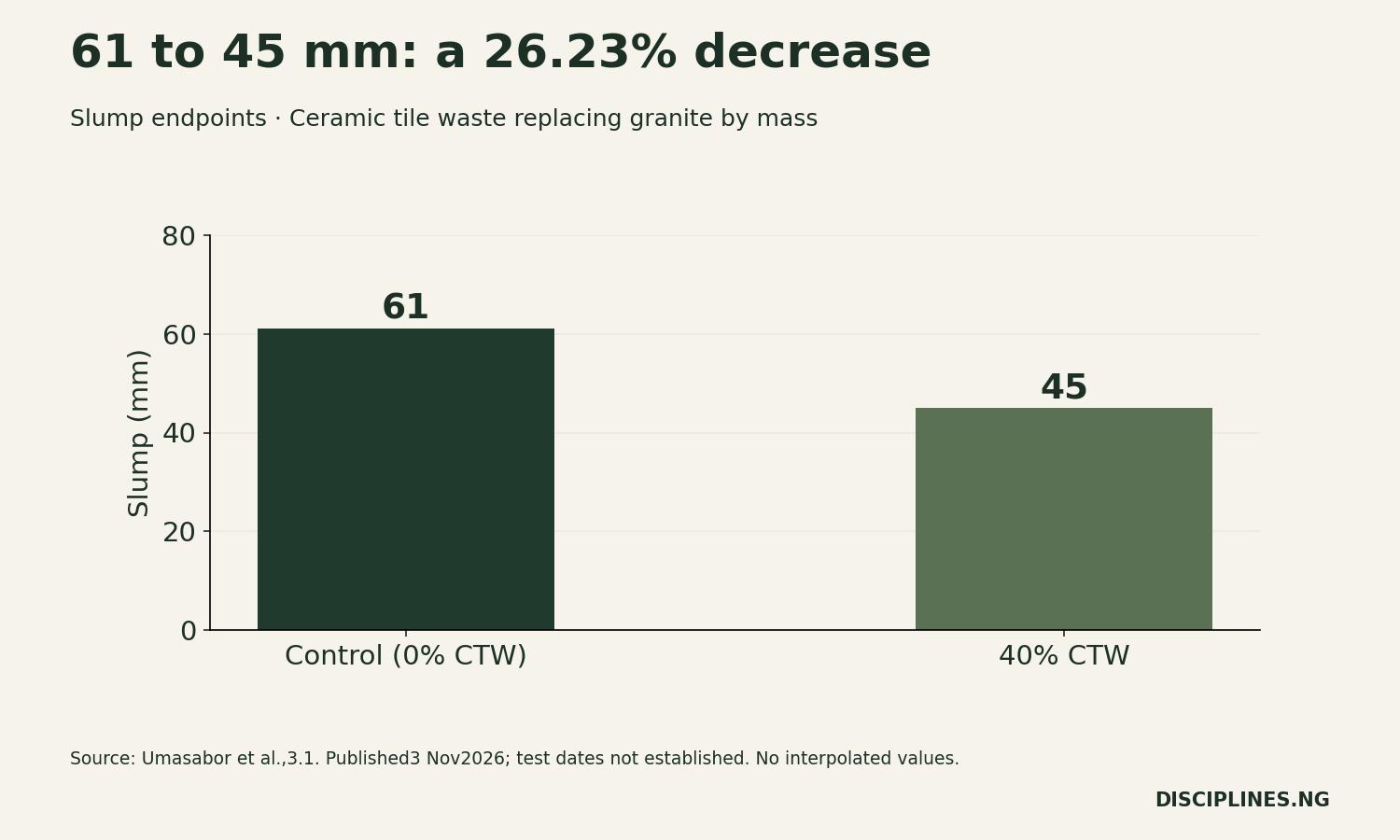
The results section reports slump of 61 mm for control and 45 mm at 40% replacement. The conclusion calls this approximately a 74% decrease. Recalculation gives a 26.23% decrease and 73.77% retained.
The paper also conflicts on absorption: section 3.3 reports a 51% increase at 10% replacement, while conclusion iii gives approximately 25%. Flexural and tensile percentage wording differs across sections too. These discrepancies remain unresolved in our ledger.
Recalculate the denominator before interpreting the result
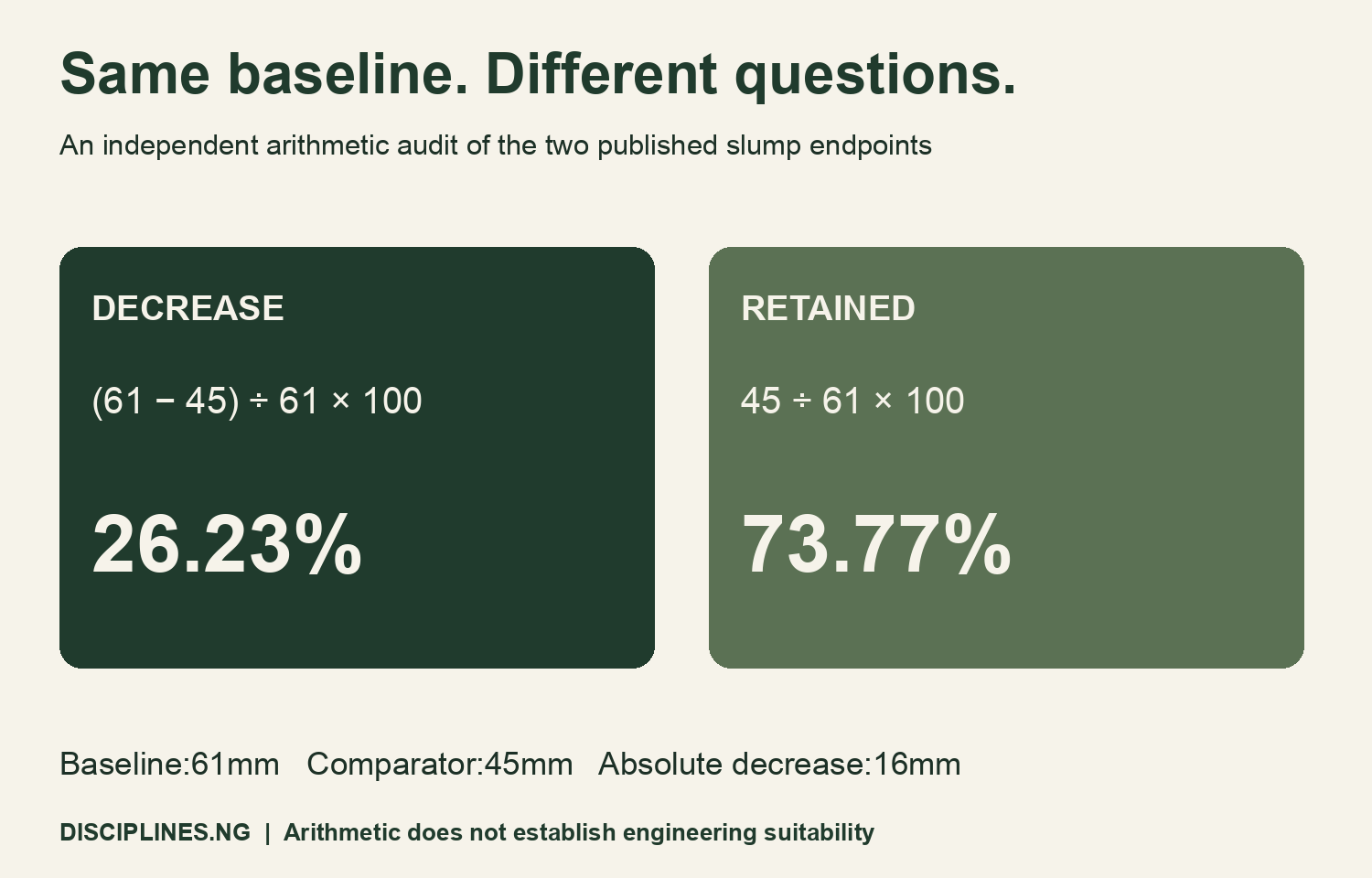
Start with the difference: 61 − 45 = 16 mm. For a percentage decrease relative to control, divide that difference by 61 and multiply by 100. Thus, 16 ÷ 61 × 100 = 26.2295%, rounded to 26.23%.
For the retained share, divide 45 by 61 instead. That calculation gives 73.7705%, rounded to 73.77%. The retained share and the decrease add to 100% before rounding. They answer different questions.
| Calculation | Formula | Result |
|---|---|---|
| Absolute decrease | 61 − 45 | 16 mm |
| Percentage decrease | (61 − 45) ÷ 61 × 100 | 26.23% |
| Percentage retained | 45 ÷ 61 × 100 | 73.77% |
When checking another paper, write the denominator beside every percentage. “Control is higher than the alternative” can use a different denominator from “the alternative is lower than control.” Reversing the sentence does not preserve the percentage automatically.
Strength, durability and sustainability need separate evidence
A compressive-strength result describes a specimen response under stated test conditions. It does not settle every performance requirement. Similarly, a preliminary absorption measurement does not establish comprehensive durability, and using waste does not by itself establish a lifecycle benefit.
The study describes absorption as preliminary and identifies missing sulfate-resistance and rapid chloride-penetration testing. Testing dates were not established for this appraisal. We do not convert its broad recommendation into site-specific approval.
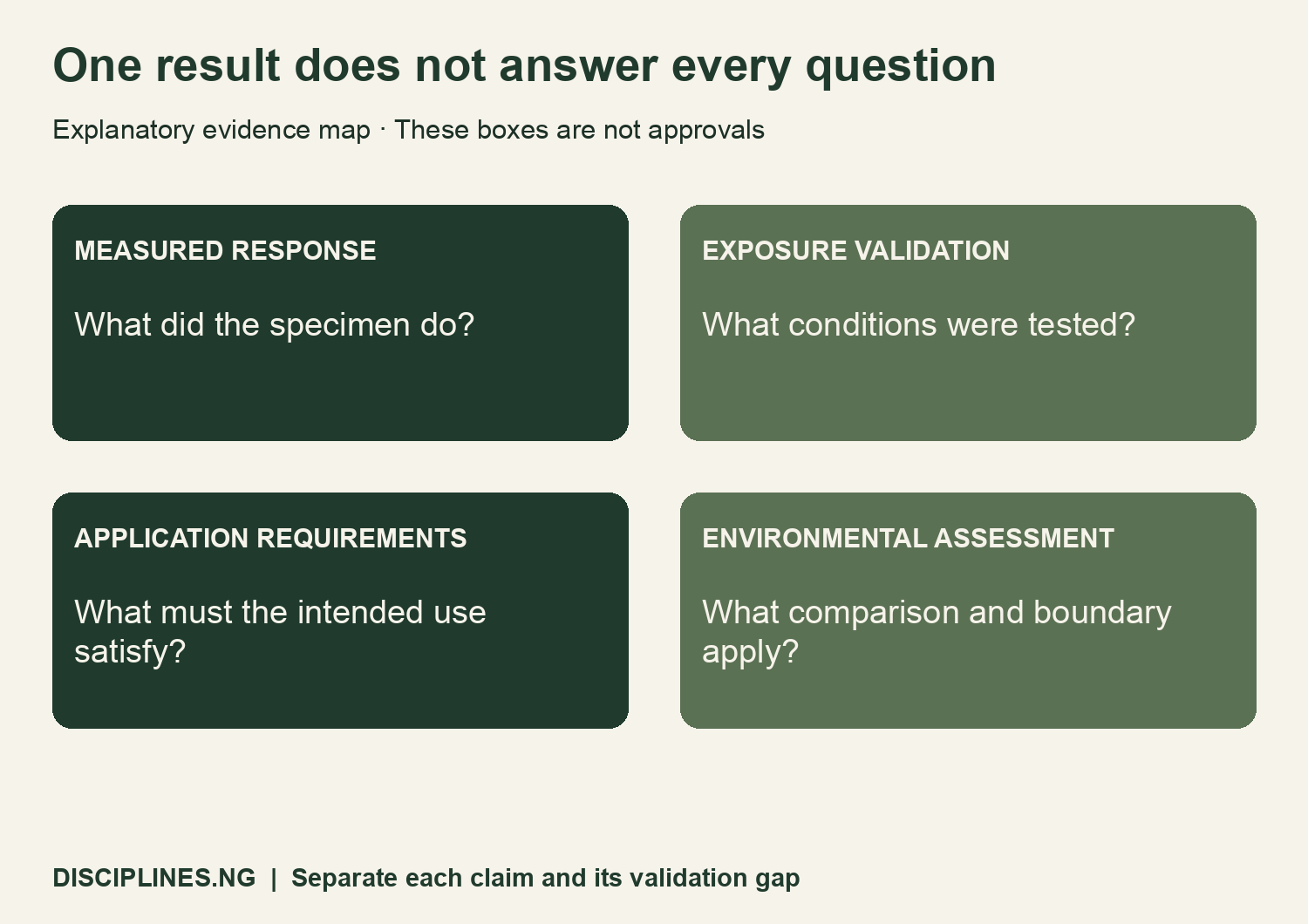
An evidence matrix helps a student keep those claims apart. Add a row for each property, its test condition, its result and the next validation question. A blank field makes a knowledge gap visible; it should not become a favourable result.
For sustainability claims, define the comparison and its boundary. A future study might examine material processing, transport, service performance and end-of-life assumptions. Those are proposed research questions here. We did not conduct a lifecycle assessment or estimate installed-cost savings.
Preserve conflicts instead of choosing the convenient number
The absorption discrepancy matters because the two statements describe different magnitudes. We retain each source location and mark the issue unresolved. We do not average them, silently select one, or produce a chart that presents one as the settled result.
Likewise, we do not reconstruct unextracted intermediate slump values from a visual trend. A smooth line through assumed values would look precise while adding information we have not verified. The endpoint chart therefore uses two separate bars with no interpolation.
A supervisor or specialist can use the ledger to identify questions for the authors. Resolving a discrepancy requires the relevant underlying results and definitions. An attractive chart cannot resolve it on their behalf.
A proposed student research plan
The downloadable plan is blank. It helps frame a future supervised experiment rather than instructing readers to produce a structural mix. Results must remain empty until approved tests occur.
- Define the research question and comparison material.
- Document material origin and batch characteristics.
- Specify the control and applicable test methods with a supervisor.
- Identify experimental units and planned replication.
- Record curing conditions, measurement uncertainty and exclusions.
- Predefine how results and conflicting statements will be checked.
Keep an analysis log when moving from laboratory records to a report. Record unit conversions and any excluded observation. Explain why an observation was excluded before interpreting the remaining pattern.
For another example of separating a measured relationship from a stronger claim, use our university ICT evidence exercise. Its subject differs, but the discipline of matching a claim to its measurement also applies here.
Download the audit and blank tools
Reproducible slump percentage audit (CSV)
Source discrepancy ledger, including absorption and strength wording (CSV)
Measured-property and validation-question matrix (CSV)
Blank supervised research plan (CSV)
The audit file contains the baseline, comparator, formula and rounded calculations. The ledger distinguishes published statements from our arithmetic. The matrix and plan are original educational resources, not validated approval forms.
Methods and limitations
We checked the paper's methods, results and conclusion, independently calculated the slump change and retained conflicting statements. All visual designs are original; we did not reproduce publisher artwork or reanalyse specimen-level data. The study's reported values retain their original scope and conditions.
This appraisal of ceramic tile waste concrete in Nigeria does not establish a universal safe replacement rate, durability in a specific environment, or economic advantage. For broader project planning, see our research-readiness checklist.
Use the resources to ask a more precise question: which measured property supports the proposed claim, and what evidence remains missing? A correct percentage is one necessary check within that larger appraisal.


