



Older adult physiotherapy placement records should explain what a student actually learned and how a supervisor reviewed it. A count of sessions cannot answer that alone. For Nigerian placement coordinators, the useful starting point is to separate educational exposure from the measures used to evaluate it.
A 17 November 2026 BMC Medical Education paper by Ibekaku and colleagues offers a historical baseline: 303 survey respondents at nine universities and 15 purposively selected interviews. Data collection ended in May 2019. The publisher identifies the available paper as peer-reviewed, accepted research that may receive further edits, rather than the final version.
Older adult physiotherapy placement: read the dates first
These findings do not describe the current national student population. They also precede subsequent curriculum developments. A coordinator planning a new evaluation should record the programme version, cohort and placement setting rather than assuming a 2026 publication date makes the underlying observations current.
Our original contribution is a reproducible coefficient chart and a supervisor-reviewed learning log. The tools help organise educational questions. They do not prescribe treatment, assess an individual student’s fitness to practise or establish that a particular placement design works.
Interpret the two estimates on their own scale
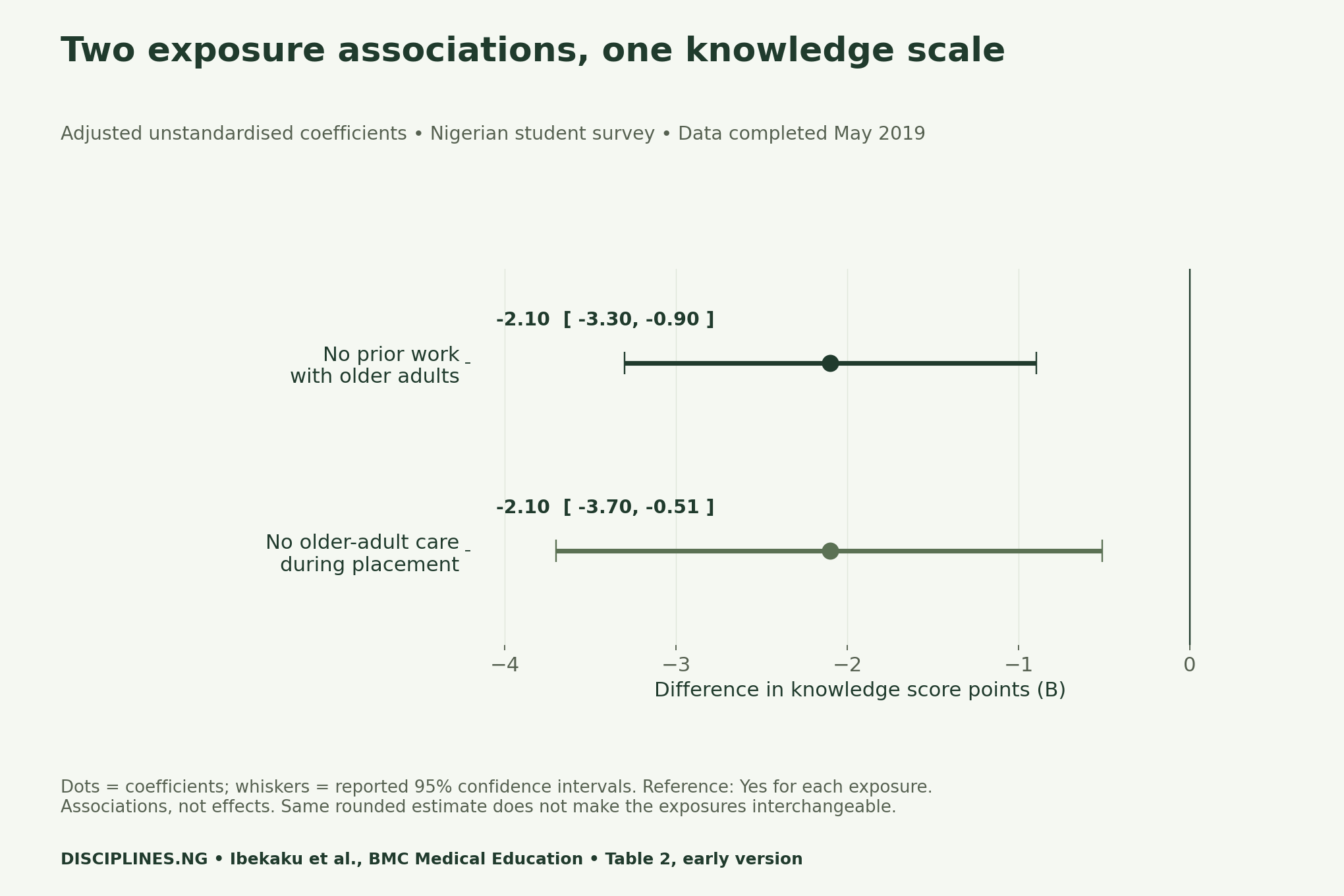
Both coefficients round to −2.10 knowledge-score points, but their intervals differ. Do not pool the estimates, convert them to percentages or conclude that the exposures are interchangeable. Neither estimate measures a patient outcome. A cross-sectional comparison cannot show what would happen if a coordinator changed a placement.
There is also a wording distinction worth retaining: Table 2 labels the second exposure as care during clinical placement; the abstract describes co-management. Our source CSV preserves both labels. A new log should define its own categories explicitly instead of treating every contact as the same experience.
Record exposure separately from a learning measure
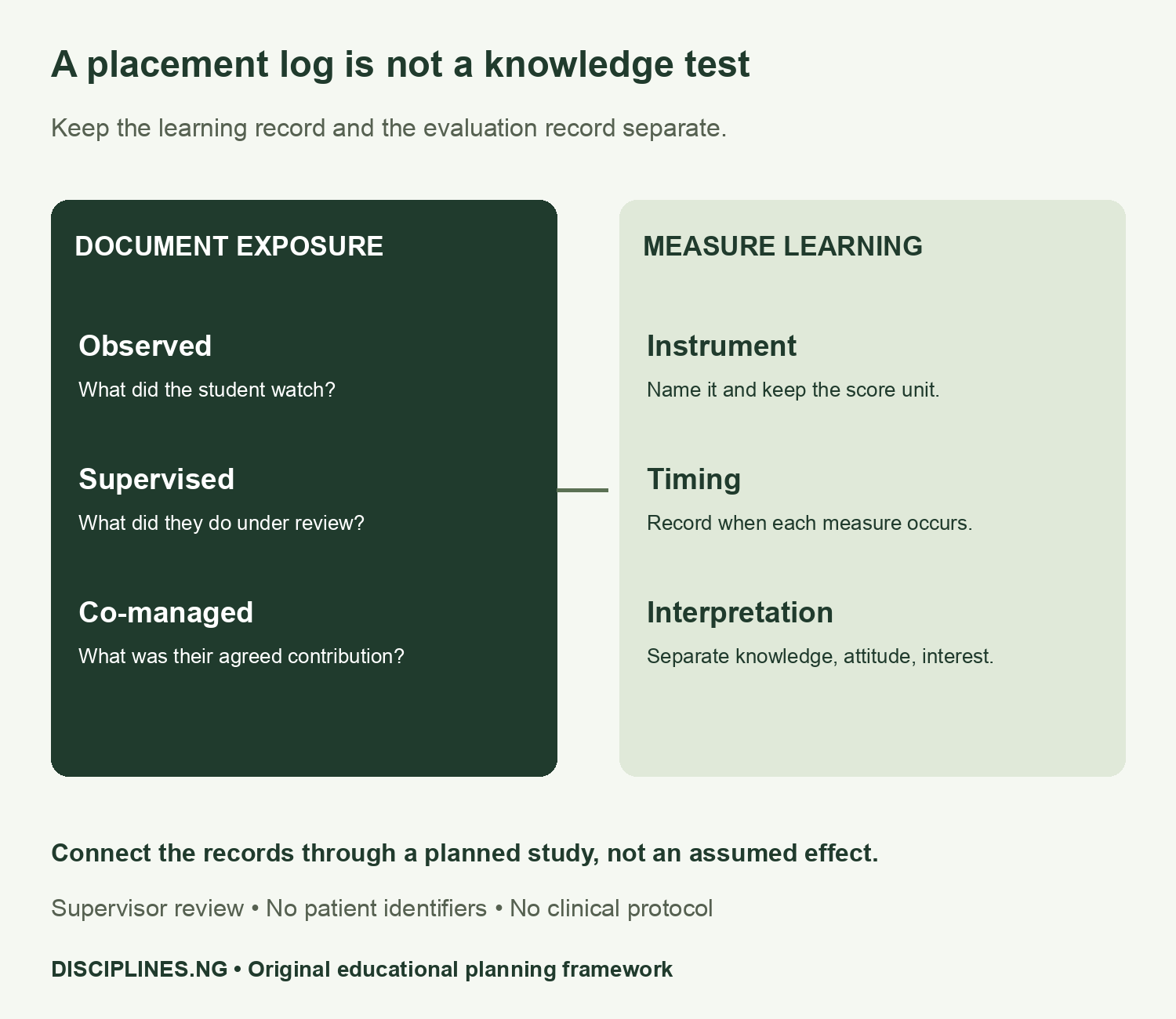
Start with one learning goal that a supervisor can discuss. Then describe an activity without patient identifiers. For instance, a student might observe how a supervisor explains a learning task, contribute to a case discussion or reflect on a team interaction. Record what the student actually did, not an impressive activity label chosen afterwards.
Next, distinguish observed, supervised and co-managed participation. These are proposed log categories, not a replacement for institutional rules or the paper’s questionnaire. Agree their local meanings before collection starts. If a student watches an activity, do not record independent performance. If an entry is unclear, ask the supervisor to clarify it.
The log includes supervisor role, feedback, reflection and the next learning step. A short reflection can ask, “Which assumption needs checking?” That makes uncertainty visible without turning the record into a patient history. Use institutional systems for any real placement records; keep the public example fictional and non-identifying.
A fictional example of a better learning record
| Field | Fictional entry | Why it helps |
|---|---|---|
| Learning goal | Explain a rationale in a classroom case | Defines the educational question |
| Mode | Supervised discussion | Distinguishes participation from observation |
| Feedback | State why the question was chosen | Captures a reviewable comment |
| Next step | Review one relevant learning resource | Links reflection to a learning action |
A completed row is evidence that an activity was documented, not proof that knowledge improved. The coordinator still needs to decide who reviews the entry, what counts as a complete record and how disagreement is resolved. Those rules should be clear before a cohort begins, so recording standards do not shift between students.
Plan the next evaluation before scoring it
Choose the learning outcome first. Knowledge, attitudes and interest are different constructs; do not compare their raw totals as if they share a scale. Name each instrument and version, state when it will be used and explain its interpretation. A log should not invent a pass mark or create a composite score from unrelated measures.
If a future study links exposure records to scores, plan consent, missing-data handling and analysis in advance. Record the timing of exposure and measurement. Also consider factors that may affect both placement participation and test results. A before-and-after design can describe change, but it does not automatically separate a placement effect from other learning.
For a small educational pilot, test whether supervisors understand the categories and whether students can complete the log consistently. Review confusing fields before collecting a larger dataset. Keep identifiable information out of shared teaching files and do not publish row-level placement records as an open dataset.
Limits, methods and four reusable CSV tools
We transcribed the two knowledge coefficients and their reported intervals from Table 2 of the accepted manuscript. The chart keeps a common score-point axis and a zero line. It does not create an overall exposure effect or confidence intervals for an invented intervention. The example log and blank tool are our educational designs, separate from the source questionnaire.
The study uses self-reported, cross-sectional observations and purposive interviews. Its adapted measures and classifications have limitations, so the findings do not diagnose students or validate our log. Interview themes add context; their purposive sample does not establish how common each view is. Treat the historical results as a prompt for a better-defined subsequent study.
For related context, see our physiotherapy ethics overview. Browse further work in Research & Reports. Use the downloads below to inspect the exact estimates and adapt the fictional learning records for supervised educational planning.
- Exact exposure coefficients and confidence intervals (CSV)
- Fictional supervisor-reviewed placement log (CSV)
- Blank non-identifying placement log (CSV)
- Exposure and measurement dictionary (CSV)
Source: Ibekaku MC, Kalu ME, Ezema C and colleagues, BMC Medical Education, 17 November 2026, accepted early version, CC BY 4.0. We redrew selected numerical results and added independent teaching tools. Suggested citation: “Older Adult Physiotherapy Placement in Nigeria: What to Log”, Disciplines In Nigeria, 21 November 2026.


