






For textile test report vs product certification Nigeria questions, first identify the claim you want the document to support. A laboratory report, a product certificate and a destination-market requirement are different parts of an evidence chain. Keep each document within its own scope.
SON’s 26 November 2026 ARSO competition announcement uses cotton-to-clothing trade and conformity assessment as its theme. We use that news as a teaching hook, rather than as an entry guide. The practical question here is how an engineering student can describe one fictional fabric swatch without inventing a test result or a market-access outcome.
Textile test report vs product certification in Nigeria
Read a sample-specific report with its sample identity, method, date, reported result and stated limitations. Ask which material the laboratory examined and which question the method addresses. Do not describe every product in a supplier’s range as tested merely because one report is in the file. This exercise supplies no numerical pass limit or measured result.
A useful reading task is to underline the exact subject of the report and circle the claim in the draft description. If the subjects differ, the claim needs revision or more evidence. Instead, keep the uncertainty in the worksheet rather than filling it with a plausible-looking number, standard code or “pass” stamp.
Product certification adds a decision and a scope
SON’s National Product Certification page describes a process that includes factory inspection, sampling and laboratory testing/analysis, then committee consideration and approval. That separation matters: the test stage is not itself the certification decision. For a certificate, check the issuer, named product, relevant specification, scope, validity and conditions.
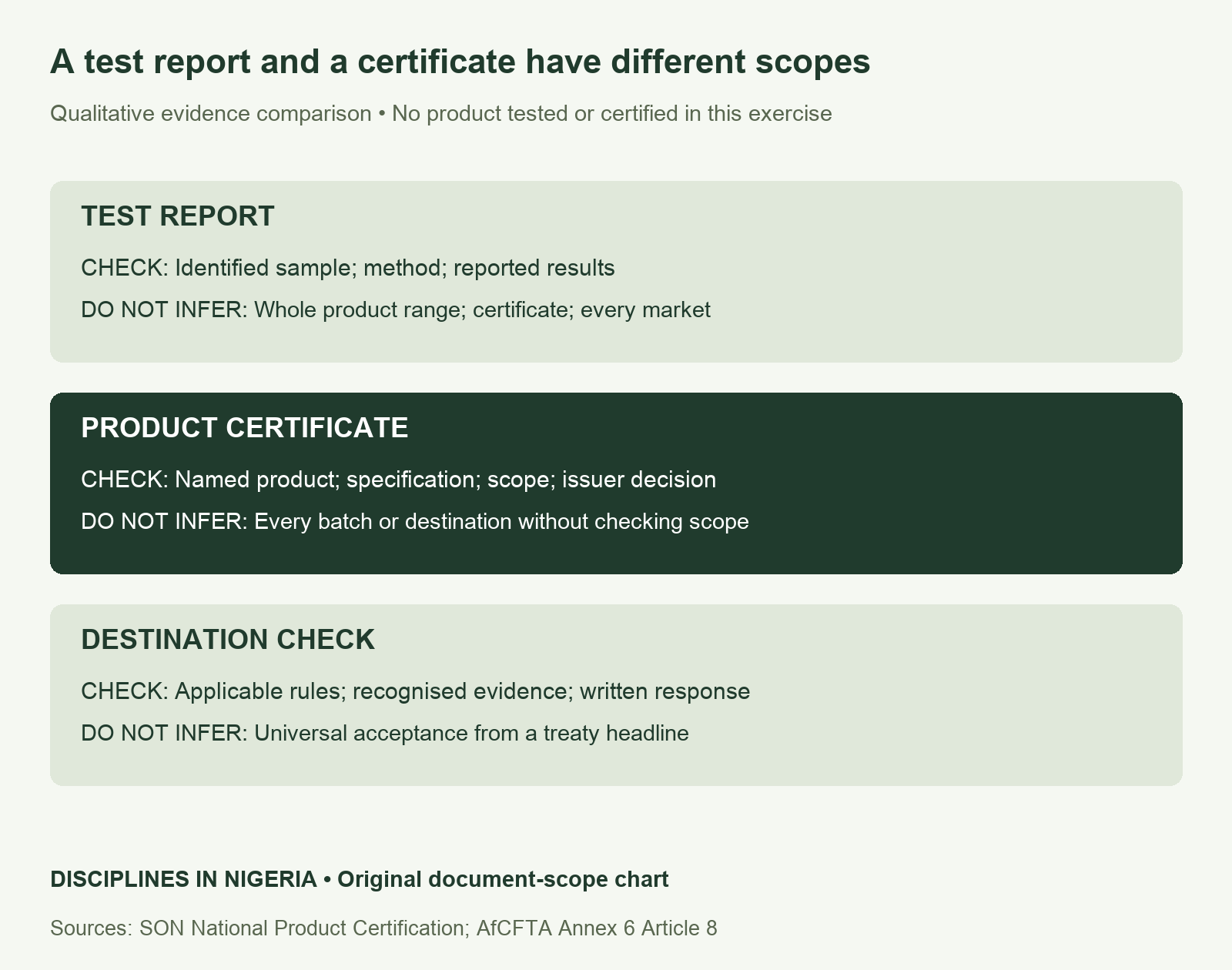
However, do not assume that a certificate for one named product covers a new material, changed specification or every production batch. The appropriate next question is what the actual document covers and which conditions remain. This guide does not decide whether any real certificate is sufficient for a real transaction.
Recognition is a destination question as well
AfCFTA Annex 6, Article 8 addresses cooperation in conformity assessment, including accredited bodies and recognition under relevant arrangements. It is not a statement that every laboratory report must be accepted in every market. Check the destination’s applicable requirements and the recognition arrangement that actually applies to the body, product and activity.
Also, keep that enquiry separate from a general treaty headline. Record the destination, the rule being checked, the evidence requested and the dated response from the appropriate authority or competent adviser. Do not mark “customs cleared” because a report exists, and do not use this teaching sheet as a shipment instruction.
Work through Teaching Swatch A
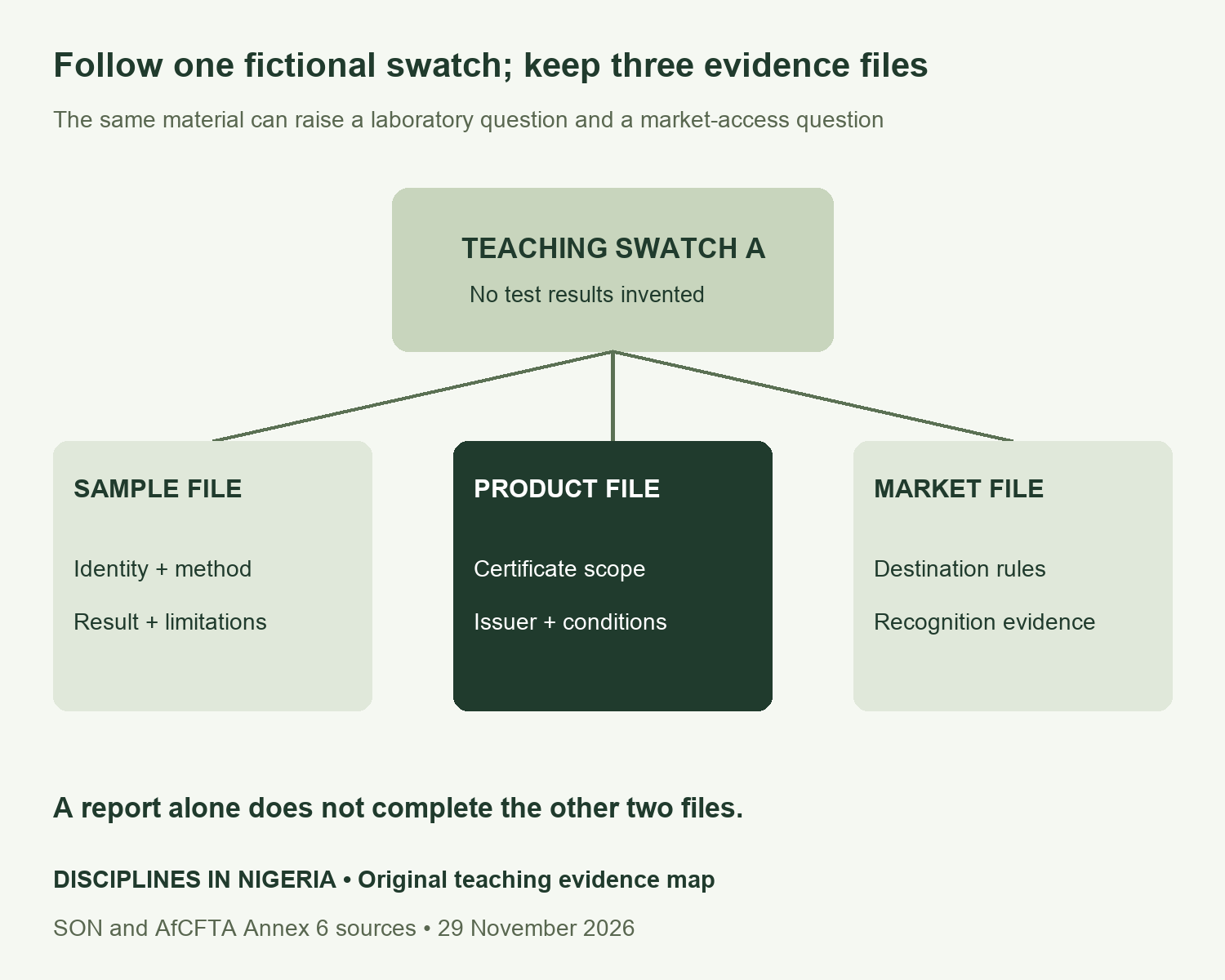
In our fictional exercise, the file description lists a sample-specific report, but the draft marketing sentence says “All fabric exports are certified.” The file supplies neither a certificate nor a destination-specific response. The exercise therefore marks that broad claim as unsupported by the described file. It does not conclude that the actual material failed a test.
A careful rewrite would stay within what the evidence actually contains, such as identifying that a report relates to the named sample and method, if the document supports that wording. Before adding a certification claim, obtain the certificate and check its scope. Before adding a market-access claim, verify the destination requirements separately. Do not invent a successful result to make the rewrite sound stronger.
| File | Question to answer | Evidence still missing in the fictional exercise |
|---|---|---|
| Sample | Which material, method and reported result? | Check the exact report fields |
| Product | Which certificate and scope? | File has no certificate |
| Market | Which destination requirements and recognition? | File has no destination-specific confirmation |
Use a claim-review log instead of a decorative stamp
Next, give each draft claim a row in the worksheet. Keep the source reference, relevant scope, unresolved point, owner and next action together. A lecturer can then assess whether the student matched the document to the claim, rather than whether the page looks like a certificate. Use dummy sample identifiers and no confidential supplier files in public examples.
For an additional exercise, change one fictional field—such as the product description—and ask which evidence needs another check. The point is to recognise a scope mismatch. It is not to assume every change invalidates a document or that the student can make the certification decision. Escalate the specific uncertainty to the appropriate issuer or authority.
Methods, limitations and four CSV tools
Checked 29 November 2026. Sources are SON’s dated announcement, its product-certification explanation and the African Union’s Annex 6 text. The comparison chart is qualitative; there is no fabricated compliance percentage, laboratory measurement or test limit. The swatch, file description and claim-review activity are original fictional teaching materials.
This textile test report vs product certification Nigeria guide explains an evidence habit rather than providing individual export or certification advice. Our campus approval evidence guide applies the same scope-matching approach to an education decision: the document should answer the exact question being asked.
- Document-scope comparison (CSV)
- Fictional swatch claim-review exercise (CSV)
- Blank textile evidence-chain worksheet (CSV)
- Source and scope register (CSV)
Suggested citation: Disciplines In Nigeria, “Nigerian Textile Testing: What Do the Lab Report and Product Certificate Each Prove?”, 29 November 2026. Credit SON and the African Union for primary sources and Disciplines In Nigeria for original comparison tools.


