





A university ERP student request workflow Nigeria exercise should reveal who owns the next step, what the student can see and which evidence proves the handoff. A portal screenshot alone cannot answer those questions. This original classroom model follows one fictional deferment request using dummy records only.
UNILAG’s 23 November 2026 notice lists ERP training in two phases: 23–27 November for Faculty Champions and nominated representatives, then 30 November–4 December for relevant stakeholders and end users. Its 2 December Student Management session includes deferment, leave of absence and transfers. These are training dates and topics, not student deadlines, an open public invitation or evidence of go-live.
University ERP student request workflow Nigeria: define the case
Start with a dummy requester and a fictional deferment form. The lecturer defines the example’s required attachment and authorised reviewer role. Those choices belong to this teaching scenario. They do not describe UNILAG’s actual criteria, approvals or software behaviour. Use a blank case label rather than a real student number.
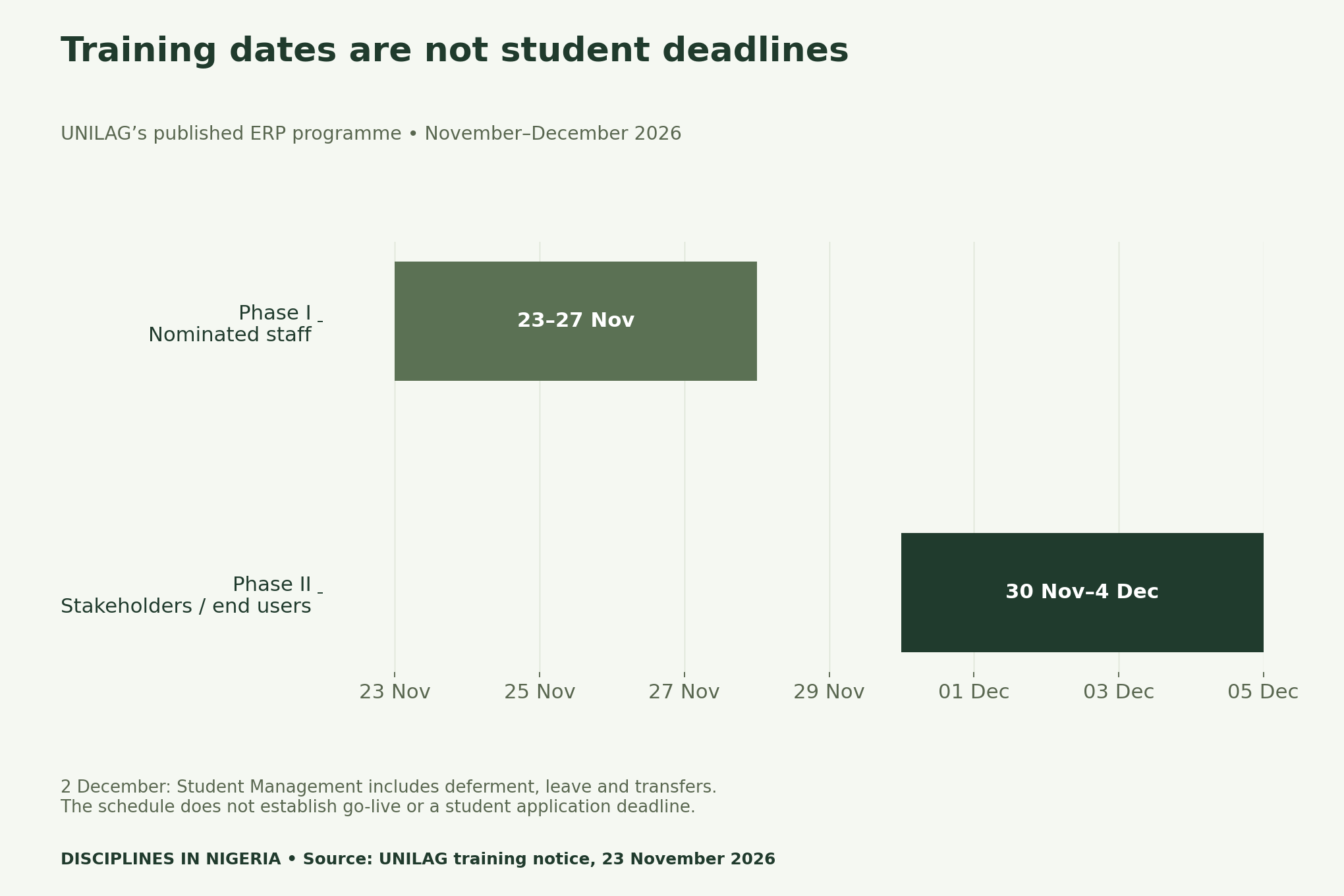
First, separate the news evidence from the teaching design. The schedule establishes what the university planned to cover. Our model asks how a reader could test a handoff. It supplies no evidence that UNILAG adopted this exact workflow or that its training produced a measured improvement.
Record an owner, a status and acceptable proof
In the model, submission creates a saved dummy request. An intake role then confirms receipt. Next, an authorised routing role assigns the reviewer, and the reviewer accepts the handoff. Keep receipt and assignment distinct: an acknowledgement can show that a request arrived without establishing who may decide it.
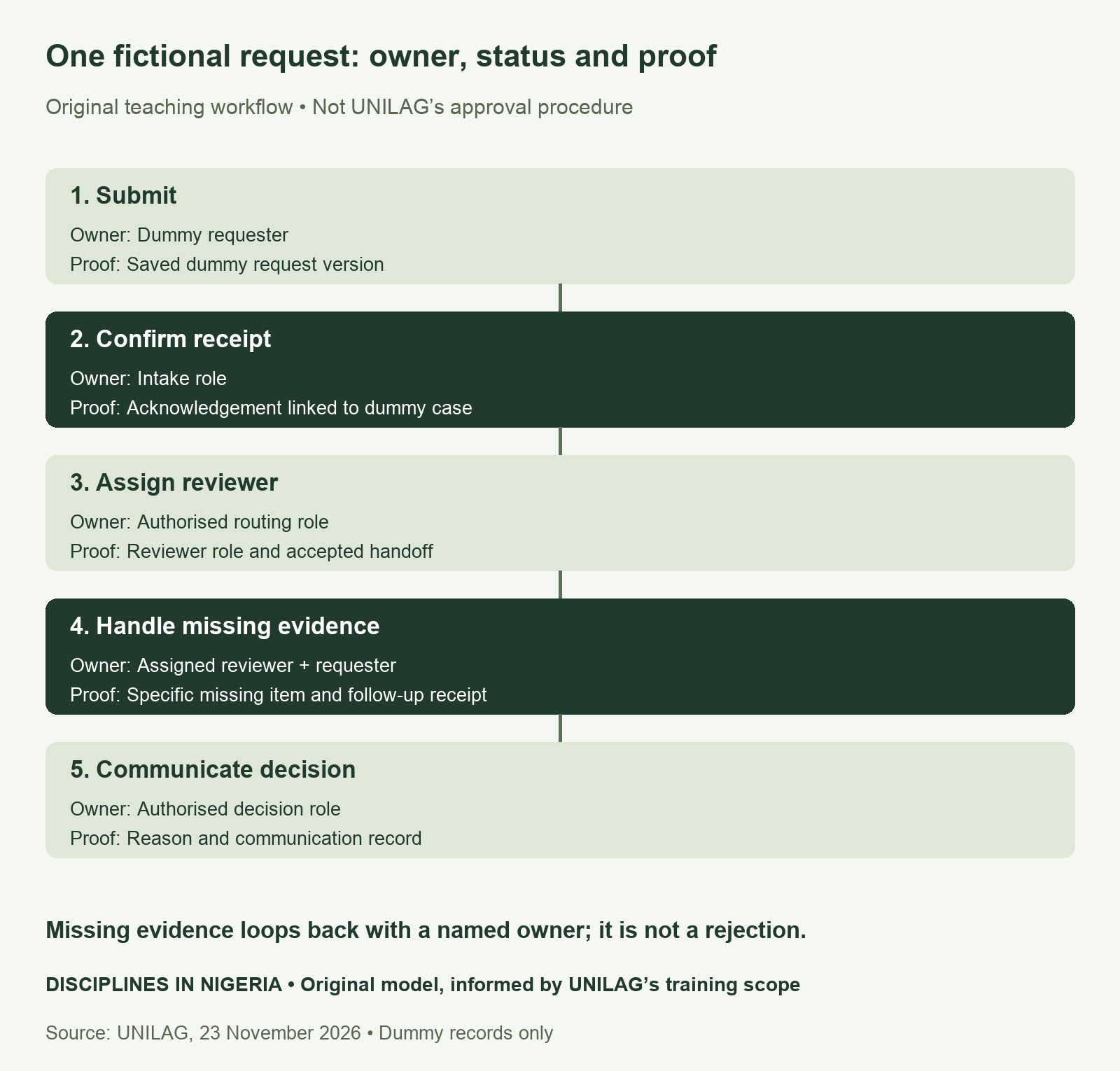
For each stage, ask the team to show the expected record and the next owner. A status label should have a clear meaning within the exercise. For example, “received” means that the model has an acknowledgement; it does not mean “approved.” If the group cannot name an authorised decision role, leave that question open rather than inventing one.
| Model stage | Proof to inspect | What it does not establish |
|---|---|---|
| Receipt | Acknowledgement for dummy case | Approval |
| Assignment | Named role and accepted handoff | Decision on eligibility |
| Decision communication | Reason and communication record | A real student outcome |
Test a missing document without losing ownership
Remove the classroom attachment from a duplicate dummy case. The expected model behaviour is a specific missing-item notice with a clear owner and a traceable way to return the evidence. Then ask whether the reviewer can see the response without forcing a second unrelated request. Record the observation; do not assume a successful result.
A missing document is not automatically a rejection in this model. Likewise, a returned attachment is not automatically approval. The task is to make each transition intelligible. Students should record the unresolved item and the expected next action, without attaching real health, identity or academic records.
Test a misrouted request and the final handoff
Next, send a dummy case to the wrong classroom queue. Ask how the team routes it to the authorised role and how that role acknowledges ownership. A silent move that leaves neither group responsible fails this teaching test. However, the example makes no claim about the behaviour of any university system.
Finally, inspect the decision communication. Does it distinguish the decision, its reason and the communication record? Can the requester tell whether any follow-up remains? The log helps a group explain its proposed process. It cannot establish a lawful institutional rule, an actual approval or a promised response time.
Methods, limits and four CSV tools
We checked the university notice on 29 November 2026, transcribed its relevant dates and created the fictional request model and exception cards. We did not access a private ERP session, test live software or process a real student request. No completion rate, delay reduction or adoption outcome is claimed.
Use the blank owner-status-proof log with the two exception cards and retain actual observations separately from expected behaviour. Our FUL verification guide covers a different official process; its instructions do not transfer to this hypothetical workflow or to UNILAG.
- UNILAG training dates and scope (CSV)
- Fictional request-handoff model (CSV)
- Blank owner-status-proof log (CSV)
- Two fictional exception test cards (CSV)
Suggested citation: Disciplines In Nigeria, “University ERP Training in Nigeria: Test Who Owns a Student Request at Each Step”, 29 November 2026. Primary news source: University of Lagos. Original teaching model, visuals and tools: Disciplines In Nigeria.