





This PR misinformation verification exercise Nigeria guide asks a student team to make one decision: can a campaign poster claim 500 attendees when its file shows 500 registrations and 310 check-ins? The example is fictional. Its purpose is to practise matching a public claim to the evidence before sharing it.
NOUN’s 27 November 2026 report describes a Mass Communication PhD student’s PR technology quiz award at a summit with more than 198 participants. Sessions included misinformation, responsible social media and digital innovation. However, the summit figure is not a published count of quiz sitters. We use the report as a teaching hook, without recreating its questions or claiming that an award is a hiring credential.
PR misinformation verification exercise Nigeria: start with the source
Give the team two dummy records: a registration sheet containing 500 unique registrations and a check-in sheet containing 310 unique attendees, all within that registration group. State those assumptions before asking for a percentage. The exercise does not include walk-ins, duplicate records or competing attendance definitions. A real campaign would need those issues resolved first.
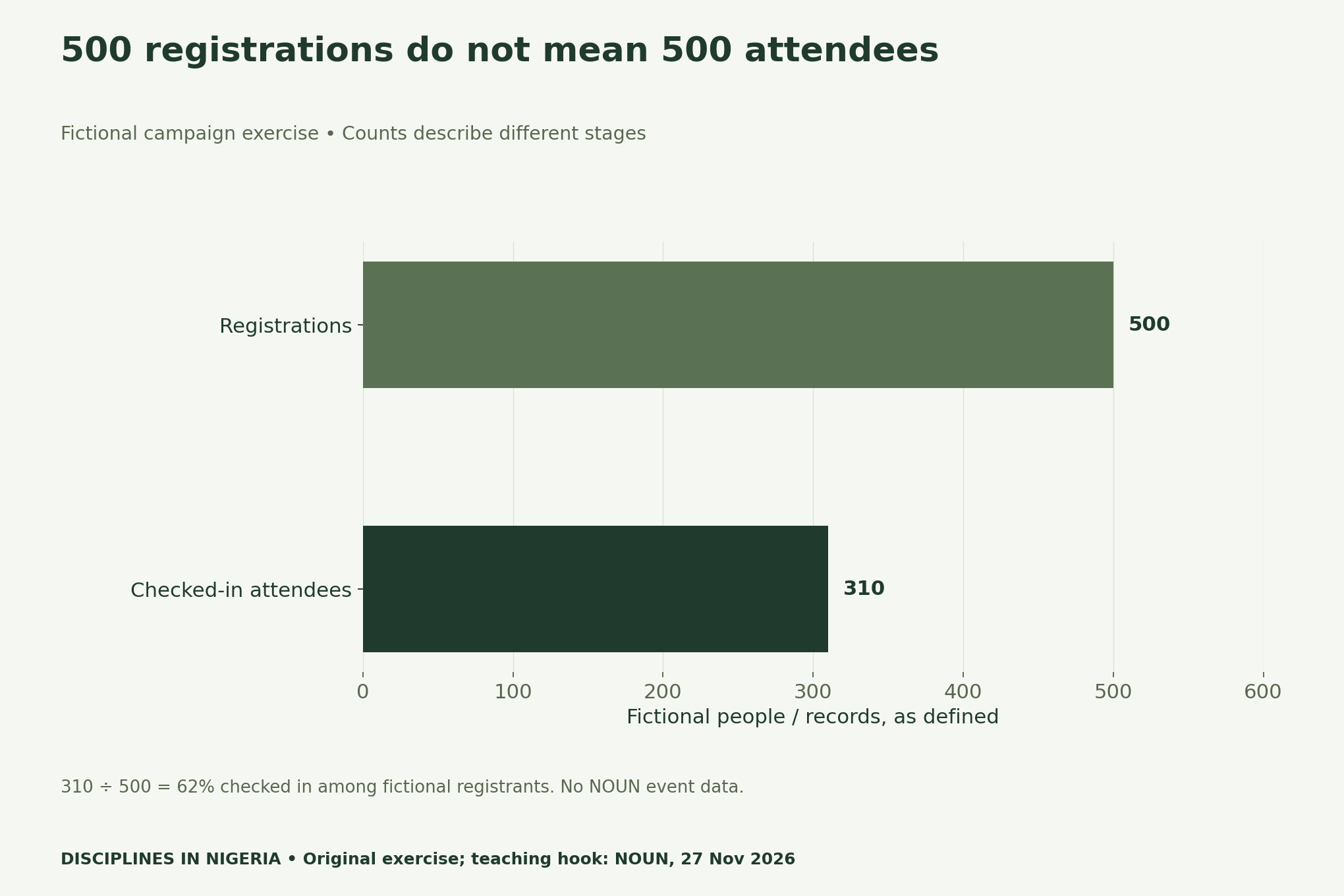
Next, underline the word “attended” on the draft poster. It describes a different stage from registration. Therefore, the larger registration count cannot support the draft attendance claim. The team must either obtain matching evidence or change the wording. Visual polish should come after that decision.
Calculate only the rate the file supports
The classroom calculation is 310 divided by 500, multiplied by 100: 62%. That is the fictional checked-in share among registrants. It is not a satisfaction score, a learning gain or a measure of campaign success. Also, the remaining 190 records establish no reason for a missing check-in.
| Fictional measure | Count | Supported statement |
|---|---|---|
| Unique registrations | 500 | Registration records in the supplied file |
| Unique checked-in attendees | 310 | Check-in records within the registration group |
| Difference | 190 | No check-in recorded in this exercise |
For a second round, let a lecturer introduce an unresolved duplicate. Ask the team which count needs review and whether the percentage can still use the same denominator. Do not silently delete a row to preserve a preferred headline. Instead, document the question and keep the working definition visible.
Rewrite the claim and keep the correction visible
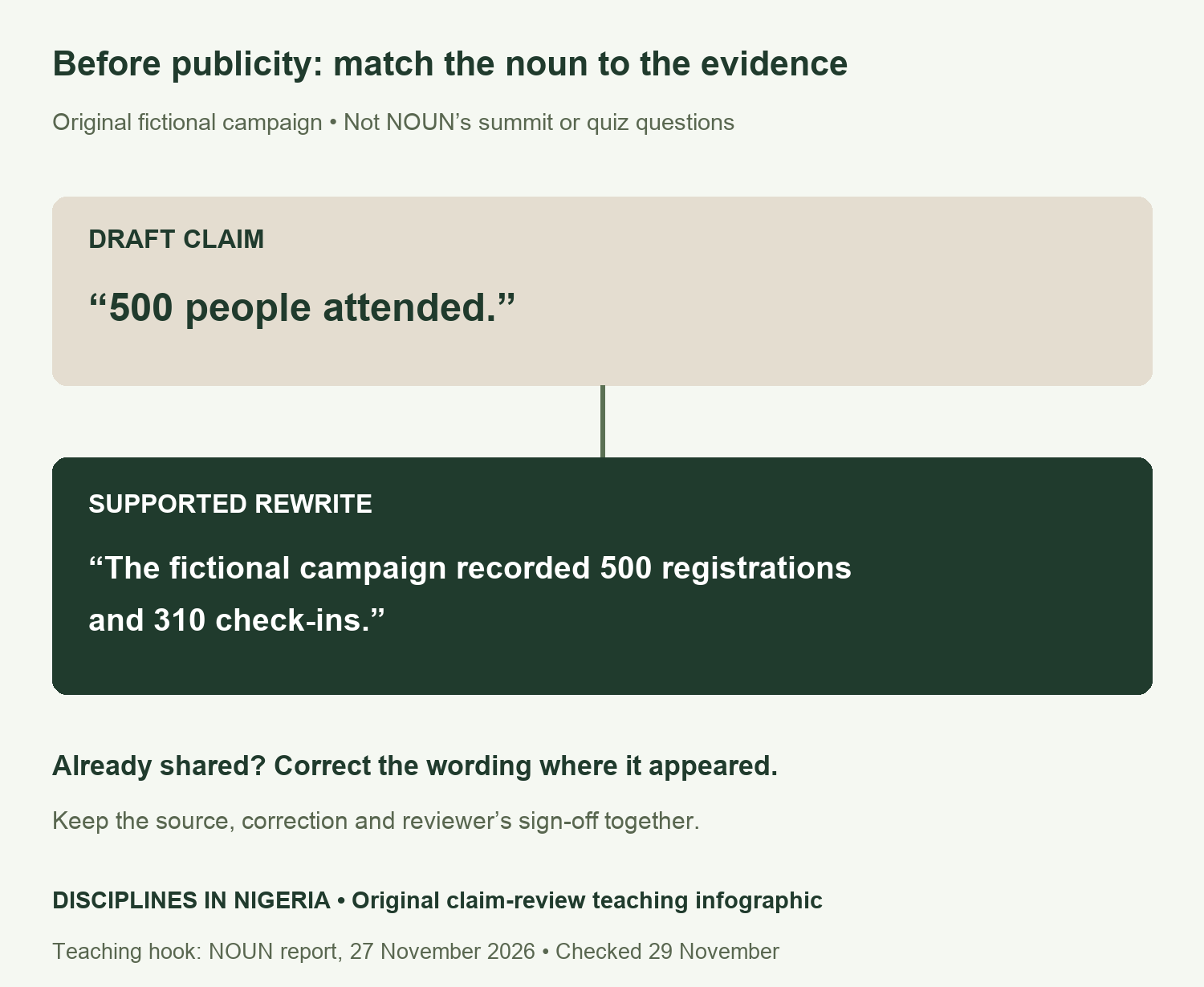
A supported version names both measures: “The fictional campaign recorded 500 registrations and 310 check-ins.” If the team has already shared the first poster, write a correction that identifies the earlier wording and supplies the supported version. Then log where the correction appears, who checked it and what remains unresolved.
For practice, use a dummy publication location rather than a real social account. The activity requires no public submission and no audience data. A correction record can show the decision trail without pretending that a live campaign took place. Keep the source reference close enough for another student to reproduce the check.
Assess accuracy, correction and sign-off
Our original rubric has three review areas. Accuracy asks whether the source supports the exact measure and population. Correction asks whether the team addresses a previous error clearly when relevant. Sign-off asks whether a named reviewer checked the final wording and unresolved issues. Mark each area ready, revise or evidence missing; the rubric is not a validated scoring instrument.
Finally, ask another team to inspect the finished poster and log. Can they find the count definition, source date and reason for the rewrite? If they cannot, improve the evidence trail. This is a practical communications task, without a promise of better hiring chances or a claim that the exercise reduces real-world misinformation.
Methods, limitations and four CSV tools
Checked 29 November 2026. The news summary comes from NOUN’s own report. Disciplines In Nigeria created the campaign, counts, answer key, chart, infographic and review rubric. No summit quiz denominator, question set, student performance result or live campaign dataset was available for this exercise.
The blank log contains fields for the claim, source, numerator, denominator, limitation, rewrite and sign-off. Use dummy records. Our textile evidence guide offers another scope-matching exercise: a document should support the particular claim, rather than a broader one.
- Fictional campaign counts (CSV)
- Claim-review answer key (CSV)
- Blank source and correction log (CSV)
- Original teaching review rubric (CSV)
Suggested citation: Disciplines In Nigeria, “PR Tech Skills for Mass Communication Students: Verify a Claim Before You Publish”, 29 November 2026. News source: NOUN. Original teaching tools and visuals: Disciplines In Nigeria.