






WhatsApp collaborative learning qualitative evidence in Nigeria should distinguish what learners report from what a selected interaction actually shows. A lecturer can value students’ experiences while still asking which source supports a specific claim. Silence in one excerpt does not explain why a learner was quiet.
A new Nigerian education study supplies a useful methods example. Our original triangulation grid uses four entirely fictional cases to help lecturers plan a modest evidence review. It does not reproduce real chats, assess named students or claim that WhatsApp improves grades.
WhatsApp collaborative learning qualitative evidence Nigeria: count the right unit
The 19 November paper by Ugwu, Rappa and Wong examines a three-month mobile collaborative-learning intervention at a Nigerian College of Education. It reports 241 valid open-ended questionnaires, 137 screenshots and field notes from 12 observation sessions. These are different record types, not counts that can be added as unique participants.
For a methods note, write the unit beside the number. A screenshot may contain several messages, while a session may observe several people. Neither is automatically an additional participant. Adding 241 + 137 + 12 produces 390 records of mixed types, not a defensible student sample size.
| Evidence source | Reported volume | What to keep distinct |
|---|---|---|
| Open-ended questionnaires | 241 valid questionnaires | Accounts of experience |
| Screenshots | 137 screenshots | Selected interaction traces |
| Participant observation | 12 sessions | Time-bounded contextual notes |
Twenty percent is the observed group share
The researchers purposively observed 10 of 50 WhatsApp groups. Our calculation is 10 ÷ 50 × 100 = 20% of groups. The denominator is the study’s groups, not all students, all messages or Nigerian universities. A purposive subset is not a random representation claim.
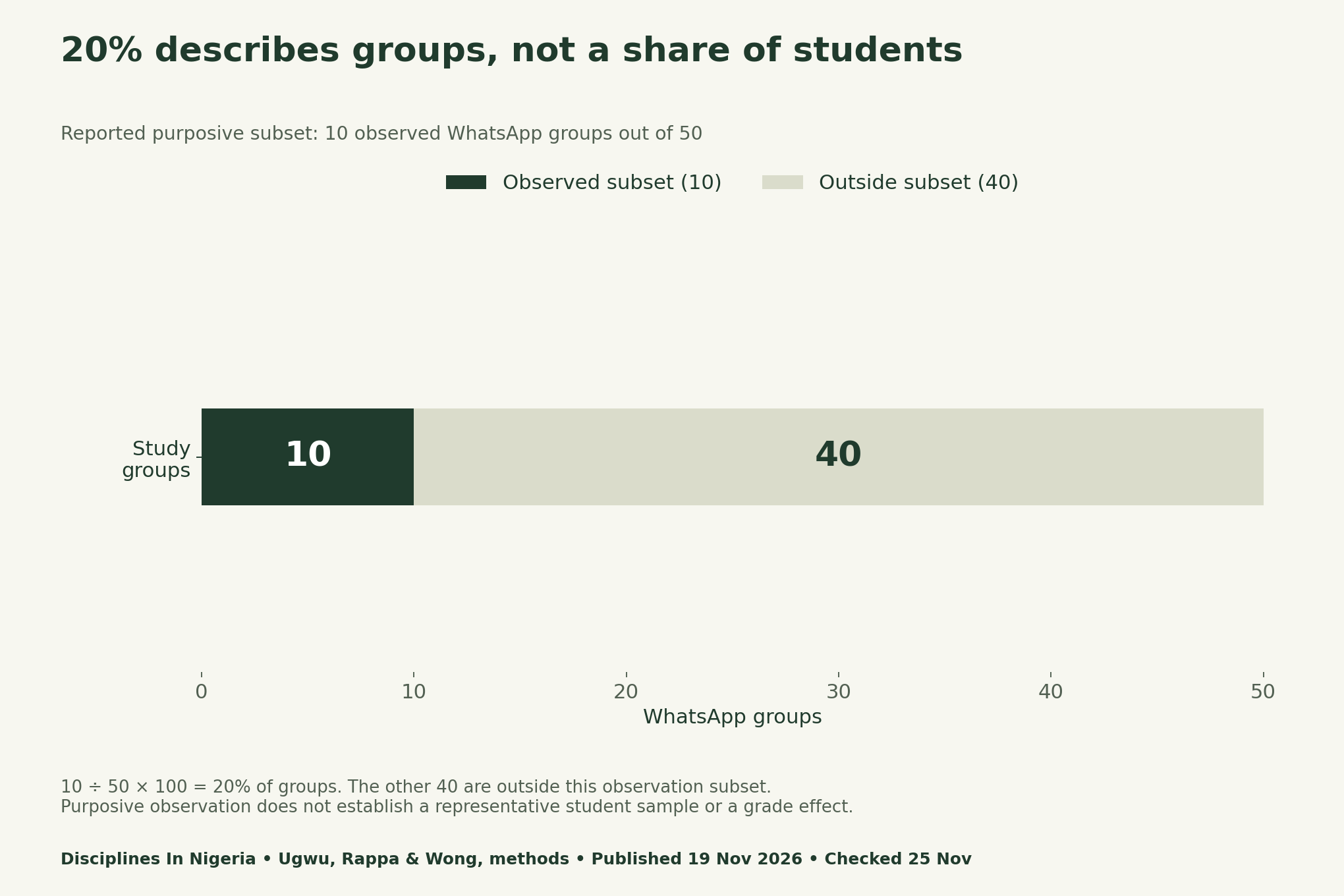
The other 40 groups are outside that particular observation subset. That does not establish that their members were absent from every other source. Keep group selection separate from questionnaire coverage rather than creating a funnel that links records without evidence.
Three sources can support, complicate or leave a claim unanswered
Triangulation is a comparison of what different sources can support within their scope. It is not a rule that three sources must agree. A self-report may describe private review that a screenshot cannot show. An observation note may reveal that an apparently immediate exchange actually involved a delay.
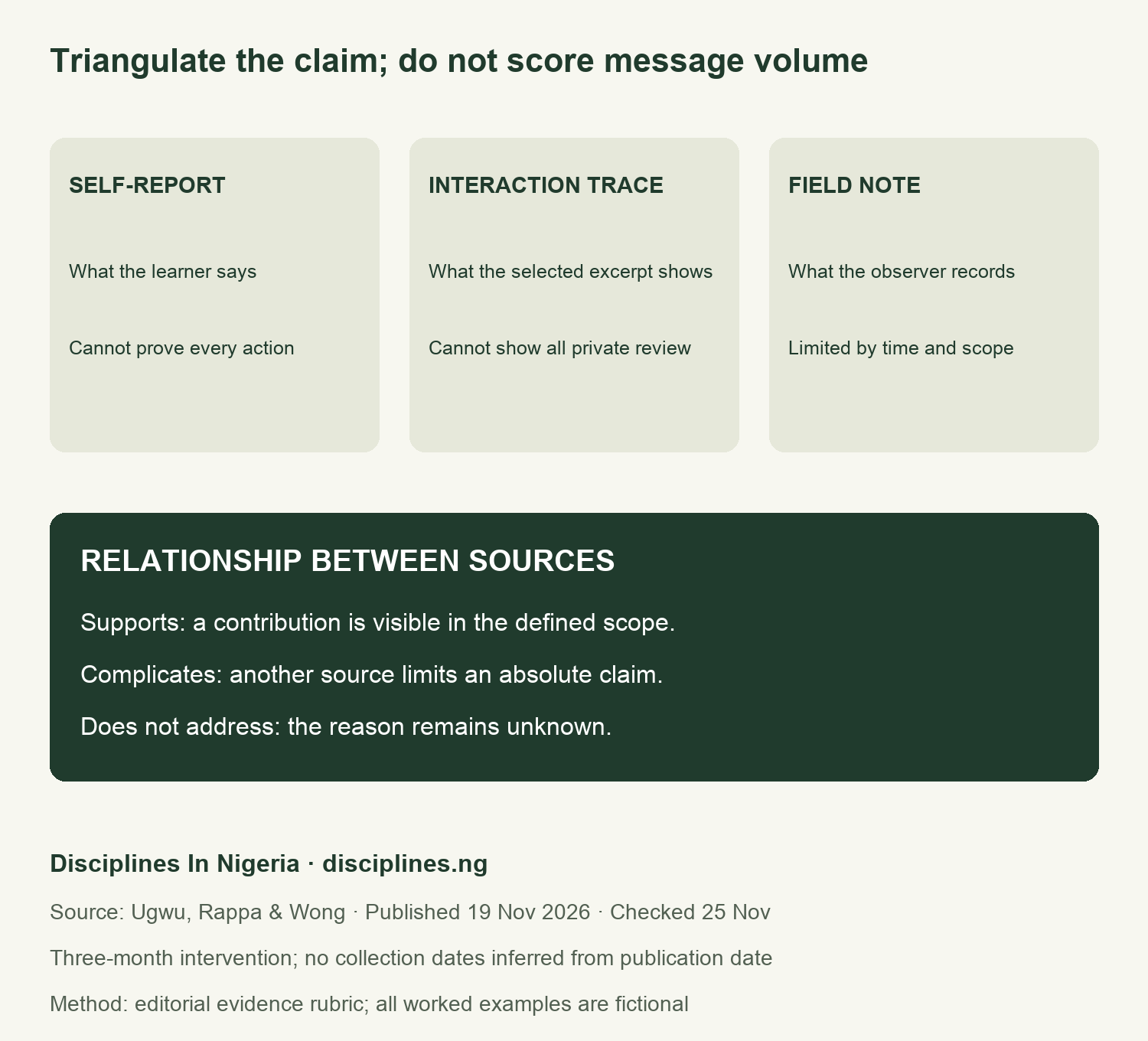
Our fictional grid has four cases. In Case A, the learner reports reviewing the task, but no contribution appears in the selected excerpt and the note has no relevant entry. Label that statement uncorroborated in these sources. Do not turn the absence into proof that no review occurred.
Case B includes a fictional explanation in an excerpt and a note about a peer’s follow-up question. That supports a claim of a visible contribution in the exercise. It does not establish that the explanation was correct, that learning improved or that all group members participated.
Case C concerns a quiet learner whose reason is unknown. The fixture gives no self-report and no explanatory note. Leave the reason unknown. Do not fill the blank with an assumption about motivation, disability, device ownership, data affordability or family commitments.
Case D contains an absolute claim of answering every question, while one fictional question remains unanswered in the selected window. The sources complicate the absolute wording. Check the window before extending the conclusion beyond it; an unanswered item in an excerpt is not a lifetime participation judgement.
The practical output is a cautious evidence note
For each claim, record what the learner says, what the selected trace shows and what the observation note adds. Then choose a relationship: supports, complicates or does not address. Explain the limit in a sentence so that another reader can follow the reasoning.
Use the blank rubric for a hypothetical or approved small pilot. It includes consent scope, unresolved questions and a retention-and-access rule. Do not assume that being a group administrator gives permission to copy personal conversations into a public report or a shared class dataset.
Avoid ranking learners by message volume
More messages do not automatically mean better understanding, and fewer messages do not reveal the reason for limited visible activity. A contribution should be interpreted against the task and available evidence. Our rubric is not a leaderboard or a grading instrument.
The paper reports themes about students’ experiences, including interest, connection and flexibility. Those thematic accounts are not a comparative estimate of grade improvement. Preserve that distinction when proposing a teaching activity or writing a funding summary.
A pilot can ask whether a particular explanation, question or feedback exchange is visible in its defined scope. A claim that the platform caused better outcomes would need evidence suited to that question. Keep the planned research question narrow enough for the records you are actually permitted to examine.
Our engineering evidence-ladder guide demonstrates another way to align a claim with its reference. Browse more academic methods tools in Research & Reports.
Method, limits and downloads
We checked the paper’s methods and source descriptions on 25 November. The source inventory transcribes reported counts, and the group-share calculation uses ten divided by fifty. All four triangulation cases are editorial teaching fixtures. We did not inspect private groups, collect personal information, code the study’s chats or evaluate student grades.
- Study record-type inventory (CSV)
- Observed group-share calculation (CSV)
- Four-case fictional triangulation grid (CSV)
- Blank consent-aware pilot evidence rubric (CSV)
Suggested citation: Disciplines In Nigeria, “WhatsApp Group Learning: How to Check What Students Actually Did”, 25 November 2026. Cite Ugwu and colleagues for the study and this guide for the original rubric and fictional cases.


