





Abia poultry credit access versus credit obtained is a denominator question before it is a funding headline. A percentage can describe farmers, a reported financing source or a ratio of money amounts. Those measures answer different questions, even when they appear in the same paper.
Our original audit rebuilds two amount ratios and keeps them apart from reported availability and use. Agricultural economics students and extension officers can reuse the CSV register to check a claim before turning it into a slide, classroom example or briefing note.
Abia poultry credit access versus credit obtained: start with the source
The 18 November Frontiers paper by Esiobu and colleagues describes a 2025 survey of 232 registered poultry farmers in nine selected Abia LGAs. The financing reference is the 2024/2025 season. Purposive area selection limits wider generalisation; this is not a national estimate.
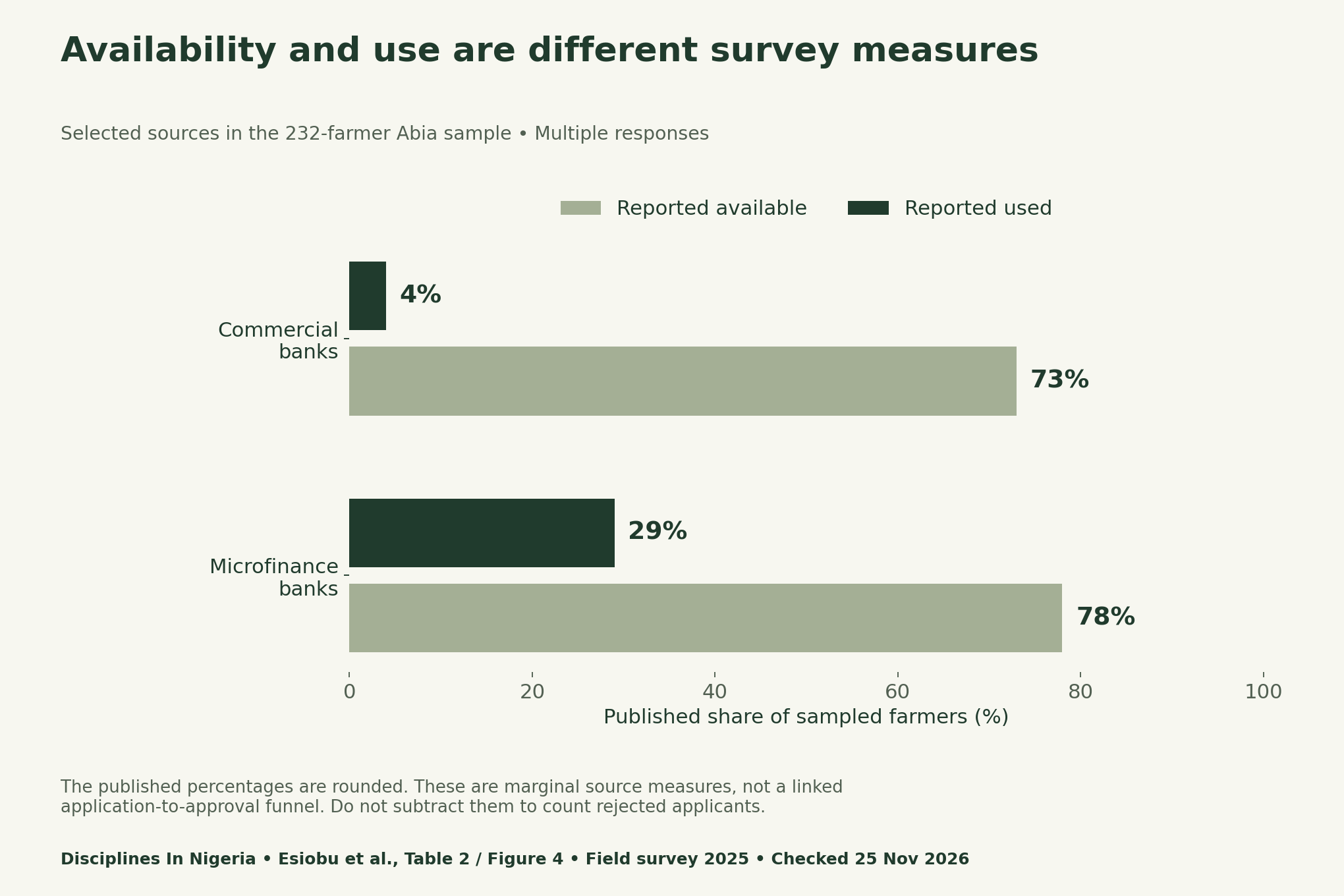
Table 2 reports commercial-bank availability at 73% and microfinance availability at 78%; Figure 4 reports use at 4% and 29%. Responses can overlap across sources. These are reported, rounded sample percentages, rather than an observed sequence of application decisions.
The commercial-bank 83% is about mean amounts
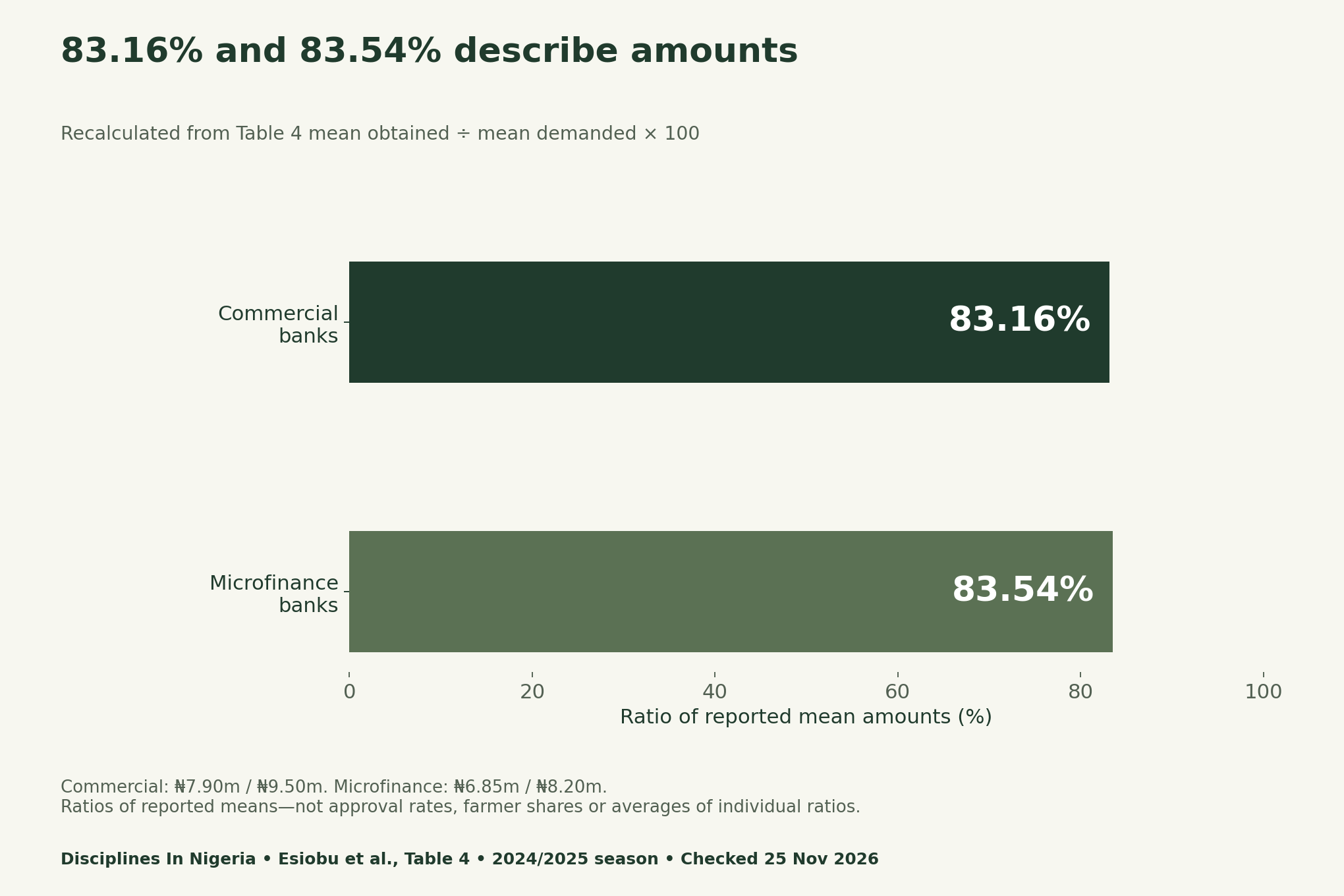
Table 4 lists nine farmers demanding commercial-bank credit, with ₦9.50 million mean demanded and ₦7.90 million mean obtained. Dividing the latter by the former gives 83.16%, which rounds to the published 83%. It does not count how many farmers were approved.
The microfinance row lists 68 farmers demanding credit and means of ₦8.20 million demanded and ₦6.85 million obtained. Their ratio is 83.54%, rounding to the paper’s 84%. Keep the source-specific row beside each calculation.
| Source | Reported mean demanded | Reported mean obtained | Our ratio, 2 decimals | Paper, whole % |
|---|---|---|---|---|
| Commercial banks | ₦9.50m | ₦7.90m | 83.16% | 83% |
| Microfinance banks | ₦8.20m | ₦6.85m | 83.54% | 84% |
Why a ratio of means is not a mean approval rate
Read the numerator aloud: mean amount obtained. Then read the denominator aloud: mean amount demanded. The resulting unit is an amount ratio. Replacing either description with people silently changes the question, even though the percent sign stays the same.
An approval rate would need a defined set of applications, a defined decision and an observation window. A source being available does not tell us that every respondent applied. A person reporting use does not supply a complete record of every application, withdrawal or decision.
Do not reconstruct an application history by subtracting availability from use. Separate marginal percentages do not identify who moved between stages. To count rejections, you would need linked application outcomes and a rule for repeat applications. That information is not created by subtraction.
Use the denominator comparison before writing a conclusion
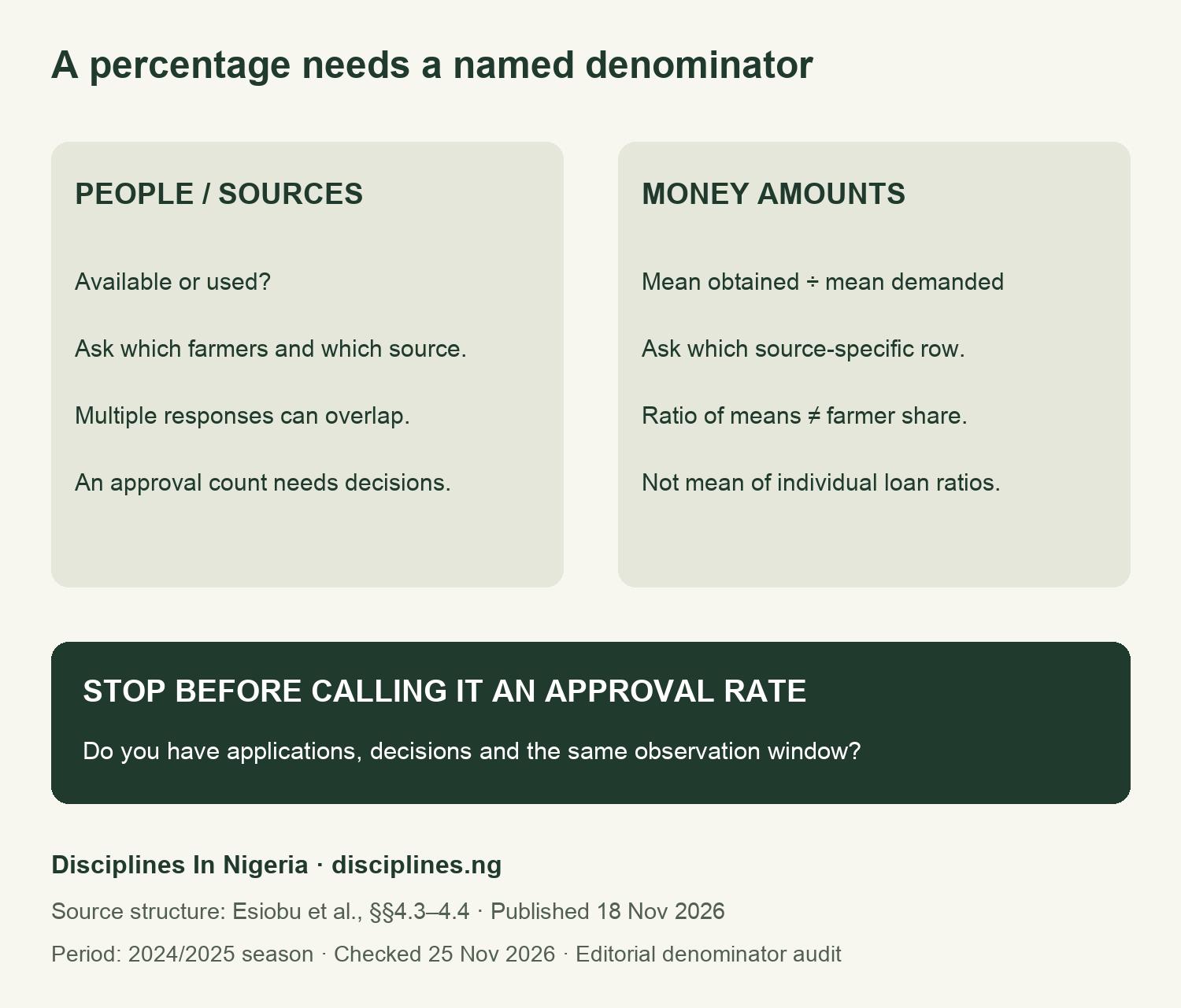
For a short evidence note, use three lines. First name the measure exactly. Next state its scope and period. Finally explain the conclusion it cannot support. This format makes the boundary visible without burying the useful finding in a long disclaimer.
For example: “The commercial-bank amount ratio is about 83%, using reported means for that source. It is not the share of sampled farmers who obtained a bank loan.” This retains the calculation while preventing a reader from substituting an all-farmer denominator.
Use the blank audit for a different paper by recording the table or figure, unit, population and source-specific row. Leave unknown application and approval counts blank. A blank is more accurate than an invented zero or an assumed complete lending history.
Keep balances and causal explanations separate
A balance reported at survey time is not automatically an overdue loan. An overdue classification needs the repayment schedule and assessment date. Likewise, a descriptive difference between measures does not identify one reason for that difference.
This guide neither recommends a lender nor estimates a farmer’s chance of obtaining credit. It does not infer a profit effect from borrowing or turn the source comparison into a ranking of financial products. Those questions require different information and, where relevant, individual advice.
Method, reproducibility and limits
We checked the source on 25 November and used its named table and figure for each measure. Our script divides the two reported mean amounts, multiplies by 100 and rounds only for display. The downloadable register preserves the reference period, row scope, units and source location.
The paper’s prose and Table 1 differ on some individual LGA allocations. We therefore do not reproduce those allocations, weight results by LGA or build a location ranking. Our audit uses the stated 232-farmer scope and the named financing rows; the inconsistency remains a source limitation.
This is a secondary interpretation of published summary values. We did not collect questionnaires, inspect loan files or reanalyse individual records. The two charts answer separate questions and are deliberately not joined into a funnel. More decimal places cannot repair a missing denominator or a source inconsistency.
For a related agriculture example, see our ogbono sample-eligibility guide. Our education evidence rubric shows why mixed record types should also stay separate.
- Source measures and denominator register (CSV)
- Reproducible ratios of reported means (CSV)
- Blank denominator audit worksheet (CSV)
- Claim-boundary checklist (CSV)
Suggested citation: Disciplines In Nigeria, “Abia Poultry Finance: Why 83% Does Not Mean Most Farmers Got Bank Credit”, 25 November 2026. Cite Esiobu and colleagues for the study and this guide for the original calculations and audit tools.


