Nigerian university research readiness starts with a project-specific question: can the institution support the work you actually intend to do? A relevant degree title and an enthusiastic supervisor are useful starting points. However, you also need a clear route to permissions, facilities, data support and project administration.
Our analysis separates three kinds of evidence: reported programme counts, research-capacity scores and the documents a prospective student should request. It includes five figures and two reusable CSV files. This is an evidence-checking guide, not a university ranking or a validated admissions instrument.
Research snapshot: 28 October 2026. APHRC published its report page on 22 October. The full report has a September 2026 cover date and describes a portfolio delivered during 2023–2025. Publication during the news week does not mean the assessment happened that week.
What the Nigerian university research readiness evidence says
The official APHRC summary reports that its Research Readiness Assessment reached 196 institutions. It separately reports five institutions with Good Financial Grant Practice certification. These are different measures. The summary does not establish 196 as the denominator for certification.
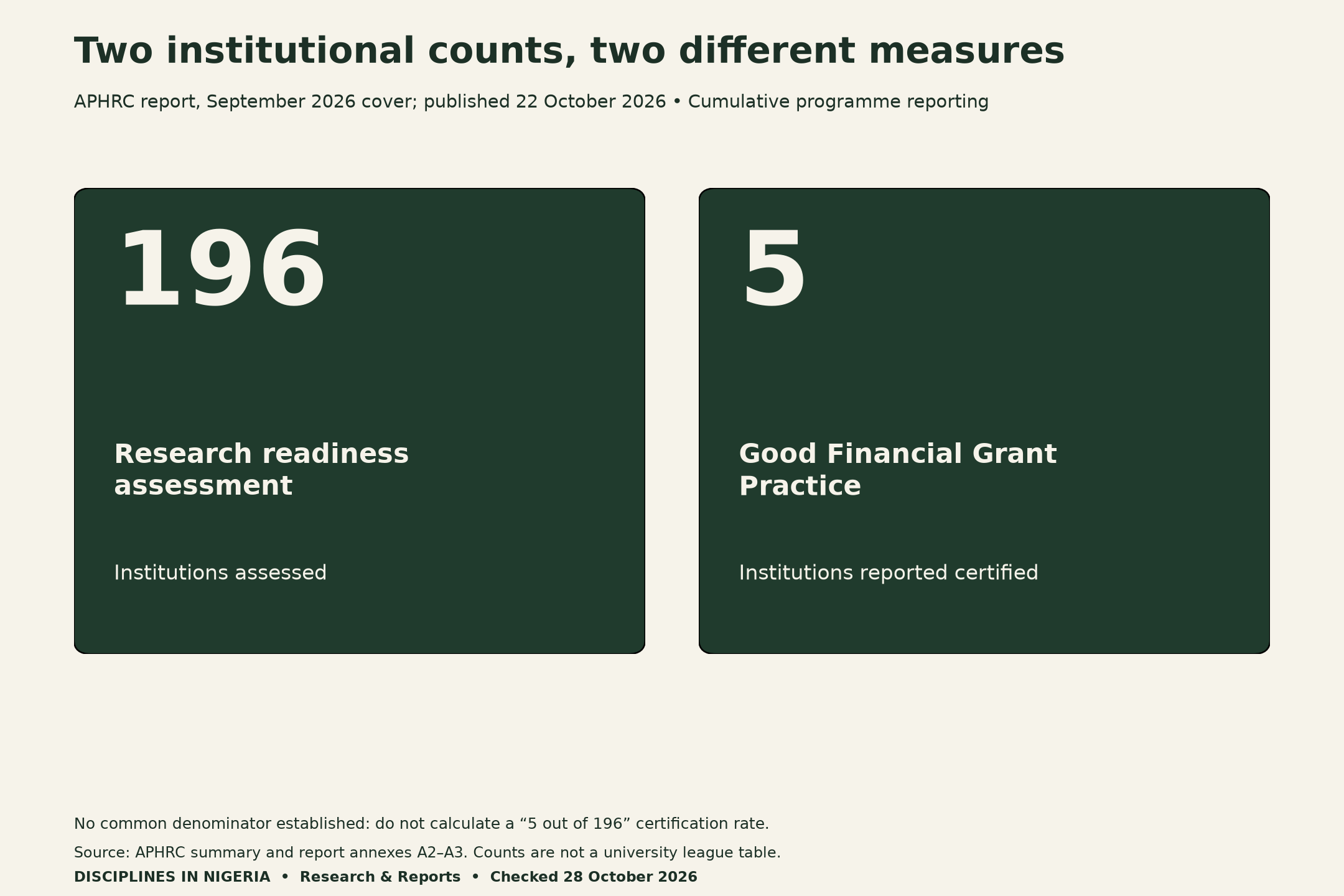
The full APHRC report contains further evidence in its annex. However, it does not supply a verified score for every university, department or proposed project. Use that distinction when interpreting the figures below.
Read the reported domain scores before judging a programme
Table A3.2 reports an overall Research Capacity Maturity Model score of 3.36 out of five. The seven domain values displayed in that table range from 2.26 for laboratory capacity to 4.39 for policy engagement. Our subtraction gives a descriptive range of 2.13 score points. It is not a percentage-point gap, a causal effect or a difference between two universities.
| Reported domain | Score out of 5 |
|---|---|
| Policy engagement | 4.39 |
| Grant management | 4.24 |
| Human resources | 4.20 |
| Ethics and data governance | 3.78 |
| Publication outputs | 3.60 |
| IP and commercialization | 2.81 |
| Laboratory capacity | 2.26 |
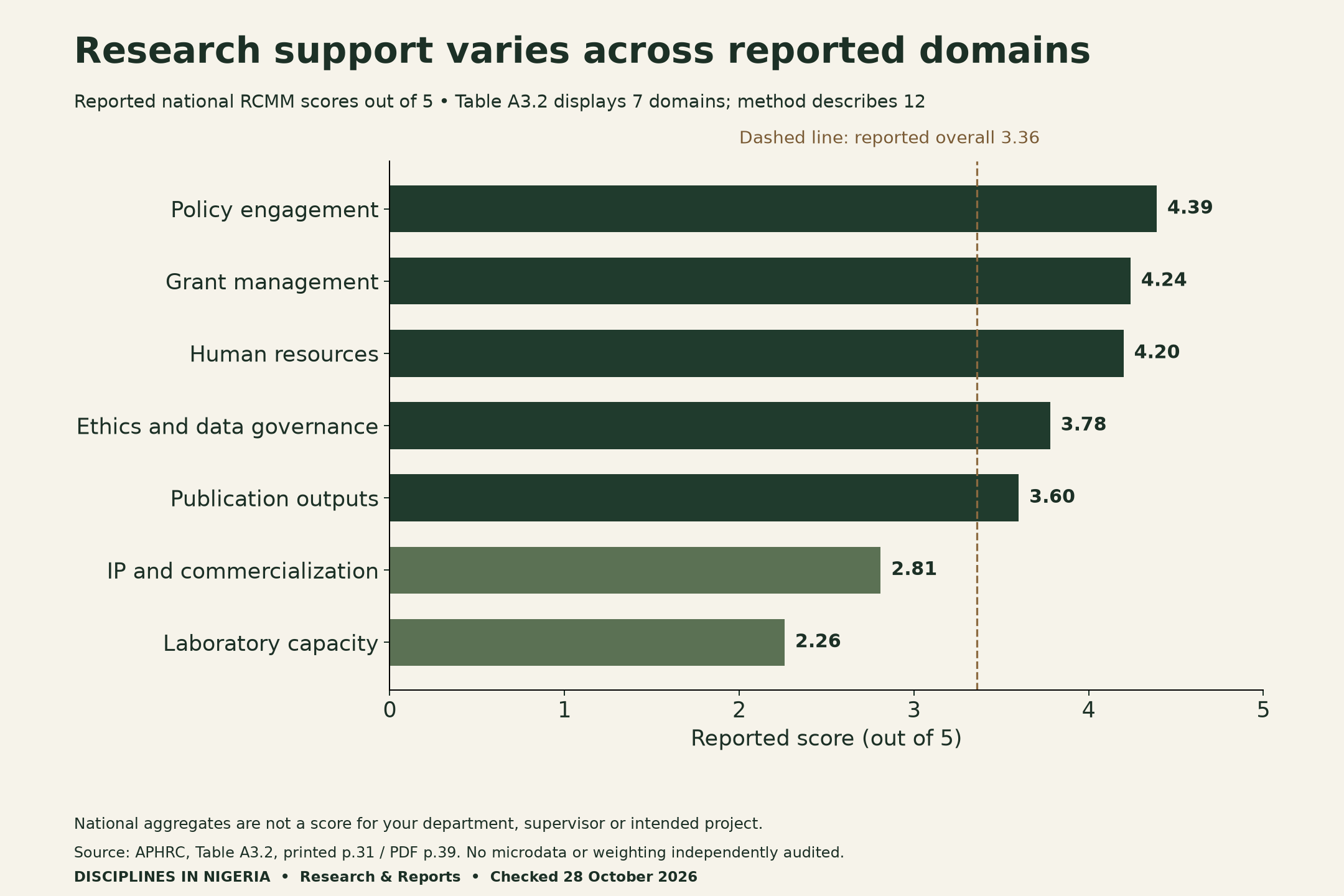
For a laboratory project, this pattern suggests a useful follow-up question: what equipment, access and technical support does my proposed method require? That is our editorial inference. The aggregate does not establish that a particular laboratory is weak, unavailable or unsuitable. Conversely, a strong reported national domain cannot guarantee a local service.
The report does not give us the institution-level records and weighting needed to audit its aggregate independently. Therefore, we preserve its values and labels rather than constructing a new readiness score. Do not turn the seven displayed domains into a complete twelve-domain dataset.
A grant certificate answers a different question
The Global Grant Community standard describes four practice areas: financial management, human resources, procurement and governance. This is useful background for asking who administers a grant. It is not evidence that your supervisor has capacity, your laboratory has a working instrument or your project will win funding.
APHRC’s Figure A2.2 separately describes a process involving 42 institutions. Its reported stage counts are 42 commencing assessment, 23 completing self-assessment, 17 with an auditor’s report finalized, eight proceeding to certification and five certified. These are stages, so adding them would double-count participation.
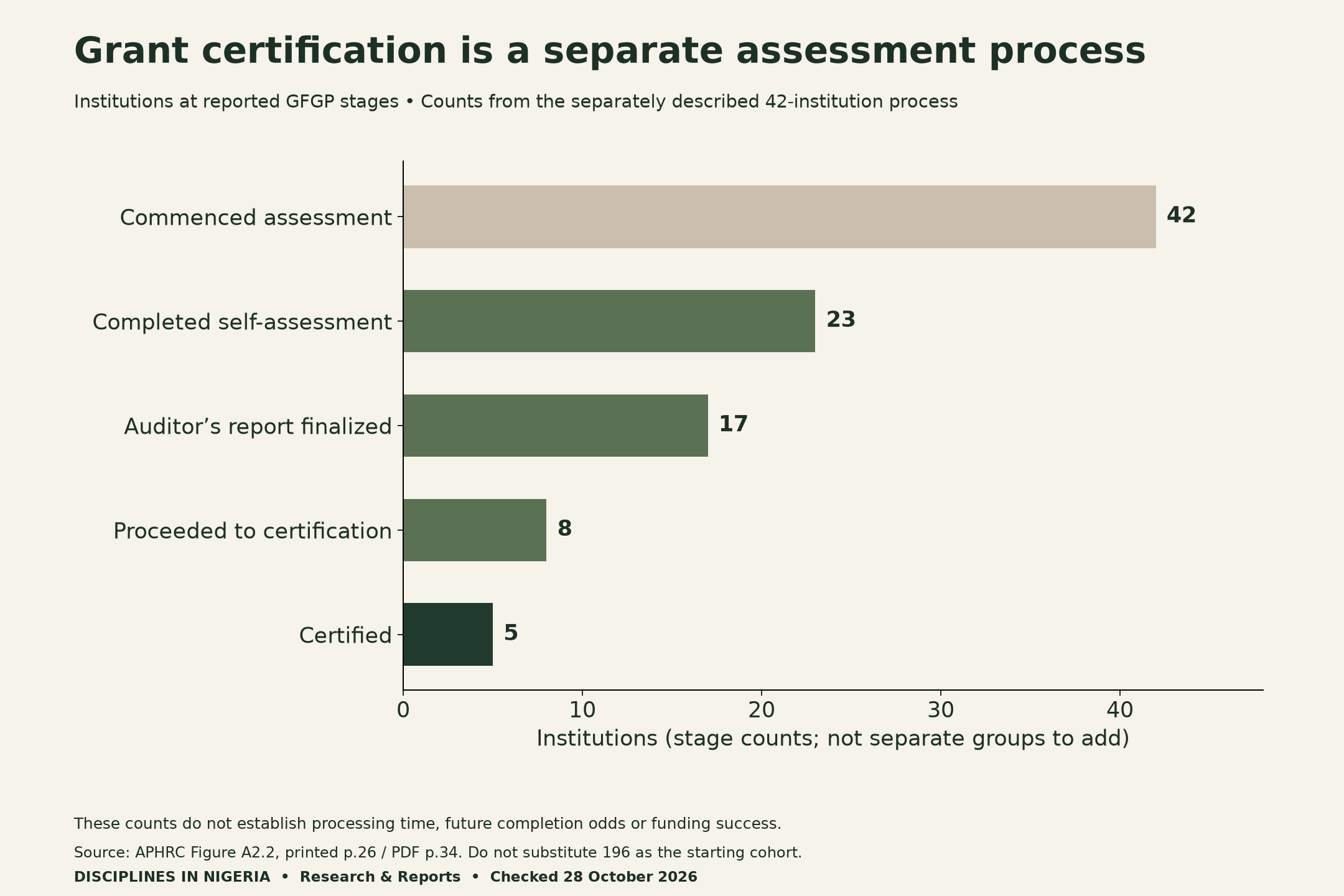
Ask the institution which office handles budget approval, procurement and reporting for your funding route. If it cites certification, request its current scope and supporting record. However, keep that check separate from academic fit and project access. Neither a certificate nor a grant announcement establishes money available for your own study.
Check Nigerian university research readiness in three layers
The report’s method distinguishes structural presence, functional operation and research output. We turn that distinction into three practical questions: what exists, what is in active use, and what relevant work has been produced? The questions are ours; they do not reproduce APHRC’s full assessment instrument.
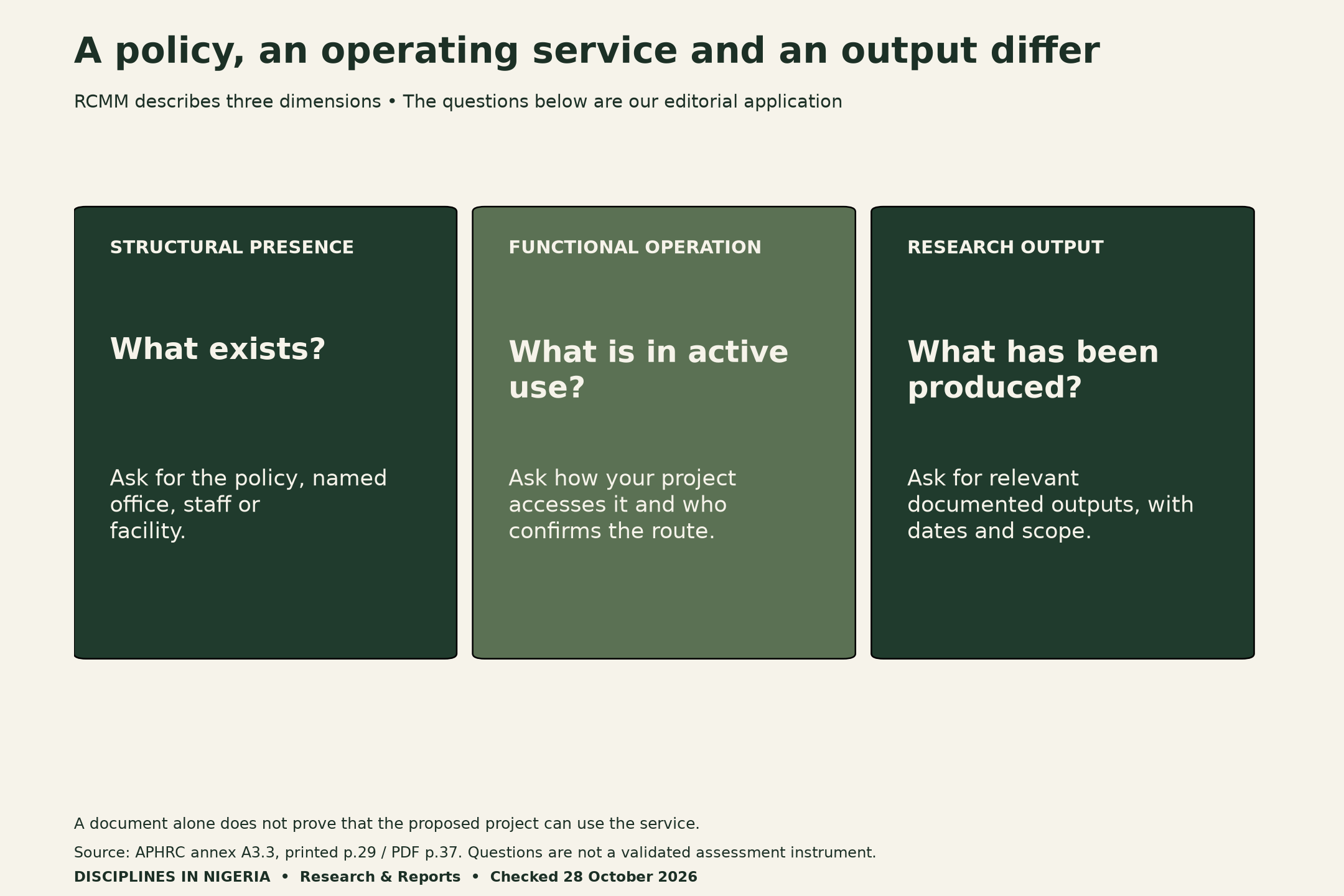
For example, finding a policy establishes that a document is publicly accessible. It does not establish that your application is approved. Similarly, an equipment list does not confirm a booking, training requirement or repair status. Ask the responsible office to explain the route for your intended project and retain its dated answer.
One concrete institutional example is the University of Lagos Research Ethics Committee. Its public guidance describes independent proposal review and submission arrangements. Use this as an example of a named review route. Confirm the current requirements for your institution, method and study site before collecting data; do not assume all Nigerian institutions follow the same procedure.

Nigerian university research readiness: build a project register
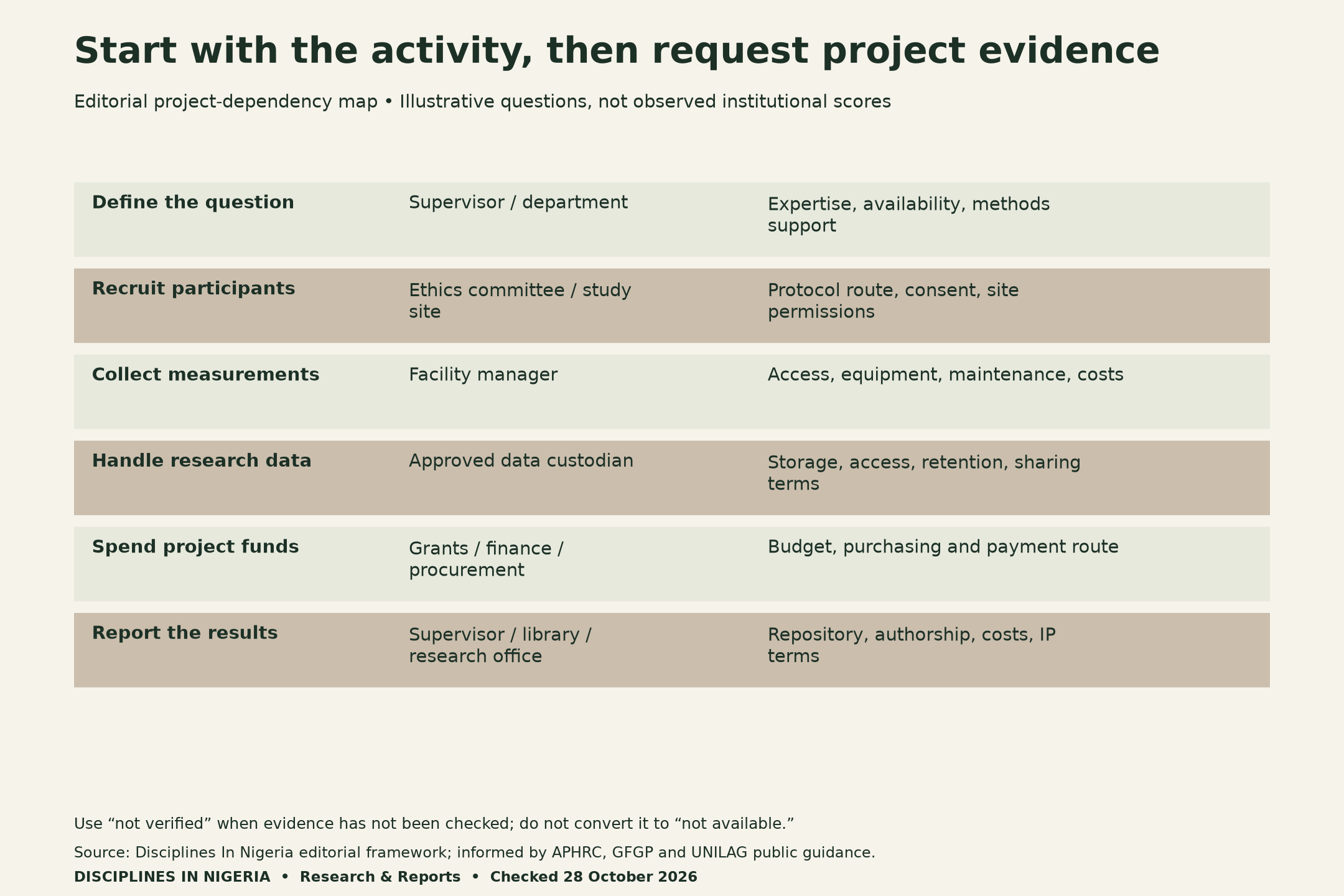
Start with the activity, rather than a university’s reputation. A document-based project, laboratory experiment and interview study need different support. Our six-row worksheet makes those dependencies explicit. It asks for the responsible office, evidence URL, document date, verification status and a follow-up question.
The UNILAG postgraduate forms page illustrates other records a researcher may encounter, including annual progress reporting and permission for research elsewhere. A listed form is evidence of a public administrative resource. Its presence alone does not prove turnaround time, service quality or approval for a particular applicant.
Use three careful status labels. Choose verified when you have checked the relevant evidence. Mark needs clarification when the record is incomplete or ambiguous. Record not verified when you have not established the fact. A missing web document must not automatically become a claim that support does not exist.
Questions to take to a supervisor meeting
First, describe your research question and likely method in a short paragraph. Then ask who can supervise that method and whether they expect to be available. Next, identify each external dependency: participants, facilities, datasets, software, permissions or specialist advice. Request a named office and a written route for each critical item.
Also ask what costs the institution covers and which costs remain yours. Discuss equipment access, consumables, travel, software, storage and publication charges where relevant. Record amounts only when a current source confirms them. A general statement that funding exists is not a project budget.
Finally, discuss progress reviews, changes of method and what happens if a critical resource becomes unavailable. Keep an unresolved issue on the register instead of concealing it inside an overall score. Our broader guide to funding and resources for economics research provides subject context; the current article adds a project-level evidence audit.
Methods, limitations and reusable downloads
We transcribed the published counts and Table A3.2 values, checked them against the PDF pages, and retained the source files. The only derived statistic discussed here is the 2.13-point range across the seven displayed domain scores. We did not recompute the overall score, audit certification, survey universities or test whether the worksheet improves student outcomes.
The report is a programme account, not a complete assessment of every Nigerian institution. Exact RRA fieldwork dates and institution-level aggregation inputs were not independently established. Historical achievements are not October-only results. The two editorial diagrams and worksheet are proposed decision aids, not validated instruments or representations of official university requirements.
Download the research-readiness source audit (CSV): 15 reported measures with units, source locations and caveats. This records published evidence, not university-level scores.
Get the postgraduate evidence worksheet (CSV): six suggested activities with blank project-specific fields. No institution has been evaluated in this template. Keep confidential personal or research-participant data out of any public copy.
Suggested citation: Naija Scholar, Disciplines In Nigeria (28 October 2026), “Nigerian University Research Readiness: What to Check Before Choosing a Postgraduate Programme.” Cite APHRC separately for its reported findings. Recheck the source and the institution’s current guidance when making a decision.